



# The Hidden Bugs in Vibe Coding: How Silent Failures Are Breaking the Promise of No-Code Development
## The Allure of the Prompt-to-App Workflow
Imagine describing a web application in plain English and watching it materialize on your screen—buttons, forms, dashboards—all crafted without writing a single line of code. This is the promise of vibe coding, an approach where large language model agents translate natural language instructions into fully functional web applications. The appeal is undeniable: non-technical users can build real products, rapid prototyping becomes instantaneous, and the traditional barrier of programming fluency dissolves.
But there’s a catch that many early adopters are discovering the hard way.
## When Everything Looks Fine but Nothing Works
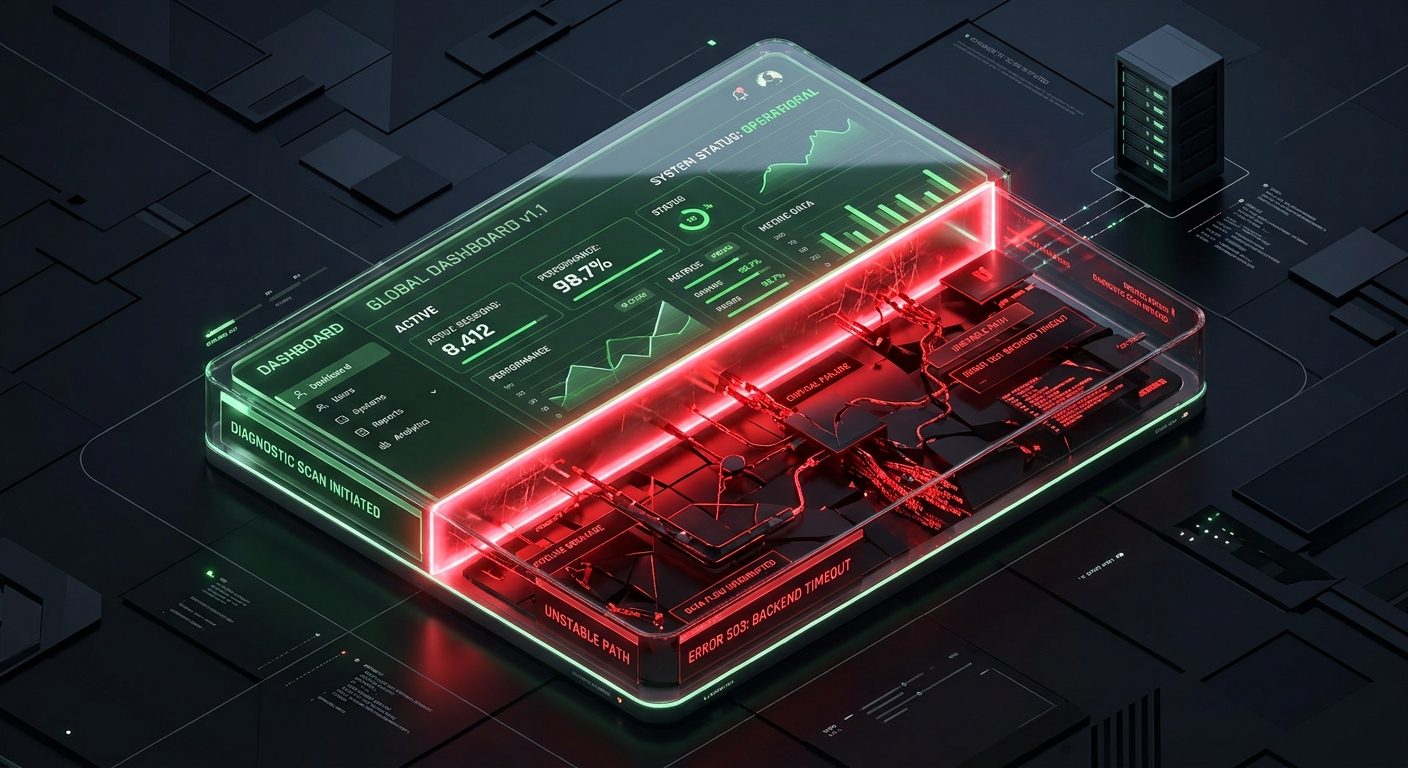
Behind the polished interfaces and satisfying animations lies a dangerous category of defects known as **silent behavioral failures**. These are bugs that are virtually invisible during casual use. A button might appear to respond correctly, a confirmation message might pop up, and the screen might update to suggest success—yet the underlying data never actually changes.
Picture this scenario: you ask an AI agent to add a discount code feature to an online store. The agent generates an input field and an “Apply” button. You type in a valid code, and the interface cheerfully displays “Discount applied!” But behind the scenes, the cart total was never recalculated, never saved to the database, and never reflected anywhere persistent. The next time you look at the cart, the original price remains unchanged. You’d never know from the interface alone.
These failures span several categories:
– **State tracking errors** — the application forgets or loses user inputs between interactions.
– **Cross-handler disconnects** — different parts of the app operate in isolation, never coordinating with each other even when they should.
– **Decoupled feedback** — the UI sends signals of success to the user without completing the corresponding backend operation.
## Why Current Debugging Approaches Fall Short
When vibe-coded applications break, developers typically try a few standard approaches to find and fix the issues. Unfortunately, each has significant limitations.
### Asking the AI Agent to Self-Debug
The most natural instinct is to simply ask the same language model that built the app to review and fix the problems. However, AI agents are notoriously unreliable at catching their own mistakes. They can hallucinate explanations, overlook edge cases, and fail to trace complex data flows through an application. Even the most advanced models from leading labs frequently miss subtle bugs, especially when those bugs span multiple interacting components.
### Relying on Unit Tests
Writing automated tests is another common strategy, but it introduces its own problems. Creating tests means writing additional code—which defeats the purpose of a no-code workflow. Tests also tend to be narrowly scoped, checking only the specific scenarios you thought to define. They rarely verify the critical connections between the user interface and the backend systems where data actually lives. Most importantly, non-programmers who rely on vibe coding are unlikely to write or interpret test results.
### Using Traditional Static Analysis
Conventional static analysis tools are excellent at catching data flow problems with mathematical precision. The problem is that these tools require expertise in specialized query languages and formal methods. The learning curve is steep, and the barrier to entry eliminates the very audience—non-programmers—who stand to benefit most from vibe coding in the first place.
## A New Approach: Verifying Apps Through Intent, Not Code
Researchers have developed a promising new methodology that sidesteps these limitations entirely. The core idea is to let users specify what their application should do by interacting with its interface, then automatically verifying that the generated code actually matches those expectations—without anyone ever needing to read or understand the underlying code.
### How It Works in Practice
The process begins when the user provides the path to their web application. A browser overlay appears, presenting a simple template structure: **”When I take [this action], these elements update: [these components].”** The user then clicks directly on the interface elements they care about—selecting a button as the trigger and a data field as the expected result—just as naturally as they would when using any web app.
This visual selection gets translated into a formal constraint using a specialized language. The constraint follows a clear logical structure, expressing that a particular event (such as writing data) should occur with certainty whenever a specific action (such as clicking a button) takes place. For example, the system might encode the expectation that when a promo code is applied, the cart total must be written to storage with absolute certainty.
These formal constraints are then compiled into queries against a static analysis engine. The engine treats the application’s code as a searchable database, tracing how data moves from user interface events through the codebase to its final destinations—whether that’s local storage, a database, or a displayed value on screen. It runs two critical checks: first, verifying that a reachable path exists between the action and the expected outcome, and second, confirming that the outcome occurs across every possible execution path, not just the obvious ones.
If the verification finds any violation—such as a button click that doesn’t result in a data write—FlowCheck flags exactly which constraint failed and highlights the specific lines of code where the problem occurs.
### Real-World Performance
To rigorously test this approach, researchers created four web applications modeled after well-known platforms—including a shopping site, a social media feed, a booking platform, and a messaging tool. Each application was generated by an AI coding agent and then seeded with 30 subtle, realistic data flow bugs that mimic the kinds of issues real vibe-coded apps would develop.
The verification tool successfully detected all 30 injected violations with zero false positives—a 100% detection rate.
For comparison, the same buggy applications were tested against three leading AI models acting as bug-finding assistants. Even with highly detailed prompts that listed every feature, every edge case, and every possible user state, the best-performing model only caught 26 out of 30 bugs. The models consistently struggled with cross-component data flows and conditional branching logic. In one telling example, a promo code action cleared the shopping cart summary while a separate checkout handler still attempted to read that summary—a disconnect the models couldn’t detect because they evaluated each handler in isolation without tracing the data between them.
Surprisingly, providing the models with more detailed instructions didn’t always improve results. As the prompts became more thorough, the models spent more time reading the code and paradoxically became more willing to accept buggy implementations as intentional design decisions rather than flagging them as errors.
## Why This Matters for the Future of App Building
The gap between what vibe coding promises and what it currently delivers is the gap between appearance and correctness. As more people rely on AI-generated applications for real work—managing orders, handling customer data, processing transactions—these invisible failures become increasingly dangerous.
Verification tools that bridge the interface-to-code gap offer a path forward. By letting users validate their applications through the same visual, intuitive interactions they use to build them, these tools democratize software correctness. They make it possible for someone without programming knowledge to have confidence that their application behaves exactly as intended—not just on the surface, but all the way down to the data layer.
The research points toward a future where building applications with AI doesn’t mean hoping for the best. Instead, it means having a reliable, automated way to prove that what you see is what you get.
—
## Frequently Asked Questions
**What is vibe coding?**
Vibe coding refers to the practice of building web applications by describing what you want in natural language to an AI coding agent, which then generates the complete application. The term emphasizes the intuitive, conversational nature of the workflow—developers describe their vision and the agent handles implementation.
**What are silent behavioral failures?**
Silent behavioral failures are defects in an application where the user interface appears to function correctly, but the underlying operations fail silently. For example, a form might display a “Submission successful” message without actually saving the data to a database. These are particularly dangerous because users have no visual indication that something went wrong.
**Why do AI models struggle to find their own bugs?**
AI models tend to evaluate code in isolated chunks rather than tracing complete data flows across the entire application. They also have a tendency to rationalize buggy code as intentional behavior, especially when the code appears well-structured on the surface. Additionally, models can hallucinate explanations for why something works when it actually doesn’t.
**How is this verification tool different from traditional testing?**
Traditional testing requires the user to write code that exercises specific scenarios and manually interpret the results. The verification approach described here is entirely visual and constraint-based—the user interacts with the running application to define expected behavior, and the system automatically translates those expectations into analysis queries that check the entire codebase without requiring any programming knowledge.
**What types of bugs does this approach catch best?**
It excels at catching data flow bugs—situations where an action in one part of the application doesn’t properly propagate its effects to another part. This includes missing database writes, lost state updates, broken cross-component communication, and cases where user feedback suggests an operation succeeded when it actually didn’t.
**Is this technology available for public use?**
The underlying research has been published and a prototype implementation is available for those interested in exploring the approach. The methodology is designed to work with code generated by popular AI coding agents and targets common web application patterns.
—
## Conclusion
The rise of vibe coding represents a fundamental shift in how we think about software development—moving from writing code to describing intent. However, this shift creates a new and urgent problem: how do you verify that the intent has been correctly implemented when you can’t read or understand the code yourself? Silent behavioral failures expose a dangerous gap between what an application appears to do and what it actually accomplishes.
The emergence of visual, constraint-based verification tools offers a compelling solution. By allowing users to define their expectations through the same intuitive interface they use to build, these tools close the loop on the vibe coding workflow. They transform verification from a programming task into a conversational one—matching the simplicity of the development process itself.
As AI-generated applications become more prevalent in everyday workflows, having reliable, accessible verification will be essential not just for developers, but for every user who depends on these tools to get real work done. The path forward isn’t to make users into programmers—it’s to build systems that prove correctness on their behalf.
Thank you for reading
