



# Choosing the Right Linear Motion Technology for Long-Travel Applications
Engineers designing automated systems often face a deceptively simple challenge: how do you move something in a perfectly straight line over a long distance, and do it with precision? The answer isn’t always obvious, because the three dominant technologies for achieving this—rack and pinion, ball screws, and linear motors—each bring distinct strengths and limitations to the table. Understanding where each excels is critical to making the right choice for your application.
## The Three Approaches to Linear Motion
At their core, these systems solve the same problem using different physical principles.
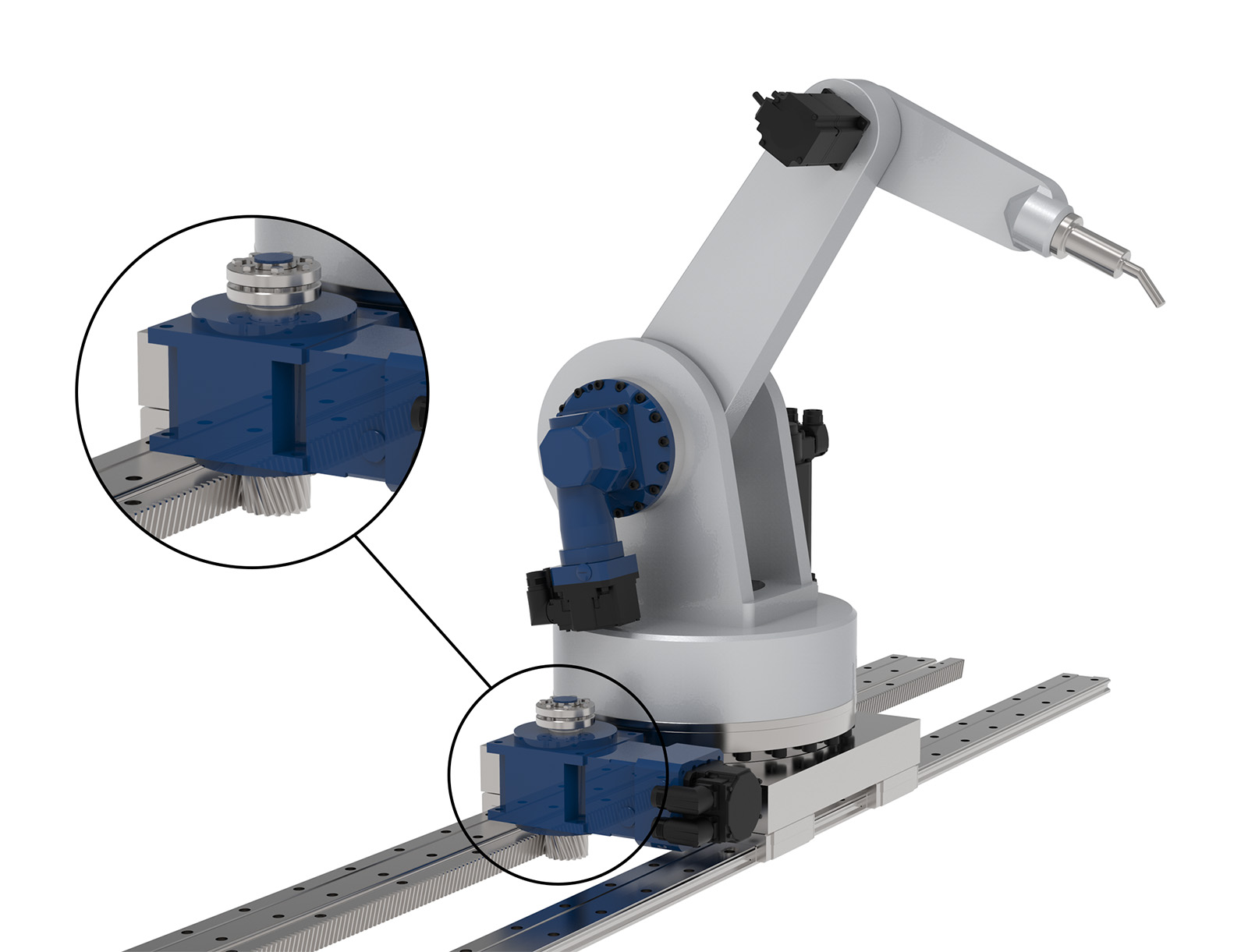
**Rack and pinion** relies on a toothed bar (the rack) meshing with a gear (the pinion). When the pinion rotates, it drives the rack into linear motion—or, depending on the configuration, the rack can be held stationary while the pinion assembly travels along it. This mechanical engagement is straightforward and highly adaptable.
**Ball screws** use a precision-ground threaded shaft and a nut containing recirculating ball bearings. As the shaft rotates, the nut translates along its length, converting rotational motion into smooth linear travel. The opposite configuration works as well. Ball screws are known for their accuracy and efficiency.
**Linear motors** take the concept of a rotary electric motor and flatten it out. Permanent magnets and electromagnetic coils are arranged in parallel, and when a servo controller energizes the coils in sequence, the resulting magnetic field propels the mover—or the stator—along a linear path. There are no mechanical contact points between the moving components.
## When Ball Screws Shine—and When They Don’t
For shorter travel distances, ball screws are formidable competitors. They deliver excellent precision and repeatability, and their compact orientation can be a significant advantage in machines with tight spatial constraints.
However, ball screws have a critical weakness: length. Once the travel distance extends beyond roughly two to three meters—though this threshold shifts depending on the screw’s diameter—problems begin to emerge.
The core issue is a phenomenon known as whip. Essentially, the long rotating shaft begins to oscillate and vibrate like a jumping rope. This vibration introduces premature wear, generates unwanted noise, reduces positional accuracy, and in severe cases can lead to catastrophic mechanical failure. At that point, the very feature that makes ball screws precise—their rigid threaded shaft—becomes their liability.
## The Scalability Advantage of Rack and Pinion
Where ball screws hit a wall, rack and pinion systems have a clear edge: they scale almost without limit. The rack is simply a long toothed bar, so extending travel distance means either cutting a shorter section or joining multiple segments together. There is no fundamental length limit imposed by the physics of the system.
This modularity also means engineers can order standard-length rack sections—often available in one-meter increments—and assemble them to match the exact travel requirements of their machine. Shorter custom lengths are widely available, and longer sections can be sourced as special orders.
Cost is another area where rack and pinion holds an advantage. A typical installation requires a rack, a gearbox, and a servo motor. The combined price for this package is generally lower than what a comparable linear motor system would cost. Furthermore, a rack and pinion setup delivers higher stiffness and greater feed forces for the same cost, footprint, and power draw.
## Linear Motors: Speed and Precision at a Price
Linear motors offer two compelling benefits: they can move extremely fast, and they provide highly precise, smooth control. Because there is no mechanical contact between the moving parts, there is no wear from friction—at least in theory.
The downsides are practical. The magnets used in linear motor systems are expensive, and extending the travel length means adding more magnet material, which drives the per-meter cost upward significantly. Linear motors also require a continuous power supply just to maintain a stationary position, and their energy consumption scales directly with the force they need to produce.
Additionally, the strong magnetic fields in these systems can create nuisance problems in workshop environments. Tools, watches, keys, and small metal debris can become unexpectedly magnetized, collecting on the moving assembly and interfering with operation. This is not a concern with rack and pinion, which has no magnetic components whatsoever.
## The Clean Room Consideration
One environment where rack and pinion faces a genuine disadvantage is the clean room. The gear teeth require lubrication to function without excessive wear, and this grease is exposed to the surrounding environment. While covers, seals, and specialized lubricants can mitigate contamination risks, they add design complexity and maintenance requirements.
Ball screws share this lubrication challenge, though protective bellows can help contain the grease. Linear motors, by contrast, have no exposed mechanical surfaces and no need for lubrication, making them the clear choice for environments such as medical device manufacturing or semiconductor fabrication.
## The Importance of Careful Installation
Regardless of which technology is selected, the quality of the final system depends heavily on how carefully it is assembled. Precise alignment, proper mounting, and attention to detail during installation are essential. A well-planned and meticulously executed setup will yield reliable, accurate performance from any of the three technologies. Conversely, a rushed installation can introduce problems that undermine even the best-engineered system.
—
## Frequently Asked Questions (FAQ)
**Q: Can rack and pinion achieve the same level of precision as ball screws?**
A: For shorter travel distances, ball screws generally offer higher positional precision. Rack and pinion systems can still achieve excellent accuracy, but they tend to have slightly more backlash depending on the gear quality and installation. High-precision pinions and ground racks can narrow this gap considerably.
**Q: Are rack and pinion systems suitable for high-speed applications?**
A: Yes, rack and pinion can operate at high speeds, particularly when paired with appropriate gearboxes and servo motors. They are often used in applications where both speed and long travel are required, such as large CNC machines and automated material handling systems.
**Q: Do linear motors require more maintenance than rack and pinion systems?**
A: Linear motors have fewer mechanical wear points since there is no contact between the motor and the guide. However, they require a continuous power supply to hold position, and the magnetic components can attract debris, which may need regular cleaning in industrial environments.
**Q: What is the maximum travel distance for a ball screw?**
A: Ball screws are typically effective up to about 2 to 3 meters in length, though this depends on the screw diameter and support configuration. Beyond this range, whip and vibration become significant concerns that compromise performance and reliability.
**Q: Can I extend a rack and pinion system’s travel after initial installation?**
A: Yes. Because the rack is modular, additional sections can be joined to extend travel distance relatively easily, making rack and pinion a flexible choice for applications where requirements may change over time.
**Q: Is lubrication the only contamination concern with rack and pinion in clean rooms?**
A: Lubrication is the primary concern, but dust and particulate generated by the gear teeth meshing can also be an issue in ultra-clean environments. Proper sealing and the use of food-grade or low-outgassing lubricants can help address these challenges.
—
## Conclusion
Selecting the right linear motion technology for a long-travel axis is a balancing act between precision, speed, cost, length requirements, and environmental conditions. Rack and pinion offers unmatched scalability and cost-effectiveness for long distances, making it the go-to choice in heavy-industry and large-format automation. Ball screws excel in shorter, precision-focused applications where their accuracy and compact design are paramount. Linear motors provide exceptional speed and cleanliness, but come with higher costs and magnetic considerations that may not suit every workspace.
The key takeaway is that no single technology dominates across all scenarios. Success comes from matching the system to the specific demands of the application—considering travel length, load requirements, environmental constraints, and budget from the earliest stages of design.
Thank you for reading
