



# Montreal Becomes Hub for Physical AI Research as Vention Unveils New Lab Dedicated to Industrial Robotics
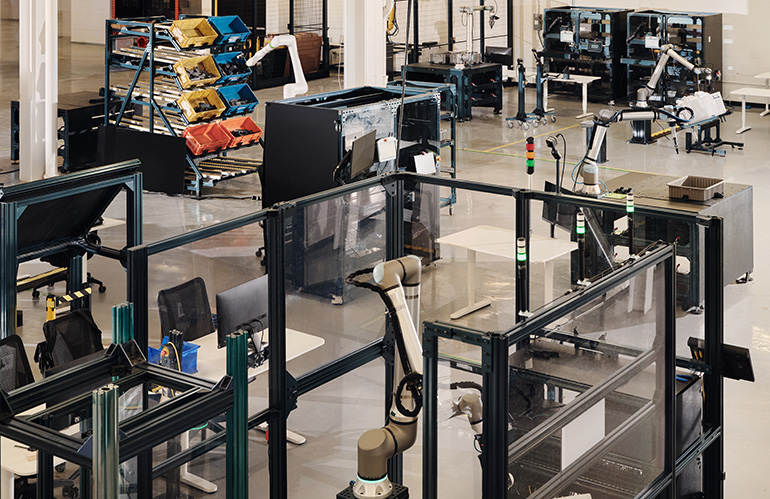
A new research facility in Montreal is aiming to bridge the gap between cutting-edge artificial intelligence and real-world factory automation. The laboratory, focused on physical AI for manufacturing, opened recently and is designed to accelerate the development of robotic systems capable of performing complex, unstructured tasks on production lines.
## Why Industrial Data Matters for Physical AI
Developing AI models that can control robots in manufacturing environments requires massive amounts of high-quality data. The new facility takes advantage of its parent company’s extensive footprint, which includes the annual deployment of hundreds of robotic workcells across industrial sites worldwide. Each of these cells generates valuable manipulation data that can be used to train and refine foundation models for physical AI.
“We have access to real production environments and a continuous flow of data that simply isn’t available in most research settings,” said the company’s founder and CEO. “This scale is what allows us to move beyond proof-of-concept demonstrations and build systems that actually work on factory floors.”
The company behind the lab has already deployed more than 28,000 machines globally and serves a community of over 6,000 factories, including dozens of organizations from the Fortune 500. Its full-stack platform combines hardware, software, and AI capabilities, enabling businesses to design, program, and deploy automation solutions in a matter of days.
## A Lab Built for the Factory Floor
The facility integrates several core areas of research, including industrial data collection, robot motion planning, classical computer vision, vision-based foundation models, learning from demonstration, and reinforcement learning. Researchers at the lab focus specifically on complex manufacturing tasks that involve variability and unpredictability—conditions that are common in real production environments but difficult to replicate in traditional laboratories.
“We’ve built a feedback loop between academic research and live production challenges,” said the lab’s director, a robotics and machine learning researcher with over a decade of peer-reviewed work in computer vision, robot perception, and autonomous manipulation. “Our industrial partners participate in the development process from the start. When we solve a research problem, it can be tested on actual production lines almost immediately.”
The lab director previously led the company’s physical AI strategy and its collaboration with a leading GPU technology company, translating advances in AI research into practical robotic applications.
## GRIIP: A Modular Pipeline for Robotic Intelligence
One of the lab’s first major outputs is GRIIP, which stands for Generalized Robotic Industrial Intelligence Pipeline. Launched earlier this year, GRIIP is a modular system that handles scene digitalization, object segmentation, pose estimation, grasp selection, and collision-free motion planning. It draws on foundation models from major technology partners as well as proprietary models developed by the company.
The company has announced plans to release a public software development kit for GRIIP, making the pipeline more accessible to the broader robotics and AI community. It also intends to showcase its physical AI and agentic AI capabilities at a major manufacturing technology exposition later this year, where both toolsets will be unified under a single platform.
## Real-World Applications in Kitting and Assembly
Among the most promising use cases being explored at the lab is kitting—the process of preparing groups of components for specific stations on an assembly line. This task is highly relevant across multiple industries, including automotive, aerospace, and consumer electronics.
For example, electronics manufacturers often receive parts from various vendors in different packaging formats. These components need to be unpacked and reorganized into kits tailored for specific positions on the production line. Similarly, automotive assembly may require a headlamp assembly complete with a wiring harness, a mounting bracket, and fasteners—all staged precisely at the correct workstation for each vehicle being built.
The company is currently collaborating with a major automotive original equipment manufacturer on high-complexity, unstructured robotic tasks in final assembly, where variability in parts and processes makes automation particularly challenging.
## Strategic Partnerships and Advisory Support
To strengthen its research direction, the company has appointed a prominent AI researcher as an external technical advisor. The advisor previously served as vice president of AI research at a major technology company, earned a doctorate from a leading Canadian university, and managed the teams behind a widely used foundation model for visual segmentation. Her contributions are expected to influence model architecture decisions, research priorities, and the lab’s connections within the broader AI community.
As foundation models continue to mature, the company believes the complexity and cost of deploying robots in manufacturing will decrease significantly, expanding the range of businesses that can adopt automation. The lab is expected to play a central role in validating new AI capabilities against the reliability, cost, and performance demands of real production environments.
—
## Frequently Asked Questions
**What is physical AI in the context of robotics?**
Physical AI refers to artificial intelligence systems that enable robots to perceive, reason about, and interact with the physical world. Unlike purely digital AI, physical AI models are trained to handle the unpredictability of real environments, including variations in objects, lighting, positioning, and task requirements.
**Why is Montreal significant for this type of research?**
Montreal is home to one of the world’s leading AI research ecosystems, with deep expertise in machine learning and robotics. Combining this academic talent with the company’s industrial deployment experience creates a unique environment for developing practical physical AI solutions.
**What kinds of tasks can physical AI robots perform?**
The lab focuses on complex and unstructured manufacturing tasks, including kitting, object manipulation, assembly preparation, and sorting. These tasks require robots to adapt to varying object types, orientations, and environmental conditions.
**How does GRIIP work?**
GRIIP is a modular pipeline that processes a manufacturing scene step by step—digitizing the environment, identifying and segmenting objects, estimating their positions, selecting appropriate grasp strategies, and planning collision-free robot movements. It combines publicly available foundation models with proprietary technology.
**Will GRIIP be available to the public?**
Yes, the company plans to release a public software development kit for GRIIP, allowing developers and researchers to integrate the pipeline into their own robotic systems and experiments.
**What role does the automotive industry play in the lab’s development?**
A large automotive OEM is among the lab’s collaborators, working on high-complexity, unstructured robotic tasks in final assembly. The automotive sector represents a demanding use case due to the precision, reliability, and variability requirements involved in vehicle manufacturing.
**How has the company’s physical AI business grown?**
Revenue associated with physical AI has increased by 400% over the past year, reflecting growing demand for AI-powered automation solutions across industrial sectors.
—
## Conclusion
The opening of this new physical AI laboratory represents a significant step forward in the effort to bring advanced AI-driven robotics into everyday manufacturing. By combining large-scale industrial data, real-world deployment experience, and deep research expertise, the facility is well-positioned to tackle some of the most pressing challenges in industrial automation—from reliable manipulation in unpredictable environments to cost-effective scaling across thousands of production sites. As foundation models continue to improve and deployment costs decline, the work being done in this Montreal lab could help shape the next generation of intelligent factory systems.
Thank you for reading
