



# Vision AI: The Missing Safety Layer for Construction’s Automated Future
## When Machines Get Smarter, People Need Smarter Awareness
The construction industry is undergoing a dramatic transformation. Over the next several years, autonomous equipment — from compactors and excavators to inspection drones and robotic layout tools — is expected to become a routine presence on job sites around the world. Market projections suggest that the global construction robotics sector could surpass $3.5 billion within the next five years.
Yet as machines take on more complex and dangerous tasks, a critical question emerges: how do autonomous systems coexist safely with human workers who are constantly moving, adapting, and reshaping the environment around them?
The answer, increasingly, is vision AI.
## The Hidden Danger of Shared Workspaces
Construction remains one of the most hazardous industries in the world. Falls, struck-by incidents, electrocutions, and caught-in/between accidents collectively account for the majority of workplace fatalities each year. Among these, struck-by events involving vehicles and moving equipment claim over a hundred lives annually in the United States alone.
Autonomous machines bring compelling advantages. They do not fatigue, lose focus, or become impatient during long shifts. But they also lack the situational awareness that an experienced human operator develops instinctively — the ability to notice a worker ducking behind a materials stack or a crew migrating into a zone that was clear moments earlier.
This gap becomes especially dangerous during what safety experts call the “transition zone” — the moments when a job site’s configuration changes faster than any single machine’s programmed understanding can keep up with. A trench is opened. A material staging area shifts. A new access path is created for a different trade. In each case, the landscape of risk has been rewritten, and autonomous systems that were operating within safe parameters moments before may now be navigating an entirely different risk profile.
This is precisely why emerging safety standards, including frameworks developed for autonomous mobile robots operating in dynamic environments, are evolving beyond the older assumptions that robots simply follow fixed paths on predictable terrain.
## How Vision AI Changes the Picture
Every autonomous machine already depends on perception systems — cameras, lidar, radar, ultrasonic sensors, and GPS — to navigate and avoid immediate hazards. These onboard systems are remarkably effective at understanding what is happening directly around the machine.
But a construction site is not the world a single robot inhabits. It is a fluid, multi-trade environment where conditions shift by the hour. Workers cross between excavation zones and electrical work areas. Temporary walkways are opened and closed. Heavy equipment is redirected to new locations without warning.
No individual robot, no matter how sophisticated its sensors, can perceive the full picture alone.
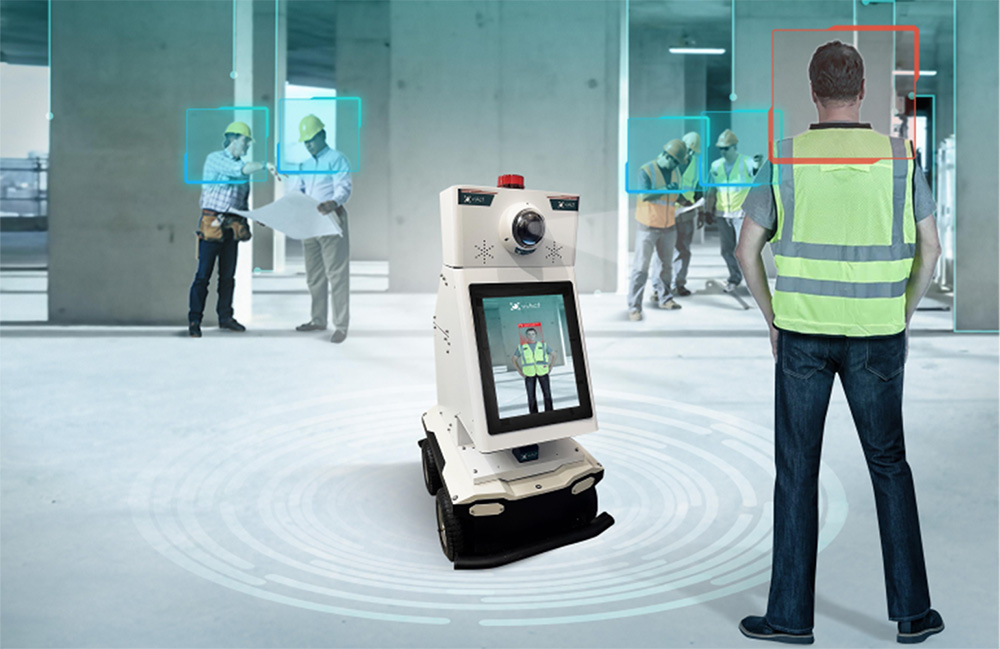
Vision AI addresses this limitation by operating as a site-wide awareness layer rather than a feature embedded in a single machine. It analyzes live video feeds from existing security cameras, temporary site-mounted cameras, drones, body-worn devices, and — increasingly — ground-based sensor networks. By synthesizing all of these inputs, it builds a real-time understanding of how people, vehicles, and autonomous equipment are interacting across the entire site.
This is not a theoretical concept. Practical implementations now include autonomous ground-based patrol units that physically travel through areas fixed cameras cannot cover — basements, tunnels, interior floors under active construction, and zones that change configuration as the project progresses. These units do not simply replace cameras. They extend the perception layer into the physical spaces where blind spots persist and where neither fixed infrastructure nor aerial drones can maintain consistent coverage.
The critical insight is that vision AI does not replace any single robot’s onboard perception. It complements it by creating a unified, site-wide operational picture that no individual sensor could produce on its own.
## From Alerts to Intelligent Response
The capabilities of vision AI are advancing rapidly. Early systems focused on detecting PPE compliance — hard hats, vests, safety glasses — and flagging when workers entered designated exclusion zones. These tools were valuable, but they operated in isolation: one alert from one camera with no broader context.
The next generation of systems is fundamentally different. By combining computer vision with advanced reasoning capabilities, these platforms can interpret the meaning behind what they see. They correlate live video with equipment telemetry, drone imagery, scheduled work plans, and real-time movement data to understand not just that something happened, but why it matters.
Consider a scenario where a worker enters an area that an autonomous compactor is about to traverse. An older system would trigger a basic zone-breach alert. A more advanced vision AI platform would recognize the worker’s position relative to the compactor’s planned path, assess the time available before an interaction becomes critical, evaluate whether the worker can safely exit the zone, and then either alert the supervisor, signal the compactor to pause, or both — all within seconds.
Crucially, much of this processing happens at the edge — close to the cameras and sensors themselves — rather than requiring constant communication with a remote cloud server. This low-latency approach is essential for active job sites, where a safety intervention that takes several seconds to process may already be too late.
At the same time, centralized dashboards give site supervisors a consolidated view of everything happening across their project. Instead of monitoring dozens of unrelated camera feeds, leaders can see the interactions between workers, robots, vehicles, and equipment as they unfold in real time. This enables faster, more informed decision-making — and helps bridge the gap between human intuition and machine precision.
## Looking Ahead
The trajectory of construction robotics points toward deeper automation, greater machine intelligence, and expanded capabilities for handling hazardous and repetitive tasks with minimal human involvement. These advances will continue to accelerate.
But the reality is that humans and machines will share job sites for the foreseeable future. Warehouses, infrastructure projects, and building developments will continue to require the collaboration of skilled tradespeople and autonomous equipment working in proximity. The question is not whether they will coexist — it is whether the industry has built the awareness systems needed to make that coexistence safe.
Vision AI is not about replacing human judgment or eliminating the need for experienced workers. It is about providing the continuous, comprehensive perception that neither humans nor machines can achieve alone. It is the connective tissue between isolated robotic systems and the dynamic, unpredictable reality of a living construction site.
As the industry moves deeper into automation, this layer of shared awareness may well prove to be the most important technology deployed — not because it is the most visible, but because it operates silently in the background, catching the moments when everything else is functioning exactly as designed but the situation has quietly changed.
—
## Frequently Asked Questions (FAQ)
**Q: What is vision AI in the context of construction?**
A: Vision AI refers to artificial intelligence systems that analyze live video and sensor feeds from cameras, drones, and other devices across a job site to understand and interpret real-time activity. It goes beyond simple detection to provide contextual awareness of how workers, vehicles, and equipment are interacting.
**Q: How is vision AI different from the sensors built into autonomous machines?**
A: Onboard sensors give a robot excellent awareness of its immediate surroundings but a limited view of the broader site. Vision AI operates as a site-wide layer that synthesizes data from many sources — fixed cameras, mobile units, drones, and wearable devices — to create a comprehensive picture of what is happening across the entire environment.
**Q: Why can’t existing safety practices handle the rise of autonomous equipment?**
A: Traditional safety practices rely heavily on human observation, communication, and procedural controls. Autonomous machines operate continuously and without fatigue, but they also lack the intuitive awareness that experienced workers develop. When job site conditions change rapidly, the gap between what a machine “knows” and what is actually happening becomes a critical safety risk.
**Q: What are autonomous ground-based patrol units, and why are they important?**
A: These are self-driving robotic units that physically move through a construction site to gather visual data from areas that fixed cameras cannot reach — such as interiors, tunnels, and basements. They extend the vision AI layer into spaces where neither permanent infrastructure nor drones can sustain a consistent presence.
**Q: Does vision AI require constant internet connectivity to function?**
A: Modern vision AI systems are designed to process critical safety data at the edge, meaning the intelligence runs close to the cameras and sensors themselves. This allows hazards to be identified and acted upon within seconds, without depending on a continuous connection to a remote server.
**Q: Will vision AI replace human workers or their jobs?**
A: No. Vision AI is designed to augment human decision-making and improve situational awareness for everyone on site — workers and supervisors alike. It supports safer collaboration between people and machines rather than replacing either.
**Q: What does the future look like for vision AI on construction sites?**
A: The technology is moving toward more intelligent, context-aware systems that can not only detect potential hazards but also reason about them and recommend or trigger coordinated responses. As autonomous equipment becomes more common, this kind of integrated awareness will likely become a standard requirement rather than an optional enhancement.
—
## Conclusion
The automation of construction is no longer a distant possibility — it is actively reshaping how projects are built. Autonomous equipment, robotic systems, and AI-driven inspection tools are becoming standard fixtures on progressive job sites. But the real measure of success for this transformation will not be how fast machines can work. It will be how safely they can work alongside the people who build our world.
Vision AI fills the awareness gap that no single machine, sensor, or human observer can close alone. By creating a shared, real-time understanding of the entire site, it gives both autonomous systems and frontline workers the context they need to operate safely in a constantly shifting environment.
Investing in this technology is not just about adopting the latest innovation. It is about building the foundation for an industry where automation and human expertise can coexist — where every worker goes home safely at the end of the day, not despite the machines, but because of the systems designed to keep them protected.
The path forward for construction robotics depends on this often invisible layer of perception. And as the industry continues to automate, ensuring that vision AI is at the core of every deployment will be one of the most important decisions the sector makes in the years ahead.
Thank you for reading
