



# Why Hardware Development Is the Next Frontier for Humanoid Robotics
The leap from laboratory prototypes to practical, human-facing machines has revealed a stubborn truth: software intelligence alone cannot carry a humanoid robot through the demands of real-world physical interaction. As engineers push these machines toward greater dexterity and autonomy, the mechanical and electrical systems that enable movement have become the defining bottleneck.
## The Weight of Complexity in a Humanoid Frame
A traditional industrial robot arm operates in a controlled, fixed environment. It stays bolted to a floor, draws power through thick cables routed to external cabinets, and rarely needs to justify its own weight. Add six or seven axes and a controlled workspace, and the engineering tolerances remain generous.
A humanoid tells a completely different story. With 30 or more degrees of freedom, every wrist rotation, elbow bend, and finger articulation demands its own set of motors, power electronics, current and position sensors, and safety mechanisms. All of that hardware must travel with the robot. Every additional gram increases the energy cost of motion, and every millimeter of circuit board or wiring competes for space inside an already tightly packed limb.
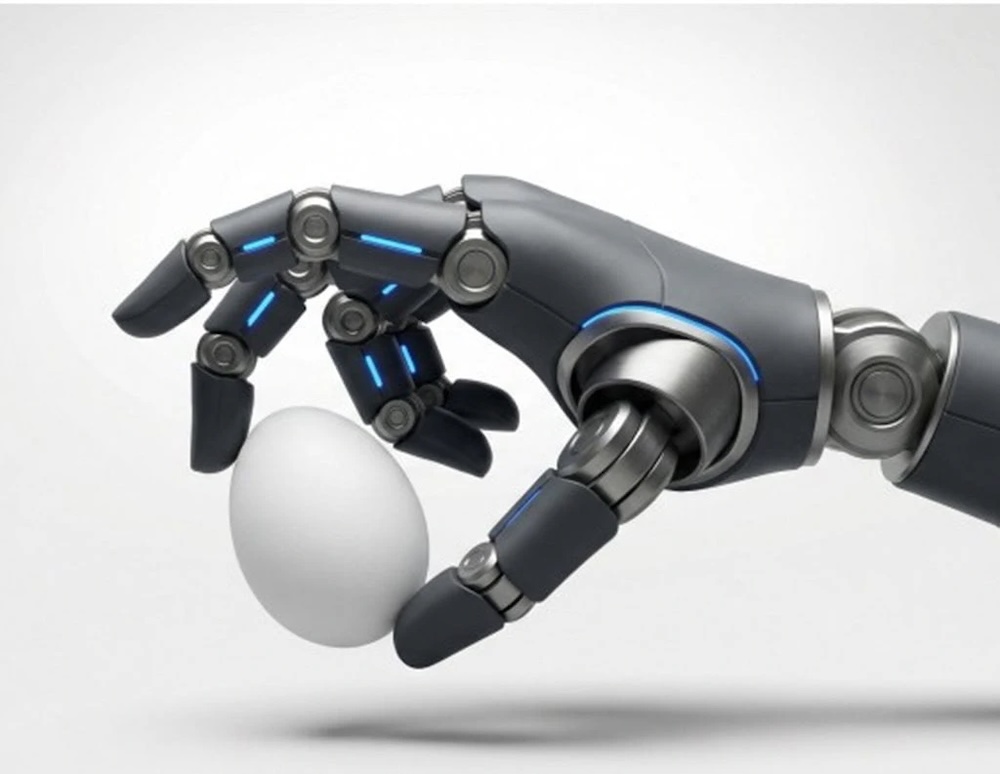
This creates a paradox at the heart of humanoid design: the electronics required to give a robot freedom of movement consume the very space and add the weight that can restrict that freedom. Nowhere is this more apparent than in dexterous hands, where multiple motors, sensors and control boards must coexist in a volume barely larger than a human fist. The joint itself becomes a full system-level design challenge.
## How Voltage Choices Shape a Robot’s Body
One of the most consequential engineering decisions in modern humanoid design involves power distribution. Early robotic systems typically operated on low-voltage architectures, often 12V or lower. As mobile and bipedal platforms have grown more capable, the industry has shifted toward 48V DC power systems.
The physics behind this shift is straightforward. For a given amount of power delivered, quadrupling the voltage reduces the required current by a factor of four. Thinner wiring becomes possible, cutting copper weight throughout the machine. Because resistive losses scale with the square of current, that same fourfold reduction in current translates to a sixteenfold drop in wiring losses.
Inside a humanoid, these electrical gains produce direct mechanical benefits. Less wiring means less mass to accelerate, and lower thermal dissipation makes it far easier to embed electronics inside joints where elaborate cooling systems are impractical.
However, higher voltage introduces a new complication. During rapid deceleration, electric motors can act as generators, producing transient voltage spikes well above the nominal DC bus level. The electronics governing each joint must survive these events without damage or loss of control. The tradeoff is clear: higher voltage reduces current, heat and weight, but it raises the bar for the reliability and ruggedness of motor-control circuitry.
## Intelligence vs. Execution
Advanced AI models now enable humanoids to interpret complex instructions, recognize objects, plan trajectories and make real-time decisions about how to interact with their environment. A robot can determine that it should pick up a cup, turn a valve or hand a tool to a nearby worker.
The instruction, however, does not move anything by itself. Behind every AI decision sits a dense control loop running inside each joint. Position encoders report where the limb is, current sensors measure how much force the motor is applying, and a feedback system continuously compares actual movement against the commanded path. If something resists the motion — a heavier object than expected, an obstacle in the way — the joint must detect the discrepancy and adjust in real time.
Even a seemingly trivial task like handing someone a glass of water requires continuous coordination. The robot cannot simply move its arm to a fixed set of coordinates and stop. It must modulate torque throughout the motion, respond to changes in the object’s weight and orientation, and release at the right moment. This physical intelligence — the fusion of sensing, actuation and feedback — is what bridges the gap between a machine that thinks and a machine that acts.
Different joints impose wildly different demands. A shoulder assembly may house large motors that generate significant electromagnetic interference, while a fingertip joint must deliver precise position sensing in a space smaller than a coin. No single sensor architecture is likely to serve every joint effectively, which means designers must tailor sensing strategies to each location on the body.
## Safety as a Built-In Property, Not an Add-On
When robots operate behind fences in factory environments, safety is largely a matter of separation. A humanoid designed to work beside people, or to assist in a home, cannot rely on that buffer. Functional safety must be woven directly into the robot’s control system.
The system must continuously monitor operating conditions, detect faults or anomalous behavior and swiftly move any affected subsystem into a safe state. Achieving this from the ground up involves hardware redundancy, robust software diagnostics and extensive certification efforts.
Lessons from adjacent industries offer a useful blueprint. Automotive systems such as electronic power steering and braking already combine high-power electromechanical actuation with embedded sensing, diagnostics and safe-state behavior. Humanoids face different performance requirements, but the design principle holds: building safety into the architecture from the beginning is far more practical than retrofitting it after the fact.
## The Joint as an Integrated System
At the scale required by advanced humanoid platforms, the components inside each joint — semiconductors, sensors, power converters, thermal management elements and safety circuitry — must be treated as a single, tightly coupled electromechanical subsystem. The goal is to collapse the physical and electrical distances between sensing, control and actuation into the smallest possible footprint.
Advances in semiconductor integration play a key role here. By placing control circuitry and sensing electronics closer together on the same silicon or in tightly integrated packages, engineers can reduce printed circuit board routing complexity, minimize parasitic effects and avoid localized heat buildup. The result is a joint that is lighter, more reliable and easier to thermally manage.
More importantly, this kind of integration frees robotics engineers to focus their efforts on the higher-level challenges: kinematics, motion planning and the software that gives each robot its unique capabilities. The joint becomes the critical bridge between artificial intelligence and the physical world — and its design determines just how effectively that bridge can carry intelligence into action.
## Toward Machines That Can Feel
Current humanoid platforms depend heavily on vision and AI-driven perception to understand their surroundings. Cameras, depth sensors and neural network models allow these machines to identify objects, map environments and plan manipulation strategies.
Yet human dexterity depends on more than sight. When a person lifts a fragile cup or grips a slippery tool, tactile and force feedback reshape the movement in milliseconds. We feel the contact, sense the resistance and adjust without conscious thought.
Replicating this capability remains one of the most significant unsolved problems in robotics, particularly for the hand. Embedding force-sensitive and tactile sensors into fingertips, palms and joint surfaces would give machines a richer picture of what happens when they touch the physical world. That information could then be fed back into the control loop, allowing movements that are adaptive, gentle and precise.
The remarkable progress in AI has brought humanoid robotics closer to machines that can decide what to do. The next major advance will likely depend on whether the physical systems carrying that intelligence can execute it efficiently, accurately and safely enough to earn a place beside people in everyday environments.
—
## Frequently Asked Questions
**What is the main hardware challenge facing humanoid robots today?**
The core challenge is packing enough motors, sensors, power electronics and safety circuitry into every joint to enable fluid, autonomous movement — all while keeping weight and volume low enough to preserve battery life and agility.
**Why are humanoid robots moving toward 48V power systems?**
Higher voltage reduces the current needed to deliver the same power, which cuts wiring weight, lowers resistive heat losses and simplifies thermal management inside joints that have limited space for cooling.
**Can AI alone make humanoid robots capable of complex physical tasks?**
No. AI can decide what to do, but each joint still requires its own closed-loop control system — combining sensing, actuation and feedback — to translate decisions into precise, safe physical movement.
**How does functional safety work in a collaborative humanoid?**
Functional safety requires the control system to continuously monitor for faults, detect abnormal behavior and move affected joints into a safe state quickly, without relying on physical separation from humans.
**Why is tactile sensing important for humanoid dexterity?**
Tactile and force feedback allows robots to adjust grip pressure and movement in real time when handling delicate or irregularly shaped objects, much the way humans use touch during fine motor tasks.
**What role does semiconductor integration play in joint design?**
Tighter integration of sensing, control and power electronics on smaller silicon or package-level platforms reduces wiring complexity, heat generation and physical volume inside each joint.
—
## Conclusion
Humanoid robotics stands at a pivotal moment. The AI layer has matured rapidly, giving machines the ability to perceive, plan and reason in increasingly sophisticated ways. But none of that intelligence matters if the hardware beneath it cannot deliver precise, safe, energy-efficient movement across dozens of joints in unpredictable environments. The next phase of progress will be defined by breakthroughs in power architecture, sensor integration, electromechanical design and safety systems — all working together to turn artificial decision-making into physical capability.
Thank you for reading
