



# How Google’s Latest AI Weather Model Is Reshaping the Renewable Energy Forecasting Market
## A New Era in Weather Intelligence for Power Grids
Artificial intelligence is rapidly transforming how the energy industry plans for and manages weather-dependent power generation. The latest entry into this space comes from a major tech company, which has unveiled its third-generation weather forecasting model. The system is designed with a specific focus on the needs of wind and solar operators, delivering predictions for conditions at the altitude where modern turbines operate — approximately 100 metres above the ground.
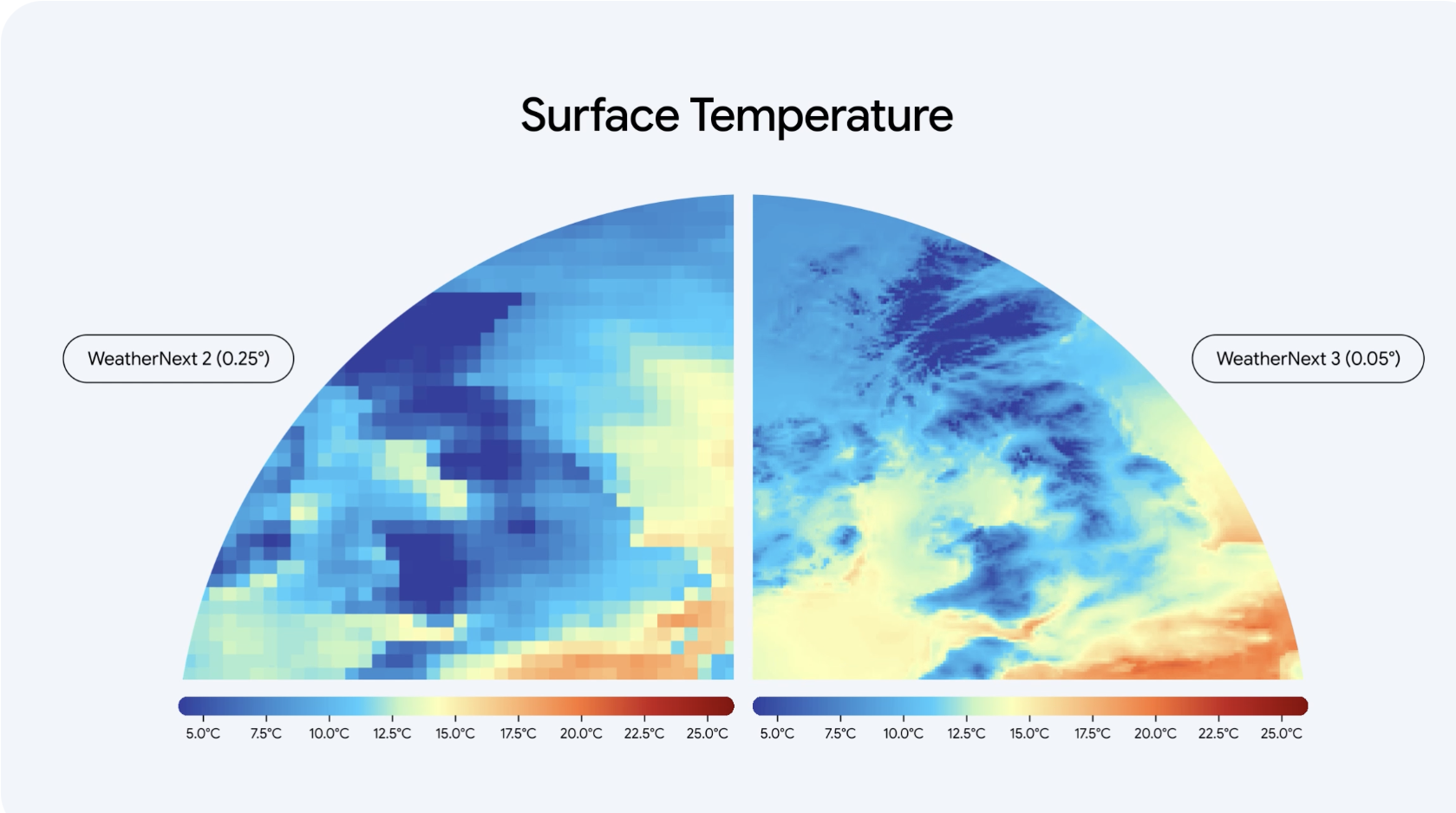
The model generates global forecasts on an hourly basis with a resolution as fine as five kilometres. Unlike many of its predecessors, it tracks a broader set of energy-relevant variables, including cloud cover, surface-level solar irradiance, and wind speed at turbine height. This hourly cadence represents a significant upgrade over earlier versions that refreshed only every six hours on coarser grids.
—
## Why the Energy Sector Needs Better Forecasts
The urgency behind AI-driven weather forecasting is rooted in a fundamental shift in how electricity grids operate. Over the past decade, wind and solar have become the dominant sources of new generation capacity worldwide. In the United States alone, projections for 2026 show solar installations and battery storage systems accounting for tens of gigawatts of new capacity, dwarfing additions from conventional sources.
The challenge is straightforward: renewable output depends entirely on the weather, and grid operators must balance generation against demand in real time. When a forecast underestimates wind availability, operators are forced to procure expensive backup power, often from natural gas plants kept on standby. When a forecast overestimates output, renewable generators may be paid to curtail production because the grid lacks the capacity to absorb it. Both scenarios carry financial and operational costs.
Meanwhile, electricity demand itself is growing more volatile. The rapid expansion of data centres — driven by the computational demands of artificial intelligence workloads — has introduced a new layer of uncertainty into load planning. Industry analysts project that data centre consumption alone could reach extraordinary levels within the next decade, representing a dramatic increase from current figures. This means grid operators must now forecast both supply and demand with unprecedented precision, and weather is the single largest variable in both equations.
—
## What Makes This Model Different
Most modern AI weather forecasting systems are trained on output from numerical weather prediction models — complex physics-based simulations run on supercomputers. These simulations are powerful but carry inherent limitations. They process atmospheric data with a delay, typically on the order of several hours, which can introduce inaccuracies when tracking rapidly changing conditions such as rainfall or surface temperature shifts.
The new approach taken by Google’s latest model represents a departure from this workflow. Rather than relying exclusively on simulated outputs, it ingests live satellite imagery and trains directly on measurements collected from individual weather stations. The system processes one-hour satellite mosaics alongside traditional historical datasets, allowing it to incorporate the most recent observations available rather than waiting for the next scheduled analysis cycle.
The practical result is a meaningful reduction in data latency. Where earlier AI weather systems operated with a lag of roughly seven hours, this new model compresses that window to approximately three or four hours. While it does not entirely eliminate dependence on physics-based simulations, it significantly reduces it. The model architecture channels satellite data, station observations, and cyclone tracking information into a unified forecasting pipeline, producing gridded global outputs at hourly intervals.
—
## The Commercial Landscape
Selling weather intelligence to the energy sector has long been a specialised business. A number of established providers offer forecasting platforms tailored to wind farms, solar installations, and grid operators. These competitors bring deep domain expertise and, in some cases, proprietary physics-based modelling approaches that have been refined over decades.
One notable competitor, a Swiss-based firm, has publicly claimed its own model outperforms several leading alternatives on accuracy benchmarks while updating far more frequently than most rivals. Its product embeds physical constraints into the forecasting process, a design choice the company argues is critical during extreme weather events — precisely the scenarios that cause the most damage to grid reliability.
However, the new entrant brings a different kind of advantage. The forecast data is accessible through multiple channels simultaneously: as a searchable dataset in a major cloud data warehouse, as a geospatial analysis layer in a well-known earth observation platform, through a mapping API, and as the default answer in a widely used search engine. No other provider in the energy forecasting space offers that breadth of delivery. For utility companies and renewable developers, this means the same trusted forecast can be integrated into existing workflows without engaging a specialist vendor.
The hourly refresh rate also closes a gap that competitors have previously used to justify premium pricing. Where some services update only a handful of times per day, the new model’s continuous cycle gives operators a much finer-grained picture of how conditions are evolving, which is especially valuable for short-term scheduling and real-time dispatch decisions.
—
## What the Numbers Actually Show
Accuracy claims deserve careful scrutiny. The company has reported significant improvements over reference datasets when measured at early lead times: one benchmark shows roughly 60% improvement against a satellite-based precipitation product, another shows a 30% gain against radar estimates, and a third demonstrates a 10% improvement against ground-based rain gauge readings. A separate claim of approximately 50% better precipitation forecasting applies specifically to forecasts made a day or more in advance.
It is important to note that these figures represent best-case scenarios under specific conditions. Each benchmark uses a different reference dataset, and the percentages are not directly comparable or additive. The company has also not released results from independent third-party validation. Instead, it points to ongoing evaluations conducted by an external firm whose leaderboard ranks global weather models, citing a top position among entries.
For a utility company deciding whether to replace an existing paid forecasting service, a global ranking position is less relevant than how the model performs across its specific geographic territory and across its particular portfolio of generation assets. Real-world accuracy on a regional basis, at the scale of individual wind farms or solar parks, is the metric that ultimately matters.
—
## A Company With a Stake in the Outcome
There is an irony in the timing of this launch. The company behind the new model is one of the largest operators of data centres in the world, and it is among the companies driving the very electricity demand growth that is making grid forecasting more difficult. The same company has entered into large-scale agreements to procure renewable energy for its own facilities.
Accurate forecasting of wind and solar output is, therefore, not just a commercial product offering — it is a competitive advantage for a company that needs to match clean energy supply against a growing and variable load. The decision to include energy-specific variables in this release is consistent with that strategic position. The commercial logic is clear: better predictions enable better scheduling, lower costs, and more efficient use of renewable assets.
Pricing details for enterprise access have not been disclosed. It remains unclear whether querying the forecast data through cloud services incurs standard usage charges or requires a separate licensing arrangement. For organisations evaluating a switch from an existing specialist provider, cost transparency will be a key factor alongside accuracy.
—
## The Broader Picture
The arrival of this new model is part of a wider trend in which artificial intelligence is being applied to problems that were long dominated by physics-based simulation. Weather forecasting is one of the most computationally intensive scientific domains, and the prospect of achieving comparable or superior accuracy through data-driven approaches at a fraction of the compute cost is attracting significant attention from both technology companies and energy firms.
For grid operators, the implications are tangible. A forecasting tool that updates every hour, covers the globe at five-kilometre resolution, and is accessible through familiar cloud platforms lowers the barrier to adoption dramatically. It removes the need for specialised expertise in weather modelling and allows integration into existing data infrastructure with minimal setup.
Whether this model will ultimately displace established players in the energy forecasting market remains to be seen. Physics-based models still hold an edge in extreme and unprecedented weather conditions, where learned patterns from historical data reach their limits. Hybrid approaches that combine AI pattern recognition with physical constraints may ultimately prove to be the most robust path forward.
What is certain is that the energy sector’s reliance on accurate weather intelligence will only intensify as renewable generation expands and data centre demand continues its steep upward trajectory. The companies that can deliver the most reliable, timely, and actionable forecasts will find themselves in a strategically important position.
—
## Frequently Asked Questions (FAQ)
**Q: What specific weather variables does the new model forecast?**
A: The model predicts wind speed at 100 metres above ground — the typical hub height of a modern wind turbine — as well as cloud cover, the amount of sunlight reaching the Earth’s surface, temperature, and moisture at the surface. It also delivers standard atmospheric variables across a global grid.
**Q: How does the update frequency compare to older systems?**
A: The model refreshes its global forecast every hour. Previous generations operated on a six-hour cycle, meaning operators now have access to conditions four times more frequently, which is critical for short-term operational decisions.
**Q: Why is data centre growth relevant to weather forecasting for energy?**
A: Data centres consume enormous amounts of electricity, and their demand is highly variable. As AI workloads expand, the additional load creates new forecasting challenges for grid operators who must balance supply and demand in real time. Better weather predictions help manage the renewable side of that equation.
**Q: Has this model been independently validated?**
A: The company has not published independent third-party validation alongside its launch. It points to evaluations conducted by an external firm and a public leaderboard where it ranks highly. However, individual utilities will need to assess performance against their own regional data and asset portfolios.
**Q: How does the model’s approach differ from traditional AI weather models?**
A: Most AI weather models are trained on output from numerical weather prediction simulations, which carry a several-hour data lag. This new model ingests live satellite imagery and station observations directly, reducing the dependency on simulated data and cutting the effective data delay roughly in half.
**Q: Can smaller renewable developers access this model?**
A: The forecast data is available through cloud platforms and APIs, which means it can theoretically be accessed by organisations of any size. However, there is no published pricing information for enterprise access, so cost remains an open question for smaller operators.
**Q: What are the limitations of purely data-driven weather models?**
A: Data-driven models learn patterns from historical observations. During truly unprecedented weather events — where atmospheric conditions fall outside anything the model has seen in training — physics-based models that encode fundamental laws of atmospheric behaviour tend to perform more reliably. This is a recognised limitation across the field.
—
## Conclusion
Google’s third-generation weather forecasting model represents a meaningful step forward in the application of artificial intelligence to energy grid management. Its combination of hourly updates, fine spatial resolution, energy-specific variables, and broad accessibility through cloud platforms sets a new standard for what renewable operators and grid planners can expect from an AI forecasting tool.
At the same time, the limitations are worth acknowledging. The absence of independent validation, the unclear pricing structure, and the inherent difficulty of forecasting extreme weather events with purely data-driven methods are all factors that potential adopters must weigh carefully. The model’s accuracy advantages, while substantial, are best understood as conditional and context-dependent rather than universally applicable.
As the global energy system becomes increasingly dependent on weather-sensitive generation and faces rising demand from AI infrastructure, the value of accurate, timely, and accessible forecasts will only grow. The companies and organisations that invest now in understanding and integrating these new tools will be better positioned to navigate the complexity of tomorrow’s grids.
Thank you for reading
