



The scramble that follows a public API key leak is all too familiar. A researcher or automated scanner spots a credential exposed in a code repository, but there is no simple way to shut it down. Instead of a quick fix, the discoverer is thrust into a lengthy investigation: which organization owns this key? Who is the right contact? Is there a security policy file? By the time the correct team revokes the compromised credential, hours or days have passed—while automated bots can exploit those same keys in minutes. Even worse, a vast number of these leaked secrets remain active for years, leaving systems perpetually vulnerable.
It is a problem the industry has already solved for a different credential type. In 2013, OAuth introduced RFC 7009, which established a standardized token revocation endpoint discoverable through a well-known configuration URL. Any compliant client can instantly disable an access token. Yet, we continue to ship plain API keys—the credential type that leaks most frequently—with absolutely no revocation mechanism.
The open-source scanning ecosystem is rapidly advancing toward automatic revocation via provider APIs, but every scanner currently has to build custom, provider-by-provider integrations because no universal standard exists to simply ask an issuer, “Please deactivate this key.” That gap is the exact problem that needs solving.
### Introducing the Open Revocable Key Standard
To address this, I have drafted a specification called the Open Revocable Key Standard. The core philosophy is straightforward: credentials should come with a self-destruct mechanism built directly into their architecture.
The proposal is built on four foundational pillars:
**1. Keys That Declare Their Issuer**
Every key follows a structured format that includes a fixed prefix, an encoded issuer domain, the secret itself, and a checksum. Similar to how GitHub uses token prefixes to make scanning tractable and embedded checksums to eliminate false positives, this standard adds the issuer domain. This allows any scanner that finds a key to immediately know, offline, exactly which organization to contact.
**2. A Discoverable Kill Switch**
Every key issuer hosts a lightweight JSON configuration file at a standard, well-known directory path. This file lists the issuer’s revocation endpoint, an optional introspection endpoint, a security contact, and the specific constraints the issuer supports. This mirrors the established conventions used in identity protocols like OIDC discovery and security policies like security.txt.
**3. Revocation by Possession**
Revocation is handled by submitting the full key to the endpoint via a simple POST request. No authentication is required. The reasoning is that anyone who possesses the key already has the power to abuse it; allowing them to destroy it is a strict net improvement. By requiring the complete key for the request, there is no risk of enumeration, and the endpoint returns an identical “accepted” response whether the key was live, dead, or entirely fabricated.
**4. Declared Constraints**
The configuration file advertises which security bindings the issuer supports—such as IP allowlists, mandatory expiration windows, scope limitations, and mutual TLS requirements. This transforms previously time-consuming vendor security questionnaires into automated, programmatic queries. A procurement tool can simply fetch the discovery file to answer the question, “Does this vendor support IP-pinned keys?”
### The Quarantine Model: Restraint Without Disruption
The most common objection to unauthenticated revocation is availability. If possession grants revocation rights, a leaked key becomes a tool for sabotage—someone could instantly break production integrations with a single command.
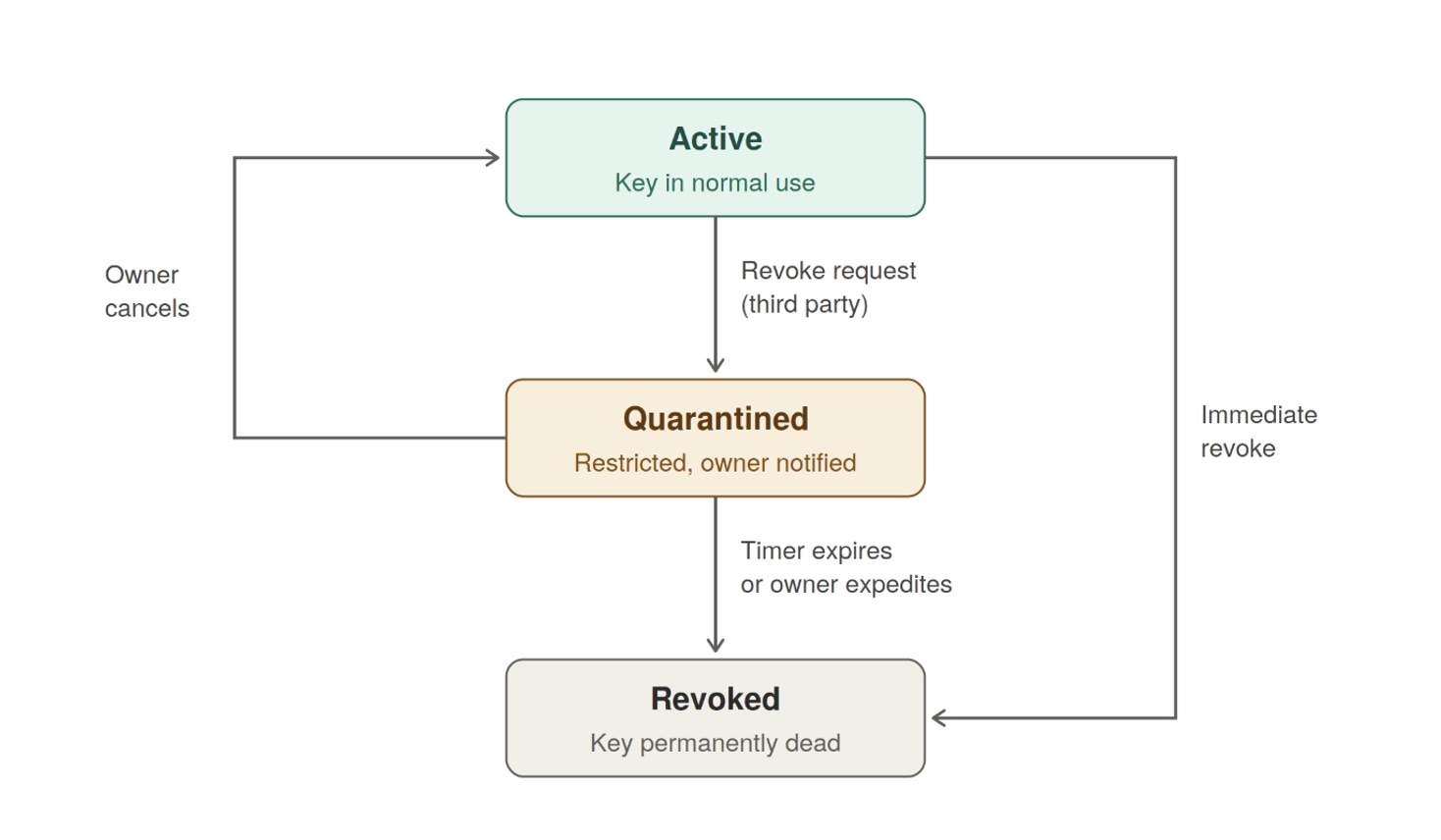
To mitigate this, the standard borrows the “andon cord” concept from manufacturing, where any worker can pull the cord to signal a problem, but the line only stops if the issue remains unresolved. The standard includes an optional quarantine mode. When an unauthenticated revocation request is received, the key is not immediately destroyed. Instead:
1. The owner is instantly notified across all registered channels, with the reporter’s evidence attached.
2. The key is immediately restricted to read-only access, with destructive operations blocked and all actions heavily logged.
3. A countdown timer begins (defaulting to 24 hours, as published in the discovery file). When it expires, the key dies automatically.
4. The owner can expedite instant revocation or cancel the request, but only through an authenticated dashboard, never via an email link.
This approach turns malicious griefing into a supervised wind-down. A genuinely leaked key spends its final hours handcuffed rather than fully operational, while high-risk keys like those for financial systems or admin panels can opt into immediate destruction by policy.
### Why AI Agents Make This Urgent
The urgency of a revocation standard has exponentially increased with the rise of autonomous AI agents. Today’s agents hold keys for email, code repositories, customer relationship management, payments, and cloud infrastructure simultaneously. Teams deploy these agents faster than they can inventory them, and the agents leak credentials differently than humans do. Prompt injections can trick an agent into exfiltrating its own secrets, and they echo sensitive data into logs at machine speed.
When a human developer is compromised, the window for response might be hours. When an autonomous agent is compromised, the window collapses to seconds. ORKS is uniquely suited for this agent-driven reality because it provides a machine-readable kill switch. A guardrail can detect an injection attempt mid-flight and quarantine the credential instantly. Furthermore, agents can be programmed with immediate-self-revoke policies and short lifespans, ensuring that a key found in a log after a task is completed is already dead, effectively enforcing least privilege across the timeline of a key’s existence.
### Frequently Asked Questions
**What happens if someone tries to grief a system by revoking legitimate keys?**
The standard uses a quarantine mode rather than immediate deletion for unauthenticated requests. The key is instantly restricted to read-only and heavily monitored, preventing sabotage. The legitimate owner is notified immediately and can manually restore the key or let it expire through their authenticated dashboard.
**How does the discovery file prevent attackers from finding sensitive endpoints?**
The discovery file itself is designed to be public. It contains the URLs for the revocation and introspection endpoints, but these endpoints do not reveal whether a specific key is valid. They simply accept revocation requests and return generic, uniform responses to prevent attackers from enumerating valid credentials.
**Why can’t we just rely on GitHub’s scanning tools?**
GitHub offers a proprietary Secret Scanning Partner Program that works well for projects on their platform, but it is invite-only and centralized. The open-source scanning ecosystem needs a universal standard that works across all hosting platforms, repositories, and cloud providers, which is why an open specification like this is necessary.
**How does this standard handle AI agents specifically?**
AI agents can use the machine-readable kill switch to automatically revoke their own credentials after completing a task. This allows keys to be minted with an immediate-self-revoke policy and a short time-to-live, ensuring that any leaked key becomes useless almost instantly.
### The Road Ahead
The beauty of well-known conventions is that they require no central authority and no massive, industry-wide coordination to begin. A single provider can implement this standard in a single sprint by prefixing their keys, publishing a static JSON configuration file, and standing up one endpoint.
As more issuers adopt the standard, the scanners that are currently racing to build per-provider integrations will get a generic detector, making every new issuer automatically more secure. The endgame is beautifully mundane: a key leaks, a scanner or an agent finds it within minutes, decodes the issuer, queries the discovery endpoint, and quarantines the credential before any damage is done. The system owner wakes up to a notification, a link to the evidence, and a simple button to rotate the key—rather than a costly fraud report.
Thank you for reading
