



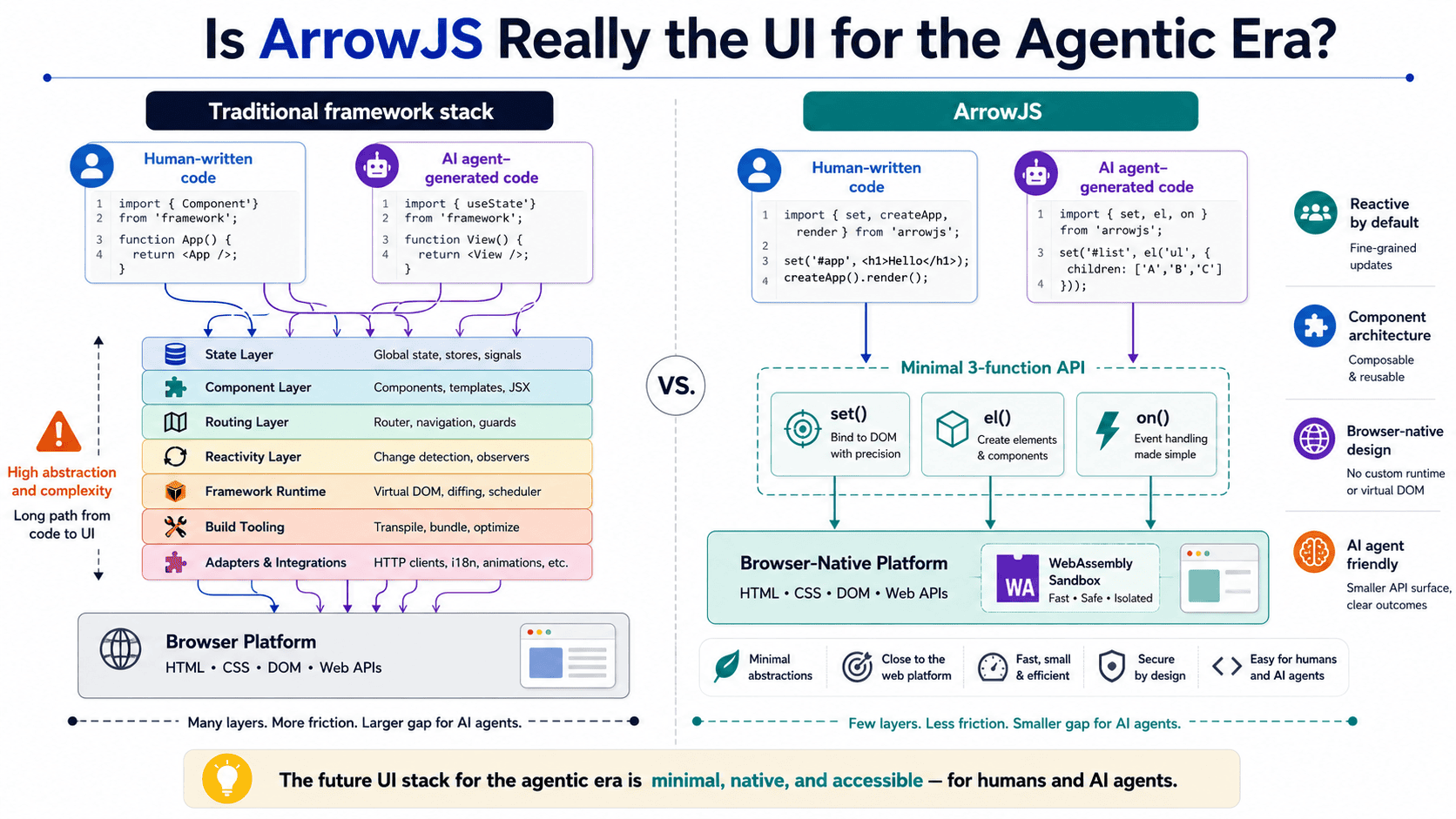
# ArrowJS: Redefining UI Frameworks for the Age of AI Code Agents
## Why the JavaScript Landscape Needs a Shift
For years, the JavaScript ecosystem has revolved around a single assumption: a human sits at the keyboard, writes code, and a framework helps structure and render it. React, Vue, Angular, and Svelte were all architected with human developers in mind — their conventions, quirks, and implicit rules all assume someone who can reason about context, read documentation, and learn framework-specific patterns over time.
But that assumption is no longer holding steady.
AI-powered coding agents like Claude Code, GitHub Copilot, and Cursor are now writing substantial chunks of production-ready JavaScript. These agents don’t “think” the way humans do. They pattern-match across enormous training corpora, generating code that looks statistically likely to be correct. The problem? When a framework’s conventions are subtle or deeply layered, agents produce code that *seems* right but quietly breaks. Hooks get called out of order. JSX gets used where native JavaScript would suffice. Build configurations become fragile and brittle.
This gap between what AI agents can do and what existing frameworks expect of them is the gap ArrowJS was designed to fill.
## The Hidden Complexity of Popular Frameworks
To appreciate what ArrowJS brings to the table, it helps to examine why mainstream frameworks create friction for AI-generated code.
### React: Powerful but Layered
React dominates the JavaScript landscape, trusted by nearly two in five developers worldwide. Its component model, hooks system, and JSX syntax are deeply powerful — but that power comes at a cost. React demands that hooks maintain consistent ordering across renders, that developers distinguish between controlled and uncontrolled component patterns, and that code passes through a compilation step before reaching the browser. Each of these requirements introduces an implicit rule that an AI agent must learn. Agents trained on statistical patterns can produce plausible-looking React code, but edge cases frequently yield components that appear correct on the surface while harboring subtle runtime errors.
### Vue.js: Gentler but Still Abstracted
Vue offers a template-based syntax that many developers find more approachable than JSX, with a well-designed reactivity system and robust tooling ecosystem. However, it still introduces a framework-specific layer between a developer’s stated intent and the browser’s actual behavior. For a human developer, this abstraction is valuable. For an AI agent relying on pattern recognition, it becomes a source of unpredictable failure.
### Svelte: The Simplicity Paradox
Svelte takes the boldest approach to simplicity by compiling components into lean vanilla JavaScript with no virtual DOM overhead. Yet its reactivity model is tightly coupled to compiler-specific syntax. Any agent writing Svelte must learn Svelte’s conventions — not just general JavaScript — which undermines the very simplicity the framework promises.
The consistent thread across all three frameworks is an abstraction layer that demands framework-specific knowledge beyond the underlying language itself. For humans, this is a reasonable trade-off. For agents operating purely on learned patterns, it becomes noise.
## ArrowJS’s Core Design Philosophy
ArrowJS approaches the problem from a completely different angle. Instead of adding abstractions, it strips them away — deliberately building a UI framework that stays as close as possible to the native web platform.
### Zero Compilation, Zero Build Steps
ArrowJS leverages tagged template literals, a built-in JavaScript feature, to define UI components. There is no JSX transform, no compiler pipeline, and no build configuration required. The entire core runtime ships at fewer than 5 kilobytes. You write standard JavaScript, and it runs — immediately — in any modern browser.
### An API Small Enough to Reason About
The full ArrowJS API consists of just three functions: `reactive`, `html`, and `component`. That covers reactive state management, template rendering, and component composition — everything needed to build a functional user interface. The framework’s entire documentation fits within roughly 5% of a 200,000-token context window. This isn’t an accident; it’s a deliberate design choice. A framework that an AI agent can fully comprehend within its context window is one the agent can reason about with confidence.
### Sandboxed Execution with WebAssembly
Perhaps the most compelling feature ArrowJS offers is its sandbox package. This tool compiles agent-generated JavaScript or TypeScript into WebAssembly and executes it in strict isolation from the host application page. The result is a safe execution environment for untrusted code — no `eval()` risks, no iframe-based UX compromises, and no need for complex server-side infrastructure. An AI agent generates a UI component from a natural-language description, that component runs inside the sandbox, and it renders directly into the application. The entire pipeline operates with minimal overhead and strong security guarantees.
## Practical Applications and Real-World Fit
ArrowJS isn’t positioned as a wholesale replacement for React, Vue, or any other established framework. Its value proposition is more targeted and specific.
### Where ArrowJS Excels
– **Generative user interfaces** — applications where UI elements are created dynamically based on user prompts or agent decisions
– **Adaptive dashboards** — data visualization interfaces that reconfigure themselves based on analytical insights
– **Chat-driven data explorers** — conversational interfaces where an AI agent builds and renders components in real time
– **Rapid prototyping with AI assistance** — workflows where agents generate candidate UI components that are then executed and evaluated safely
### Where It May Not Be the Right Fit
Teams already invested in the Streamlit, Gradio, or FastAPI ecosystems will find ArrowJS doesn’t align with their existing toolchain. Similarly, organizations that depend on large-scale design systems, extensive component libraries, and mature hiring pipelines built around React will feel the ecosystem gap acutely. ArrowJS currently holds roughly 3,500 GitHub stars as of mid-2026 — a fraction of React’s massive community footprint, and far smaller than the library and tooling ecosystem that surrounds it.
### A Note on Agent Capabilities Evolving
It’s worth acknowledging that AI coding agents are improving rapidly. Several prominent AI platforms — including v0 and Lovable — have leaned further into React specifically because its enormous training data footprint produces higher-quality generated code in practice. The argument that agents need simpler frameworks may prove to be a transitional observation rather than a permanent architectural conclusion. As model capabilities grow, some of the friction that ArrowJS eliminates today may become less relevant.
## Getting Hands-On with ArrowJS
For those curious about experimenting with ArrowJS directly, the path to exploration is straightforward:
– **The official website** at arrow-js.com provides comprehensive documentation covering the core API, the component model, and all sandbox functionality.
– **The GitHub repository** at github.com/standardagents/arrow-js hosts the source code, the full issue tracker, and the complete package breakdown — including `@arrow-js/core`, `@arrow-js/framework`, `@arrow-js/ssr`, and `@arrow-js/hydrate`.
– **An interactive playground** is available directly from the official site, allowing experimentation without any local environment setup or configuration.
## The Bigger Picture
ArrowJS represents one of the first serious attempts to reimagine a UI framework through the lens of AI-assisted development. Its design choices — minimal API surface, no proprietary syntax, no compilation pipeline, sandboxed execution — are coherent, well-motivated, and clearly articulated. Whether these choices define the future of front-end development or remain a niche solution for a specific class of generative applications will depend on how quickly agent capabilities evolve and how the broader ecosystem responds.
For data scientists, machine learning engineers, and AI practitioners who are building the next generation of intelligent applications — particularly those involving dynamic, agent-driven interfaces — ArrowJS offers infrastructure that is currently unmatched by any other framework. It rewards close attention and is worth adding to the radar.
—
## Frequently Asked Questions
**What makes ArrowJS different from React?**
ArrowJS eliminates JSX entirely, removes the need for a compiler or build step, and offers an API surface of only three core functions. It runs natively in the browser without any transformation layer, making it significantly simpler for AI agents to generate correct code. React’s strength lies in its massive ecosystem and community, while ArrowJS’s strength lies in its minimalism and agent-oriented design.
**Is ArrowJS suitable for large production applications?**
Currently, ArrowJS is best suited for applications where AI agents generate or dynamically compose UI components on the fly. For large, team-managed projects with established design systems and extensive component libraries, the ecosystem is not yet mature enough to replace frameworks like React or Vue. It excels in specific generative and adaptive UI scenarios rather than serving as a general-purpose replacement.
**How does the WebAssembly sandbox improve security?**
The sandbox compiles agent-generated code into WebAssembly, which executes in an isolated environment separate from the host page. Unlike `eval()`, which runs code with full access to the page’s scope and can introduce serious vulnerabilities, or iframes, which create UX and communication challenges, the sandbox provides strong isolation with minimal overhead. This makes it safe to run untrusted code generated by AI agents directly in a production environment.
**Can data scientists benefit from ArrowJS?**
Yes, particularly those building interactive applications where AI agents generate UI components based on user input or analytical results — such as adaptive dashboards, chat-based data exploration tools, or generative visualization interfaces. However, if your workflow centers around existing tools like Streamlit or Gradio, ArrowJS may not align with your current stack.
**Will the framework grow its ecosystem over time?**
As of mid-2026, ArrowJS has a small but growing community and approximately 3,500 GitHub stars. The framework is in its early stages, and ecosystem growth will depend on adoption, developer interest, and the broader trajectory of AI-assisted development. Whether it reaches the maturity of established frameworks remains an open question.
**What are the alternatives to ArrowJS for agent-friendly development?**
Other approaches include using plain vanilla JavaScript without a framework, leveraging template-based systems, or building custom DSLs for AI-generated code. ArrowJS differentiates itself by offering a cohesive, documented framework with built-in sandboxing rather than leaving developers to assemble these pieces themselves.
—
## Conclusion
The emergence of AI coding agents has exposed a fundamental tension in the JavaScript ecosystem: frameworks built for human cognition don’t always align with how machines generate code. ArrowJS addresses this tension head-on with a deliberately minimal, platform-native design that prioritizes correctness and safety over feature richness. Its WebAssembly sandbox is a particularly innovative contribution that enables a genuinely safe pipeline for executing untrusted, agent-generated UI code.
While the framework’s small ecosystem and early stage mean it isn’t ready to displace React or Vue for most general-purpose development, it fills a unique and growing niche. As more teams experiment with generative interfaces, adaptive dashboards, and AI-driven application workflows, ArrowJS offers a purpose-built foundation that no other framework currently provides. For professionals building at the intersection of data science and artificial intelligence, it represents a compelling tool worth understanding — even if today’s exploration is more about learning its principles than committing to it as a primary framework.
Thank you for reading
