



# Reducto r-1: A New Single-Pass Parsing Model Promises Simplicity, Speed, and Lower Cost for Document Processing
## Introduction
The landscape of document parsing has long been dominated by multi-stage workflows. Companies extracting data from invoices, contracts, insurance forms, and financial statements typically run optical character recognition, layout analysis, table interpretation, and post-processing as a chain of discrete steps — each adding its own latency and cost. Reducto’s newly announced r-1 model attempts to collapse all of that into a single full-page operation, promising a leaner path from raw document to structured, usable output.
The r-1 model is built on a completely rewritten architecture and is already available in preview through Reducto’s hosted Parse API on version 3 of its platform. This article breaks down what r-1 claims to deliver, what the numbers actually mean, and where organizations should exercise caution before drawing conclusions.
## Collapsing the Pipeline into One Pass
Traditional parsing engines treat a document as a series of problems to solve in sequence. First, extract the raw text. Then, determine the layout — where the columns are, what counts as a header, how reading order flows. If tables are present, additional logic tries to reconstruct their structure. Agentic vision language passes may be layered on top to handle ambiguity, followed by a final merge and cleanup stage.
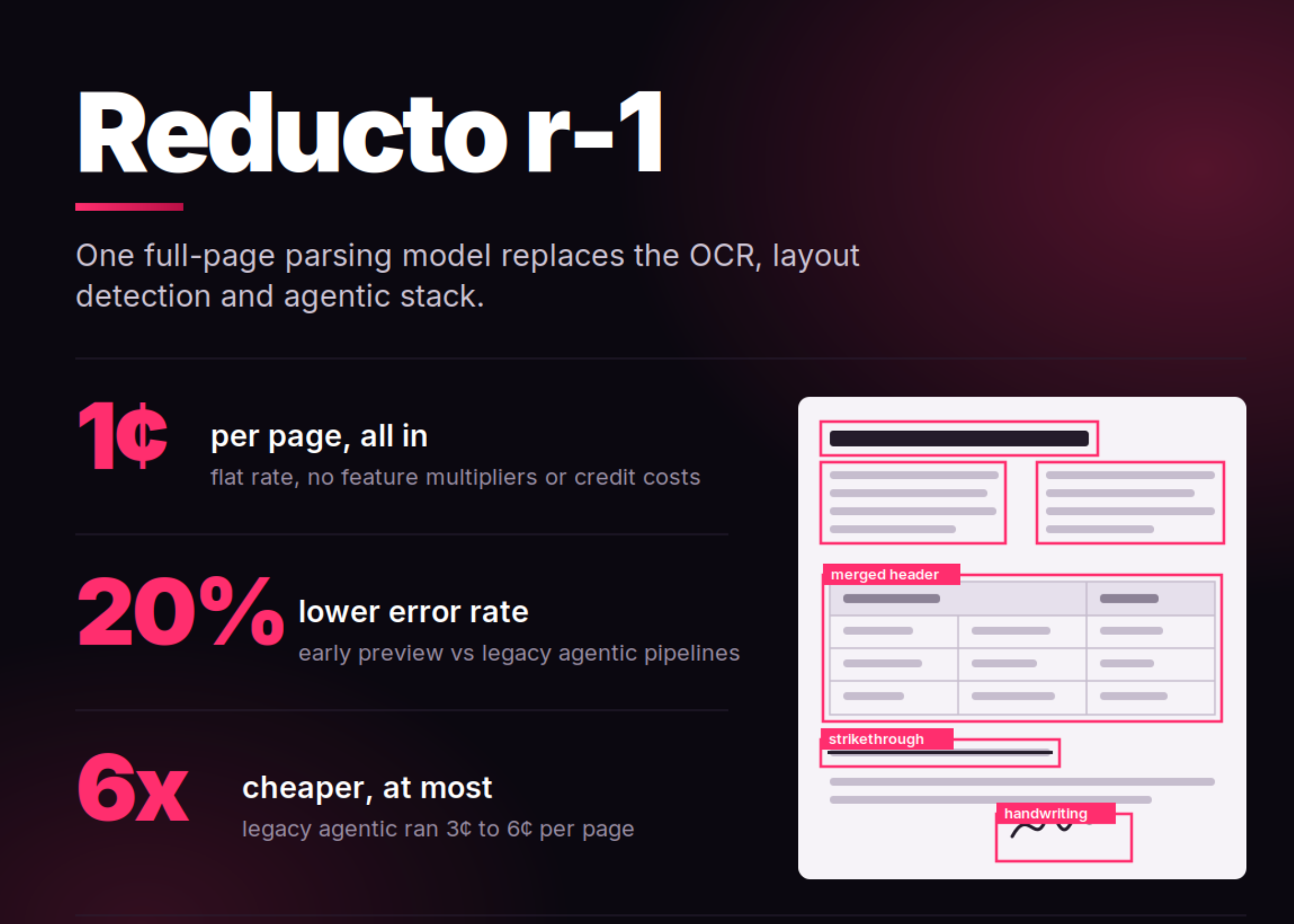
With r-1, Reducto proposes a fundamentally different approach. Instead of stitching together separate specialized models, the new architecture processes every page in a single forward pass. Text, tables, figures, layout cues, reading order, meaningful formatting like bold and strikethrough, and page-relative grounding coordinates all emerge together from one execution path.
The practical implication for engineering teams is straightforward: fewer model calls means less cumulative latency, fewer failure points where one stage’s output can degrade the next, and a significantly simpler orchestration layer to maintain. For pipelines handling financial statements, insurance claims, or dense legal contracts, the reduction in operational complexity is as consequential as any accuracy improvement.
## Pricing and Performance Claims
Reducto’s published rates tell a compelling cost story. Legacy agentic models in its ecosystem have been quoted between 3 and 6 cents per page, depending on the workload complexity and the number of augmentation stages applied on top of the base parsing. r-1 carries a flat price of 1 cent per page, with no feature multipliers and no credit-based surcharges for high-accuracy processing.
To put that in concrete terms, a monthly volume of 250,000 pages would cost roughly $2,500 on r-1, compared with $7,500 at the low end of legacy pricing or $15,000 at the high end. At five million pages per month, the gap widens to $50,000 against the legacy low end and $300,000 against the high end.
On accuracy, Reducto reports a 20% reduction in error rate when comparing r-1 against its own most powerful legacy agentic pipelines in internal benchmark runs. The company also claims that r-1 outperformed large hyperscaler document intelligence products and general-purpose large language models on complex document types. However, both claims deserve scrutiny. The 20% figure is relative to Reducto’s own prior pipeline, not an independent third-party baseline, and the head-to-head comparisons against external services were conducted using Reducto’s internal test sets with no public dataset, evaluation harness, or reproducible methodology released alongside the announcement.
## What r-1 Handles Natively
The model’s documented capabilities span a wide range of document challenges. It processes digital text, scanned pages, and handwritten content through the same pipeline. Table understanding includes support for merged cells and nested headers, using the surrounding page context rather than treating each table as an isolated grid. Columns, headers, footers, sidebars, and reading order are all resolved together as part of the single pass.
Figure detection is handled with an automatically generated short description, though Reducto notes that specialized chart data extraction — such as pulling exact data points from a graph — still requires agentic prompting on top of r-1, which adds latency back into the workflow. Formatting marks that carry semantic meaning, including headings, lists, bold text, underlines, and strikethroughs, are preserved. Every content block is returned with page-relative bounding boxes that enable downstream applications to trace answers back to their exact source region.
Reducto flags several long-tail scenarios as persistent challenges: dense tables with highly nested structures, unusual or non-standard page layouts, low-quality scans, watermarked content, and documents that follow no recognizable template pattern. These edge cases matter especially in regulated industries, where a missed strikethrough could invert a contractual clause or a misread table cell could hand an automated agent an incorrect financial figure.
## Deployment and Security Considerations
r-1 is accessible today through Reducto’s hosted Parse API on the V3 platform, toggled on with a configuration flag. There are no open-source weights available, and no local checkpoint for self-hosting. Organizations that require it can access Reducto’s multi-tenant cloud infrastructure, dedicated customer VPC deployments, on-premises installations, and fully air-gapped environments through separate licensing tiers.
Security certifications include SOC 2 Type II attestation, and higher-tier plans support HIPAA-compliant processing for workloads involving protected health information.
## Key Caveats to Keep in Mind
Several important nuances should inform any evaluation of r-1. The accuracy improvement is measured against Reducto’s own legacy systems, so it does not necessarily represent a 20% improvement over competing platforms. The comparative claims against hyperscaler and LLM products lack independent verification. Additionally, while r-1 eliminates the multi-stage pipeline for core parsing, organizations that need advanced capabilities like custom chart extraction or domain-specific structured output will still need to layer agentic processing on top, which partially erodes the speed and cost advantages.
The pricing structure is also important to understand correctly. The 1-cent figure is the full cost per page for the r-1 parsing pass itself. It does not include additional product modules such as Extract, Split, Classify, or Edit, nor does it account for any agentic augmentation added after the initial parse.
## Frequently Asked Questions
**What is r-1?**
r-1 is Reducto’s first model in a new parsing family, built on a rewritten architecture that processes entire pages in a single pass instead of running OCR, layout detection, and post-processing as separate stages.
**Is r-1 available right now?**
Yes. It is in preview and can be accessed through Reducto’s hosted Parse API on the V3 platform by enabling a configuration flag.
**Can r-1 be self-hosted?**
No. There are no open weights and no local checkpoint available for self-hosting. However, Reducto offers customer VPC, on-premises, and air-gapped deployment options through its platform.
**How does r-1 pricing compare to the previous generation?**
r-1 costs a flat 1 cent per page, compared with 3 to 6 cents per page for legacy agentic models depending on workload complexity.
**What types of documents does r-1 handle?**
It natively processes digital text, scanned documents, and handwriting. It understands tables (including merged cells and nested headers), resolves layout and reading order, detects figures, preserves meaningful formatting, and provides page-relative grounding for every content block.
**What are the known limitations?**
Dense tables, unusual layouts, low-quality scans, watermarked content, and template-free documents remain challenging. Specialized chart data extraction requires additional agentic processing beyond the base parse.
**Is the accuracy improvement verified by independent benchmarks?**
The 20% error reduction claim is based on internal evaluations run by Reducto against its own prior pipeline. There is no publicly released dataset or evaluation harness for the head-to-head comparisons against hyperscaler products and large language models.
**Does r-1 support regulated industries?**
Reducto’s platform supports SOC 2 Type II attestation and HIPAA-compliant processing on higher-tier plans, making it suitable for regulated use cases when paired with the appropriate deployment and licensing tier.
## Conclusion
Reducto’s r-1 represents a meaningful architectural shift in how document parsing systems are designed. By collapsing a multi-stage pipeline into a single full-page pass, it eliminates entire layers of complexity, latency, and cost that have historically burdened enterprises processing high volumes of structured and semi-structured documents. The 1-cent-per-page pricing and the breadth of native capabilities — tables, figures, formatting, layout, reading order, and grounding — make a strong case for organizations looking to simplify their document intelligence stack.
That said, prospective users should approach the accuracy claims with a critical eye. Internal benchmarks against the company’s own legacy pipeline, while impressive in scale, do not substitute for independent third-party validation. The head-to-head comparisons with hyperscaler and LLM products, lacking a public evaluation methodology, should be treated as directional rather than definitive.
For teams already operating within Reducto’s ecosystem or those evaluating a full pipeline replacement, r-1 in preview offers a compelling opportunity to test the single-pass approach on real workloads. For organizations with highly specialized extraction needs or strict independent validation requirements, a measured evaluation period is advisable before committing to production usage.
Thank you for reading
