



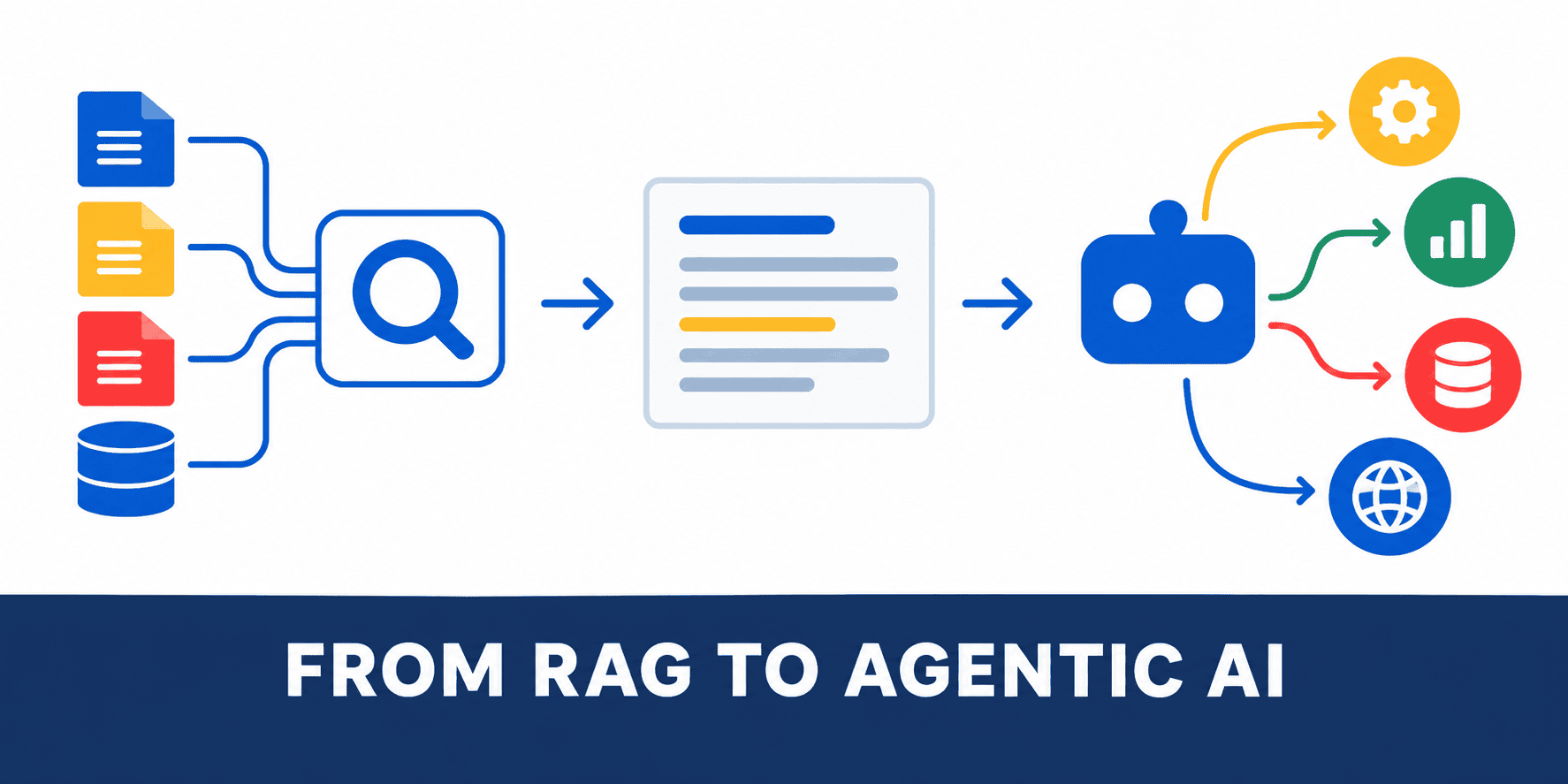
Enterprise AI Evolution: Beyond Simple Document Retrieval to Autonomous Reasoning
Traditional document-grounded generation has been a breakthrough for corporate AI. Instead of relying solely on pre-trained weights, this method pulls relevant text from internal repositories to answer user queries. However, in large organizations, this approach quickly hits its limits. When an employee asks about overlapping internal procedures, the system often fails. It struggles with department-specific acronyms, misses documents that use different synonyms for the same concept, and cannot signal whether its response is a verified fact or a confident guess. These are daily hurdles, not rare exceptions.
The First Evolution: Merging Search Strategies
The first meaningful improvement involves acknowledging that a single search method is insufficient. Semantic search understands context—finding documents about “inventory depletion” even when the query uses the term “stockout.” But it often misses exact product codes or proprietary acronyms. Conversely, keyword searches miss conceptual synonyms. The solution is a blended approach that runs both search methods simultaneously.
Merging these results requires careful deduplication—filtering out redundant chunks by unique identifier, source location, or content hash—to ensure a clean dataset. Merging rankings without normalizing scores is best achieved through reciprocal rank fusion, which promotes documents that appear high up in any search type. Executing these searches concurrently rather than sequentially drastically cuts response times, a critical factor for user adoption. Finally, a cross-encoder reranker applies a precision filter to the merged list. Yet, even flawless retrieval fails if the system lacks domain structure.
The Second Evolution: Adding Structured Context
To provide structure, organizations are overlaying their document collections with knowledge graphs. This treats data not as isolated text islands, but as a network of entities and relationships. It recognizes product hierarchies, organizational aliases, and shared parent categories.
When building these graphs, extracting entities deterministically outperforms using generative models at ingestion time. Using large language models for extraction introduces latency, ongoing API costs, and unpredictable outputs that complicate auditing. Rule-based matching against an entity index—using longest-match, normalized matching, and token-level checks—delivers consistent results in microseconds. Once entities are tagged, these graph signals can be fed back into the retrieval process, allowing documents containing the right entities (even with different wording) to surface. For continuously updated systems, incremental delta processing and atomic swap reindexing are essential to keep the graph current without system downtime.
The Third Evolution: Autonomous Reasoning
The most significant leap is shifting from linear retrieval to autonomous reasoning. Enterprise questions are rarely single-hop; they require comparing concepts, breaking down complex tasks, or consulting varied databases simultaneously. Autonomous architectures handle this by dynamically deciding the next step at each phase of execution, rather than following a rigid script.
Safety First: In corporate settings, queries frequently contain sensitive data. Security checks must act as a hard boundary at the very start of the pipeline, rejecting risky inputs before they ever touch internal documents or generation engines.
Disambiguation: Corporate language is full of overloaded terms. Lightweight, database-driven lookups based on frequency heuristics resolve these ambiguities faster and more reliably than asking a language model to guess.
Planning: For intricate queries, breaking the problem into sub-tasks and showing this roadmap to the user fosters trust and catches errors early.
Parallel Execution: Different sub-tasks can be routed to different data sources and executed concurrently, saving valuable time.
Honest Confidence: Most systems fail at telling users they don’t know. A multiplicative scoring model—where overall confidence is the product of individual component confidences—is deliberately conservative. If one step is highly uncertain, the final score drops sharply, clearly signaling a lack of reliable data, rather than averaging out the uncertainty with a confident step.
Self-Reflection: When confidence plummets, the system should not guess. It should self-critique, identify the weak point, and loop back to re-plan with additional context, bounded by strict retry limits to prevent infinite loops.
Core Design Principles
Across these generations, a few core philosophies emerge. Deterministic logic is preferable to generative reasoning whenever possible, ensuring reproducibility for debugging. Response speed is a feature that drives user adoption, so every component needs a strict latency budget. An AI that cannot express uncertainty is a liability; scoring confidence must be foundational, not an afterthought. Finally, data protection must be an immovable architectural constraint, ensuring sensitive queries never reach downstream components.
Looking Ahead
The path forward points toward multi-agent orchestration, where specialized AI agents dynamically discover and collaborate with one another across organizational boundaries. As these coordination protocols mature, enterprises that build robust, auditable foundations today will lead the next wave of intelligent systems. The journey from simple retrieval to complex reasoning is the definitive frontier for enterprise knowledge systems.
***
Frequently Asked Questions (FAQ)
**Q: Why does basic document retrieval fail in large companies?**
A: Standard retrieval methods struggle with the complexity of enterprise environments. They often misinterpret domain-specific abbreviations that have multiple meanings, fail to find documents that use different terminology for the same underlying concept, and cannot distinguish between a well-supported answer and a hallucinated one.
**Q: What is the advantage of using deterministic rules over AI for extracting data from documents?**
A: Rule-based extraction provides consistency, speed, and cost-efficiency. By using established natural language processing techniques to match phrases and tokens, systems can process data in microseconds without API costs, and they produce the same output every time—making them far easier to debug and audit in regulated industries than AI models that can vary in their responses.
**Q: How does an autonomous system decide what to do next?**
A: Unlike traditional pipelines that follow a fixed sequence of steps, autonomous systems evaluate the current situation and make dynamic decisions about which tools to use or which sub-tasks to tackle next based on intermediate results. This allows them to handle complex, multi-part questions that require different types of data.
**Q: Why is multiplicative confidence scoring better than averaging?**
A: Averaging confidence scores across different stages of the process can mask weaknesses. If one component is highly uncertain, an average might still look reasonable, hiding the fact that the data is unreliable. Multiplicative scoring is deliberately conservative; if any single component has low confidence, the overall score drops sharply, giving the system a clear signal to say “I don’t know” rather than providing a misleading answer.
***
In conclusion, the transformation of corporate AI from static retrieval tools to dynamic reasoning engines marks a pivotal shift in how organizations leverage their data. Moving beyond simple retrieval to hybrid search, structured knowledge graphs, and autonomous agentic architectures requires deliberate engineering. By prioritizing determinism, enforcing strict privacy boundaries, and designing systems that understand their own limitations, enterprises can build AI tools that are not only intelligent but also trustworthy and reliable. The journey from simple retrieval to complex reasoning is the definitive frontier for enterprise knowledge systems.
Thank you for reading
