



# When Your AI Pipeline Works Perfectly and Is Still Wrong
## The Silent Failure Problem in Multi-Agent Systems
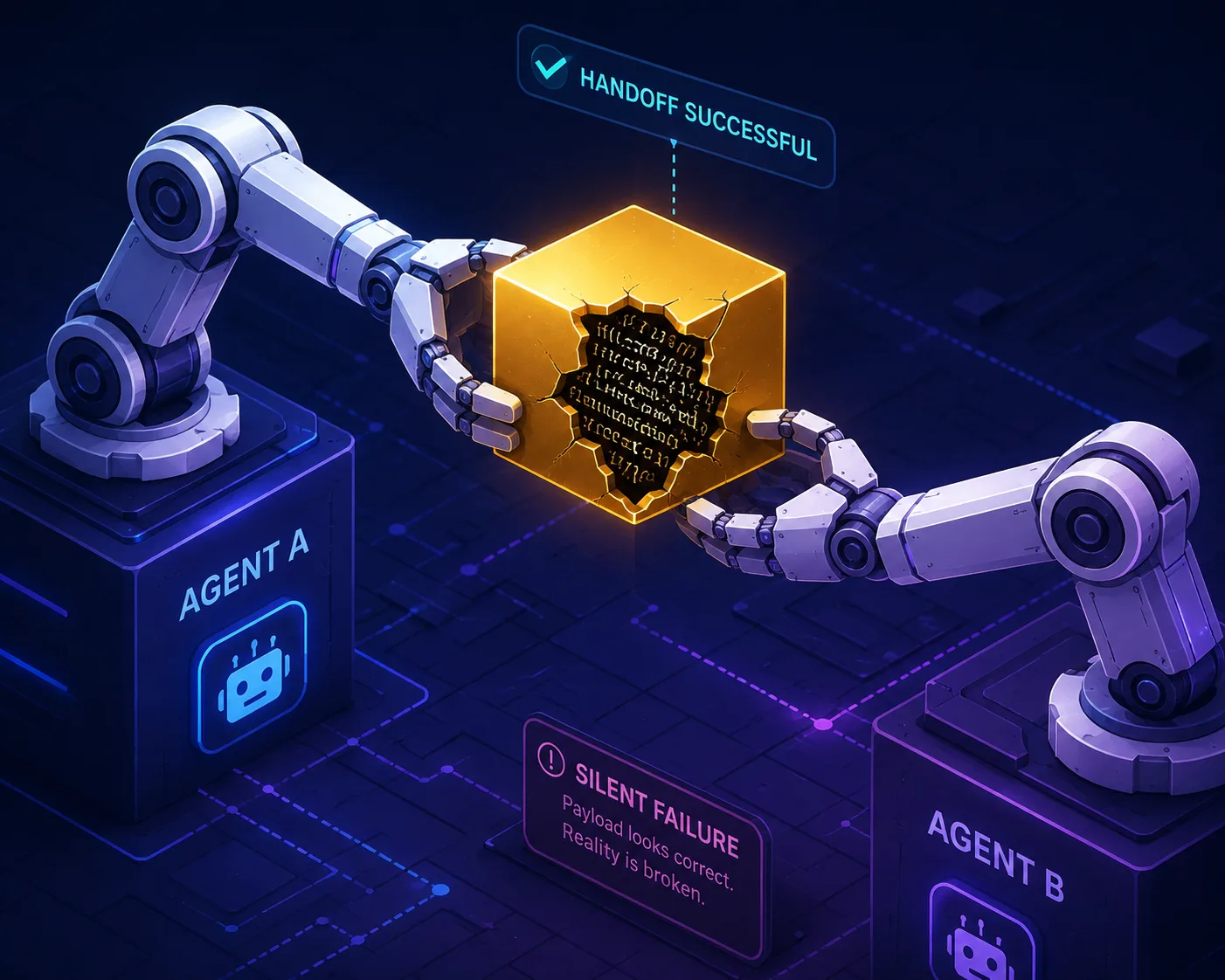
There is a particular kind of bug that haunts production AI systems, and it is the one that is hardest to find. It does not crash anything. It does not throw an error code. It returns a complete, well-structured response that looks exactly like a successful operation — and it is entirely wrong.
I have watched this pattern repeat itself across dozens of agent-based architectures. The most common setup involves three or more agents chained together, where each one is responsible for a discrete step in a larger workflow. Picture a customer support system that routes tickets, looks up billing history, and then drafts a resolution email. Each agent handles one slice of the work and passes its result to the next.
On paper, this is elegant. In practice, it introduces a subtle vulnerability that almost no one is watching for.
### How the Breakdown Actually Happens
Consider what occurs when a billing API call returns an empty dataset. The request succeeded, meaning the HTTP status code is 200, and the JSON structure is perfectly valid. There is no timeout, no malformed field, nothing that would trip a conventional error handler. The downstream agent receives this empty result, interprets it as “no billing activity exists for this account,” and moves forward with that assumption.
The final output reads perfectly. It is polite, well-formatted, and technically coherent. From the perspective of the last agent in the chain, everything functioned as designed. The problem originated several steps earlier, but by the time the wrong information has traveled through the pipeline and emerged as a polished response, the original corruption is invisible.
And here is the part that should concern anyone building these systems: nobody notices. The customer receives an incorrect resolution. No alert fires. No error log records the issue. From the system’s point of view, the pipeline completed its job without a single failure.
### Why Standard Testing Misses This Entire Category of Bugs
Most evaluation frameworks for agent systems focus on the final output. You grade the response for tone, accuracy, format, and relevance. A human reviewer might skim a batch of outputs and approve them. The problem is that all of these checks happen at the same layer — the compiled result.
Nobody is examining what happened in the middle of the pipeline. The intermediate JSON objects, the tool calls, the data transformations between agents — none of that gets scrutiny unless something fails loudly enough to leave a trace in a log.
Think of it through the lens of traditional software engineering. You would never ship a compiled application and call it tested simply because the login screen rendered correctly. You would test the database query underneath it, the authentication token it generates, the permissions check it triggers. The user interface is where a bug finally becomes visible, not where you would reasonably look for the root cause.
AI agent pipelines suffer from the same blind spot, except there is no user interface at all. The final text response is the only artifact most teams bother to evaluate, because it is the only one that is straightforward to assess. The tool calls, the data handoffs, the intermediate reasoning — these all exist in a gray area where nobody has built the habit of looking.
### A Different Approach: Evaluating What Happens Between Agents
The solution is not to write a better rubric for the final output. It is to move evaluation into the pipeline itself, specifically at the points where one agent’s output becomes another agent’s input.
I have been referring to this as intermediate state evaluation, and the concept is straightforward. Place a lightweight grader between every pair of agents in the chain. Its job is singular and narrow: examine the handoff data and decide whether it looks reasonable before allowing it to proceed.
In the billing support example, this watchdog would sit between the history lookup agent and the resolution drafting agent. It would ask itself one question: does the data being passed forward actually make sense given what was requested upstream?
The grader checks whether the account identifier in the payload matches the one that was originally requested. It examines whether an empty billing history is plausible for an active subscription. It flags results that look like fallback defaults rather than genuine lookup outcomes.
Critically, this does not require a large language model. A small, fast model running locally can handle this kind of shape-level and plausibility-level judgment with sufficient accuracy. The key design principle is that the grader does not need to be clever — it needs to be fast and decisive. A binary verdict is all that matters: does this handoff look trustworthy, or should it be stopped and investigated?
### Keeping It Practical
The implementation does not need to be elaborate. A Pydantic schema defining the expected structure of the handoff data gives the grader something concrete to validate against. A narrow prompt that asks one specific question keeps inference costs low. A simple exception mechanism stops the pipeline when something looks off instead of letting corrupted data flow through silently.
The code itself is deliberately unremarkable. The value is not in any single sophisticated component. It is entirely in the decision to place a checkpoint at the exact point where corruption is most likely to go undetected — the seam between two agents.
### The Real Trade-Offs to Understand
Every approach has costs, and this one is no exception. There are three specific trade-offs worth thinking through before adopting this pattern.
First, latency increases. Every checkpoint adds an inference call on the critical path. For a three-agent pipeline, that is two additional hops that the data must pass through before reaching the final output. If response speed is a core requirement for your product, this matters.
Second, you create a new source of problems. A watchdog with poorly tuned thresholds can start rejecting handoffs that are perfectly valid. This trades silent corruption for false alarms, and both are undesirable. Finding the right balance requires real experimentation and iteration, not a single configuration pass.
Third, it demands judgment about where to place these checks. Not every handoff between agents warrants a grade. The ones that sit immediately before an external-facing action — sending an email, charging a payment, updating a record — are the ones where the cost of catching a bad handoff clearly justifies the overhead. Everywhere else, you risk adding complexity for marginal benefit.
### Where to Start
If you are already running a multi-agent pipeline and want to experiment with this approach, the best advice I can give is to resist the urge to instrument everything at once.
Begin at the very last handoff before something leaves your system and touches the real world. The checkpoint right before a customer-facing email is sent, the gate just before a refund is processed, the guard immediately preceding a database write that creates a permanent record. That single boundary is where the consequences of a bad handoff are most severe, and it is where you will learn the most from even a minimal implementation.
Run that one checkpoint for a couple of weeks. Observe what it catches. Use those findings to decide whether extending the pattern deeper into the pipeline is worth the added complexity.
You do not need the full architecture on day one to get meaningful value from this approach. Sometimes the most important question is not whether your system can produce a polished final answer, but whether the path it took to get there can be trusted.
The output can always look correct. The intermediate trajectory is where the truth lives.
—
## Frequently Asked Questions
**What exactly is intermediate state evaluation?**
It is a practice of inserting lightweight validation checks at the points where one agent passes data to another in a multi-step pipeline. Rather than only grading the final output, these checkpoints examine the handoff data for plausibility, consistency, and structural correctness before allowing it to continue downstream.
**Why are standard evaluation suites unable to catch these failures?**
Standard suites evaluate the completed response — its tone, accuracy, and format. They operate on the final layer of the system. A failure that originates in an intermediate step but produces a grammatically correct and well-structured final output will pass every conventional test, because the evaluation never looks at what happened between agents.
**Do I need a large language model to run these checkpoints?**
No. In fact, a smaller, faster model is usually the better choice. The checkpoint only needs to perform narrow, well-defined judgment tasks like comparing identifiers, checking plausibility conditions, and flagging anomalies. Keeping the model small reduces both latency and cost, which is essential for placing checks on the critical path.
**How do I decide which handoffs in my pipeline need a watchdog?**
Prioritize any handoff that sits immediately before an action with real-world consequences — sending an email, processing a payment, writing to a database, triggering a notification. Handoffs that feed into purely internal reasoning steps that are later overwritten or refined are lower priority and may not justify the overhead.
**What happens when the watchdog incorrectly rejects a valid handoff?**
This is a known trade-off. A misconfigured or poorly calibrated watchdog can create false halts, blocking the pipeline on data that is actually correct. This needs to be treated as its own operational problem: monitoring the rejection rate, reviewing false positives, and iterating on the grader’s thresholds over time.
**Is this approach applicable to any multi-agent architecture?**
The principle applies broadly, but the practical implementation should be tailored to the specific pipeline. Systems with more than two sequential agents benefit most, since the risk of silent corruption compounds with each additional handoff. Even two-agent systems can gain value if the final output has external consequences.
**Can I implement this without a complete rewrite of my existing pipeline?**
Yes. The pattern is designed to be incrementally adoptable. Start with a single checkpoint at the most critical boundary, observe the results, and expand from there. There is no requirement to instrument every handoff in the system simultaneously.
—
## Conclusion
Multi-agent systems are powerful, but their strength — the ability to break complex tasks into specialized, independent steps — is also the source of their most insidious failures. When an intermediate node quietly returns plausible but incorrect data, the entire downstream chain builds on a corrupted foundation and produces an output that looks flawless on the surface.
Intermediate state evaluation addresses this by shifting some of the quality assurance work away from the final output and toward the seams between agents. It acknowledges a simple truth: the trajectory of data through a system matters as much as the destination it arrives at.
The approach is not without costs — added latency, new failure modes for the watchdog itself, and the ongoing judgment of where to place checkpoints. But for systems where the consequences of a wrong output are material, the trade-off is worth considering seriously.
Start small, instrument the most dangerous boundary in your pipeline, and let what you observe guide your next steps. The most dangerous bugs in a multi-agent system are the ones that never look like bugs at all.
Thank you for reading
