



**WordPress Critical XSS Vulnerability (CVE-2026-64638) Explained: From XSS to Remote Code Execution**
A critical security vulnerability has been identified and patched in WordPress, the world’s most popular content management system. Designated as **CVE-2026-64638**, this pre-authentication reflected cross-site scripting (XSS) flaw is rated **8.9 on the CVSS scale** due to its extreme severity. What makes this vulnerability particularly alarming is that it can be chained to achieve Remote Code Execution (RCE), allowing an attacker to take complete control of a website.
### The Vulnerability: XSS to Shell
Discovered by the security firm **pwn.ai**, the flaw resides in WordPress’s login screen. Unlike typical XSS vulnerabilities that require a user to click a malicious link, this one is incredibly dangerous because it requires **no authentication**. An attacker can trigger the malicious script simply by crafting a specific username and waiting for a victim—typically an Administrator—to visit a compromised or attacker-controlled page.
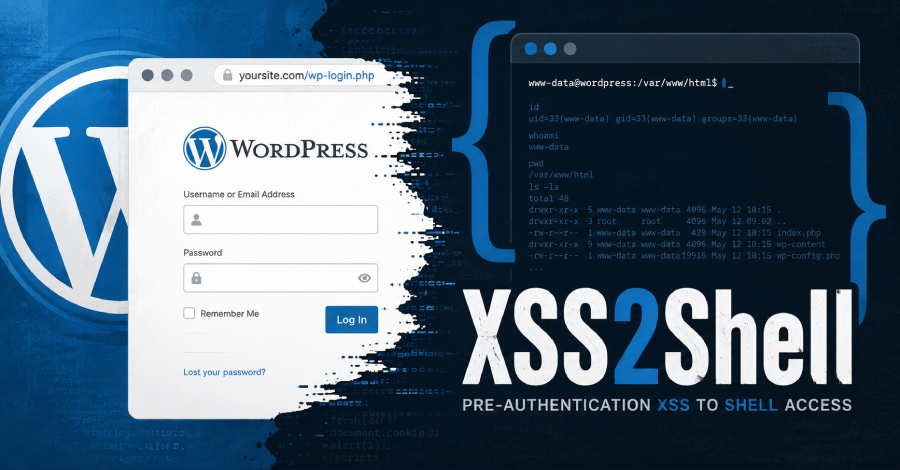
The attack chain, which pwn.ai has dubbed **”XSS2Shell,”** works as follows:
1. **The Trigger:** A victim logs into WordPress and enters a malicious username during a failed login attempt.
2. **Bypassing Filters:** The input passes through several WordPress sanitization functions (`sanitize_user()`, `wp_strip_all_tags()`, and `wp_kses_post()`). Due to inconsistent parsing, a specially crafted string that appears as text to one filter is interpreted as executable HTML/DOM elements by another.
3. **Exploiting Internal Scripts:** This injected live DOM then interacts with WordPress’s internal `user-profile.js` script, which is loaded on the login page for password reset functionality.
4. **Gaining Control:** The script manipulates an undefined variable and clobbers the `ajaxurl` variable. This steers WordPress’s own JavaScript into making an unauthorized REST API request.
5. **Execution:** Using WordPress’s JSONP support and techniques from prior research (SOME), the attacker can turn this request into JavaScript execution within the site’s context. In a demonstrated exploit, this allowed the attacker to create an Application Password, upload a malicious plugin ZIP file, and ultimately execute arbitrary PHP code on the server.
### The Impact and Risk
According to WordPress’s own advisory, successfully escalating this XSS to full RCE requires specific conditions, including an active Administrator session and social engineering to get the victim to visit the malicious page. However, pwn.ai’s research shows the chain is feasible and has been reproduced in a controlled environment.
A successful attack would allow an attacker to:
* Steal WordPress database credentials from `wp-config.php`.
* Create persistent administrator accounts.
* Modify website content at will.
* Execute operating-system commands with the web server’s privileges.
### Patching and Recommendations
The vulnerability was patched in **WordPress 7.0.3** on August 6. The fix has also been backported to the supported 4.7 branch. WordPress officially recommends that all users **update immediately**.
* **If you have automatic background updates enabled, your site should update automatically.**
* **If you are running a version older than 4.7, you are still vulnerable and should update to the latest version of the 4.7 or 7.0 branches as soon as possible.**
* The researchers noted that common hardening measures are unlikely to fully mitigate this specific XSS flaw, making the security update essential.
### FAQ
**Q1: What is the severity of this vulnerability?**
A: It is rated **8.9/10** on the CVSS scale, making it a Critical vulnerability.
**Q2: Does this require user interaction?**
A: Yes, the initial XSS requires a victim who is already logged in as an Administrator to interact with a malicious page (e.g., by clicking a link). However, the subsequent code execution chain is triggered by that single interaction.
**Q3: Which WordPress versions are affected?**
A: All versions are theoretically vulnerable, but the fix is available for WordPress 7.0.3 and later, with backports to 4.7 and above. Versions older than 4.7 are not covered by the backport program.
**Q4: What is “XSS2Shell”?**
A: It is the name given by the pwn.ai research team to the complete attack chain that leverages an XSS flaw to achieve Remote Code Execution on a WordPress server.
**Q5: What should I do to protect my site?**
A: The most critical step is to **update WordPress to the latest version (7.0.3 or newer)** immediately. If you manage multiple sites, ensure they are all patched.
### Conclusion
The discovery of CVE-2026-64638 serves as a stark reminder of the evolving sophistication of web attacks. What begins as a relatively common reflected XSS flaw can be weaponized into a full Remote Code Execution exploit. While the technical chain is complex, the fix is straightforward. WordPress users must treat this as a top-priority update. Applying the latest security patch is the only effective way to neutralize this powerful and dangerous vulnerability.
