



**Understanding the UNC6671 Cyber Extortion Threat: Vishing Attacks on Financial and Enterprise Systems**
A new and sophisticated wave of cyber attacks has been sweeping through financial services, private equity firms, and professional services sectors. The campaign is being orchestrated by a data extortion group identified as UNC6671, which has rapidly evolved from a mysterious threat cluster into a major operational force within the cybercrime landscape. Operating primarily through voice phishing (vishing) and leveraging highly targeted social engineering, UNC6671 has demonstrated a disturbing proficiency at breaching enterprise security postures without ever needing to exploit a software vulnerability.
### The Mechanics of the Attack
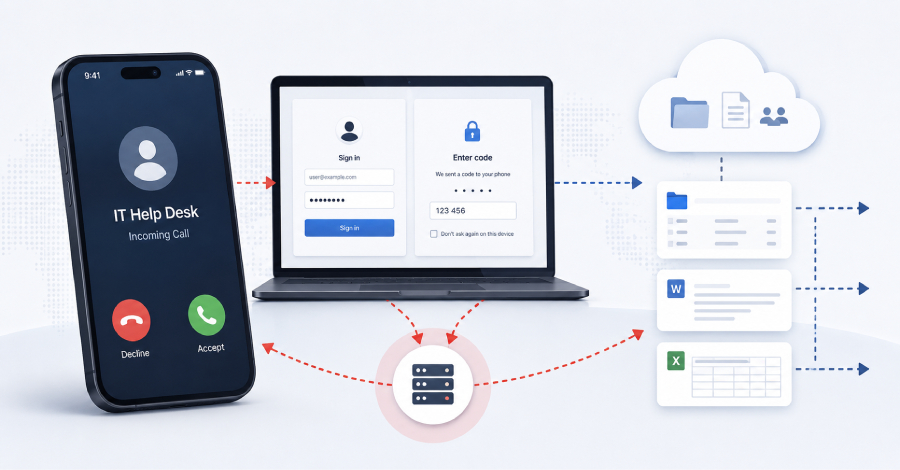
UNC6671’s primary vector of entry is the telephone. The group specifically targets enterprise employees, often impersonating IT help desk staff or technical support personnel. These calls are meticulously crafted to create a false sense of urgency, typically centered around mandatory security migrations, account issues, or software updates. The ultimate goal is to convince the victim to transfer to a spoofed login portal.
Once the victim interacts with this fraudulent portal, the group deploys adversary-in-the-middle (AitM) infrastructure. This sophisticated technique intercepts not just the user’s password, but also the critical multi-factor authentication (MFA) tokens generated during the login process. With these stolen credentials, the attackers can establish a persistent foothold within the network.
Following initial access, UNC6671 utilizes automated scripts—primarily written in Python and PowerShell—to conduct widespread data exfiltration. Their focus is on cloud environments and Software-as-a-Service (SaaS) applications, most notably Microsoft 365 and Okta. Crucially, the group does not just steal data; they also establish long-term access by registering their own malicious MFA devices onto compromised accounts, effectively locking out the legitimate user and removing existing security measures.
### Evolution and Escalation
The group operates under a modular and adaptable brand strategy. Rather than remaining static, UNC6671 has cycled through numerous public extortion brands, including Redact, Pink, Helix, and Falcon. This tactic serves to compartmentalize their operations, confuse investigators, and allow for flexible negotiation strategies. Their most recent evolution saw the retirement of the BlackFile brand, which was shut down in May 2026 after a period of intense activity targeting high-value organizations.
Their targets have also shown a worrying progression. Initially, the group focused on large-scale enterprises in manufacturing, real estate, and healthcare. However, their focus has shifted toward technology, transportation, hospitality, and ultimately, high-value financial and legal organizations. This strategic targeting suggests a move toward maximizing the financial impact of their operations.
The financial scale of UNC6671 is significant. Tracking between January and May 2026 revealed over $10.6 million in Bitcoin payments flowing to the group’s wallets. Initial ransom demands are astronomical, often exceeding $3 million, though negotiations typically result in substantial reductions. On average, the group has settled for around $750,000 per successful extortion event, indicating a high success rate and a willingness to engage in complex, protracted negotiations.
### Mitigation and Defense
Given the reliance on social engineering rather than technical vulnerabilities, traditional perimeter defenses are largely ineffective against UNC6671. Security experts emphasize that the success of these attacks highlights a critical failure in perimeter-based security models.
To combat this threat, organizations are advised to implement a multi-layered defensive strategy:
* **Phishing-Resistant MFA:** Moving beyond SMS or authenticator apps to hardware-based security keys or FIDO2 security keys is paramount.
* **Strong Identity Governance:** Implementing robust session controls, restricting authentication to trusted network sources, and enforcing corporate-managed devices for access.
* **Enhanced Monitoring:** Vigilant monitoring of Identity Provider (IdP) logs for suspicious MFA registration events and deploying tools that can alert if corporate password hashes are entered into unauthorized domains.
* **Employee Training:** Regular training to help employees recognize vishing attempts, specifically regarding the tactic of being called on personal mobile numbers.
### Conclusion
The rise of UNC6671 represents a paradigm shift in cyber extortion. By combining sophisticated vishing techniques with a franchise-like business model, they have created a resilient and highly profitable criminal enterprise. Their ability to bypass even modern MFA solutions through sheer social engineering prowess is a stark reminder that the weakest link in any security chain is often the human element. For organizations, the imperative is no longer just about building higher walls, but about fostering a culture of security awareness and implementing identity-centric defenses that render stolen credentials useless. The UNC6671 threat is not just a temporary anomaly; it is a clear indicator of the future of financially motivated cybercrime.
—
### FAQ
**Q1: What is UNC6671?**
A: UNC6671 is a data extortion group responsible for a wave of cyber attacks targeting financial, legal, and professional services. They are known for using “vishing” (voice phishing) calls to trick employees into handing over credentials and MFA tokens, which they then use to steal data and demand ransom.
**Q2: How does the UNC6671 attack work?**
A: The attack typically begins with a phone call from an attacker posing as an IT help desk representative. The caller creates a false sense of urgency to get the victim to visit a fake login page. There, the attacker intercepts the victim’s password and MFA code. Using this access, they deploy scripts to exfiltrate data from cloud services like Microsoft 365 and Okta.
**Q3: What makes this group different from others?**
A: UNC6671 is notable for its operational scale and adaptability. They constantly change their public “extortion brand” (e.g., Redact, Pink, Falcon) to compartmentalize their operations. Furthermore, they have shown a willingness to move from targeting general enterprises to specifically pursuing high-value financial and legal targets.
**Q4: Why are personal mobile numbers being used?**
A: The group often calls employees on their personal phones to bypass corporate security controls and create a more personal, deceptive interaction. Spoofing legitimate help desk numbers makes the call appear trustworthy and helps lower the victim’s defenses.
**Q5: How can my organization defend against this threat?**
A: Defense requires a shift from perimeter security to identity security. Key measures include implementing phishing-resistant MFA (like security keys), enforcing strict session controls, monitoring for abnormal MFA registrations, and conducting specific training to educate employees on the risks of vishing attacks.
**Q6: Have any groups claimed they are not part of UNC6671?**
A: Yes, the group “Falcon” has publicly claimed to be an exclusive affiliate of “Redact” and stated that it is not associated with UNC6671. However, security researchers note that the initial infection vectors and overall goals of these groups remain consistent with the UNC6671 campaign.
