



**The Exception That Proves the Rule: Why Kimi K3’s Open Report Matters**
Modern frontier labs usually operate in strict confidence: the public sees only the model’s outputs, while the critical work—how the model was trained, what reinforcement learning runs were used, and how training was made cheap enough to serve—remains proprietary. Kimi K3, the open 2.8-trillion-parameter mixture-of-experts model from Moonshot AI, is a rare exception. Alongside the model weights, Moonshot published a detailed 47‑page technical report that pulls back the curtain on the systems and methods that make a frontier model work. What becomes clear is that the model itself is only a small part of the story; the surrounding engineering, environments, and infrastructure are where the real effort lies.
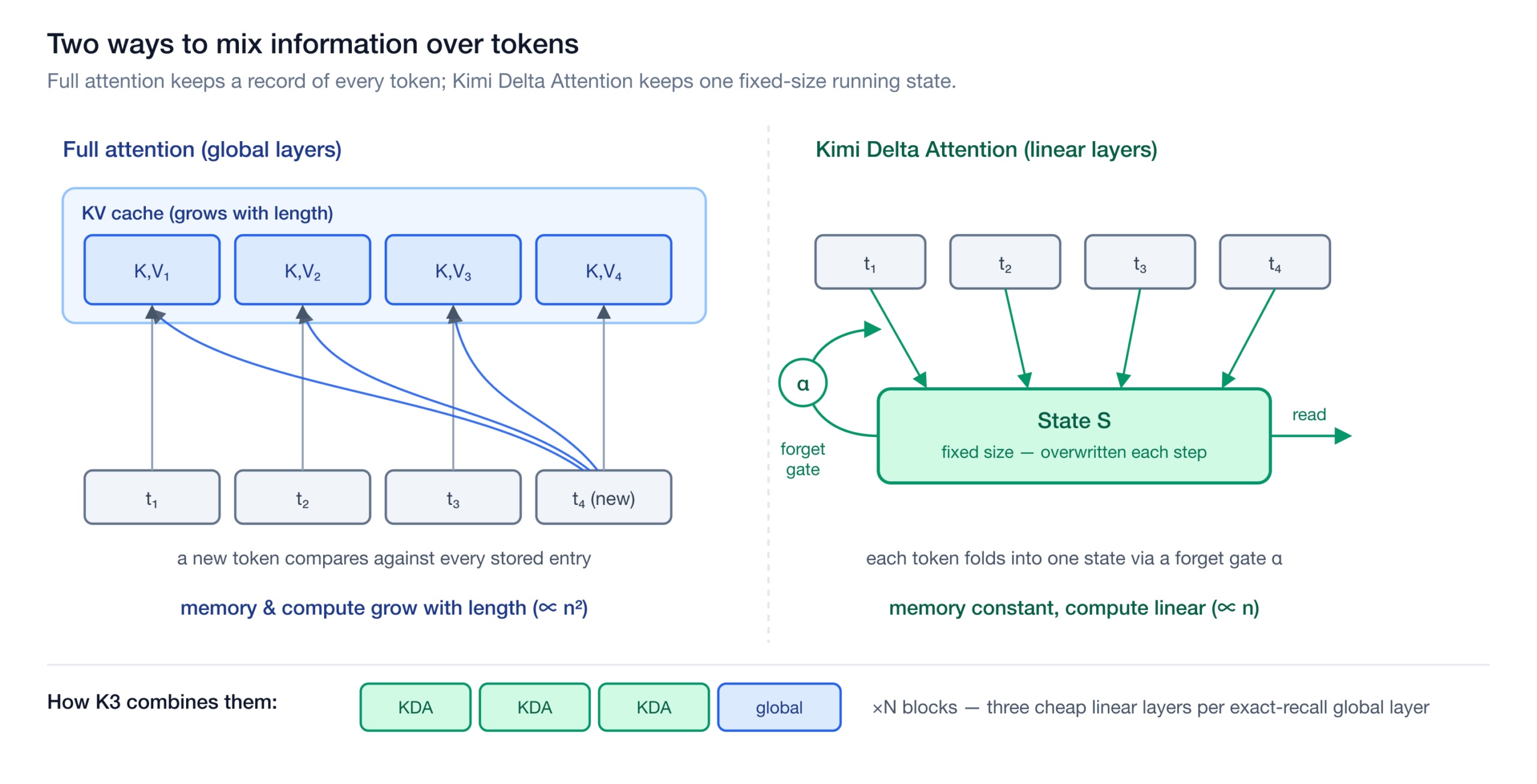
The architecture relies on a stack of familiar ideas rather than a single breakthrough: fixed‑size running states for cheap long‑context attention, attention residuals that allow layers to read earlier outputs directly, and sparse mixture‑of‑experts that lets capacity scale without proportional compute costs. These ordinary techniques—when combined and executed with care—deliver strong benchmark performance at a fraction of the cost.
Beyond the model, the report details the extensive reinforcement‑learning setup, with environments that check their own correctness, adversarial verifiers, and controllable task generation built from self‑grown knowledge graphs. Moonshot also explains how they train multiple specialist models across different reasoning efforts and then distill them into one deployable model. On the systems side, the work is substantial: custom kernels, efficient memory management, and serving optimizations such as prefix caching and request‑size budgeting are what make low‑cost, long‑context serving possible.
Independent evaluations confirm the outcome. Kimi K3 ranks among the top frontier models on capability benchmarks and is the strongest open‑weight model on several public leaderboards. It also delivers strong cost‑efficiency and competitive security results, including real vulnerability findings in widely deployed software.
**FAQ**
**Q: What is Kimi K3 and why is the report notable?**
A: Kimi K3 is an open 2.8‑trillion‑parameter mixture‑of‑experts language model with a one‑million‑token context window. The report is notable because Moonshot published detailed technical information—training data, reinforcement‑learning environments, architecture choices, and serving strategies—rather than keeping these details proprietary.
**Q: What are the three main architectural innovations in K3?**
A: The three ideas are: (1) fixed‑size running state attention with a forget gate, which keeps long‑context costs linear; (2) attention residuals, which allow layers to read earlier layers directly and reduce depth bottlenecks; and (3) mixture‑of‑experts with 896 experts and 16 active per token, scaling capacity without proportional compute costs.
**Q: How does K3 achieve efficient long‑context handling?**
A: By replacing a growing key‑value cache with a fixed‑size summary that updates at each step, removing positional encodings by carrying position through recurrence, and using a small number of full‑attention layers sparingly. This makes million‑token contexts affordable.
**Q: How does Moonshot train K3 efficiently?**
A: Training happens in three stages: supervised fine‑tuning, reinforcement learning across nine specialist models (three domains × three effort levels), and multi‑teacher on‑policy distillation into a single model. Reinforcement learning uses carefully built environments with verifiers and token‑budgeted reasoning effort to shape behavior.
**Q: What are the reinforcement‑learning environments used for?**
A: Environments include code‑correctness suites with speed and correctness rewards, security‑aware hacking detectors, and agentic tool‑use simulations such as mock Gmail, Notion, Slack, and Canvas where the model must plan and act over long horizons with verification and budget constraints.
**Q: How does task generation scale for training at this level?**
A: Moonshot grows a knowledge graph automatically as agents explore concepts, then samples from this graph to create tasks. The synthesis agent converts retrieved documents and queries into training examples, allowing controlled specialization and coverage of the training distribution.
**Q: What is the cost and performance of serving K3?**
A: K3’s per‑request serving cost is low by design, with reported prices roughly half of the nearest closed model on benchmarks and an order of magnitude cheaper than premium closed‑model settings. Much of this comes from prefix caching, cache‑aware routing, and request‑size budgeting.
**Q: How does K3 compare to leading closed models?**
A: On absolute capability, K3 trails the very best closed models such as Claude Fable 5 and GPT‑5.6 Sol, but it ranks third in composite intelligence indexes among all models and first among open‑weight models on several public benchmarks.
**Q: What security results does the report highlight?**
A: On vulnerability discovery, about 70% of findings that went to human review were confirmed real, including previously unknown bugs in Linux kernel components. On exploit‑writing tasks, K3 solves significantly more challenges than comparable open models, though it still struggles with hardened targets.
**Q: Why don’t closed labs publish this kind of detail?**
A: The core architectural ideas are not proprietary, but the environments, reward functions, data pipelines, and infrastructure are the hard‑to‑copy advantages. Sharing weights opens the model to copying, but the supporting systems—the “moat”—remain difficult to replicate quickly.
**Q: Who is this report most useful for?**
A: It is most useful for engineers and teams building with large models rather than training their own from scratch. The insights into evaluation, environment design, long‑horizon agentic workflows, and cost‑effective serving apply directly to production systems.
**Conclusion**
The Kimi K3 report demonstrates that modern frontier performance is as much about systems, environments, and training design as it is about model architecture. By open‑sourcing both the weights and the story behind them, Moonshot provides a rare, practical blueprint for how frontier language models are built and deployed. For builders, the key takeaways are the importance of robust evaluation, long‑horizon agent tooling, and serving optimizations like caching and request budgeting—areas that matter just as much in production as the model itself.
