



**Palm Garden AI’s Coherence Guard: A New Layer for Human-Facing Robots**
As service robots and humanoids advance beyond basic navigation and task execution, developers are confronting a more subtle challenge: how robots behave *around* people. Palm Garden AI is addressing this with **Coherence Guard**, described as a “platform-agnostic relational decision layer for human-facing robots.” Rather than replacing existing control stacks, Coherence Guard acts as an additional pre-action evaluator, assessing whether a robot’s next move is not just technically possible, but socially and relationally appropriate.
*“We saw the gap from two directions,”* explains Joachim Scheuerer, CEO of Palm Garden AI. Current robots often handle perception, motion planning, and task execution well, but the critical moment comes when they must decide *when to approach, when to pause, when to withdraw, and how to explain actions* in real human environments.
### What Problem Is Coherence Guard Solving?
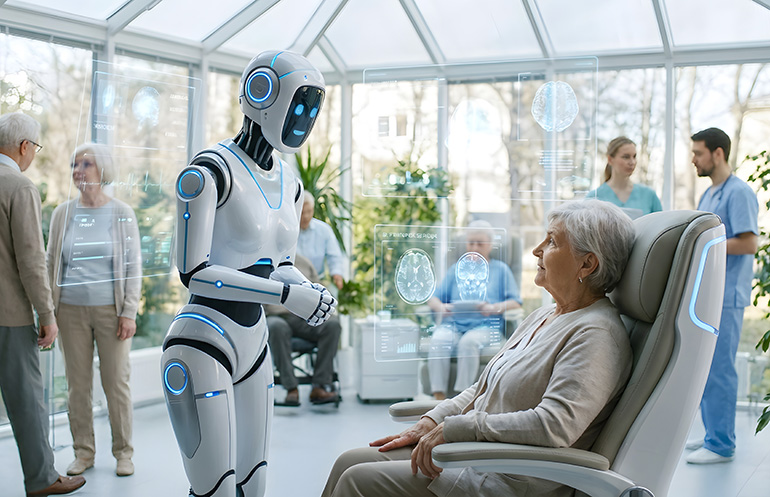
Coherence Guard is designed to solve the problem of **relational coherence**. In human-centric settings—hospitals, retirement homes, retail, education, and domestic spaces—robots encounter dynamic social cues. A gesture, tone of voice, or change in expression can signal discomfort, confusion, or a boundary. If ignored, these cues can undermine trust and safety, even if the robot’s technical performance is flawless.
*“While physical world models help AI systems understand objects, space, and movement, Palm Garden said its Relational Infrastructure Framework (RIF) adds an understanding of roles, intentions, vulnerabilities, and possible future consequences.”*
For example, “respectful withdrawal”—recognizing when a person asks for space and adjusting behavior accordingly—is one of the core benchmarks built into the system.
### How Does It Work?
Coherence Guard sits above or beside existing robot frameworks, including ROS 2, SDKs, and control systems. It does not take over motion or planning; instead, it evaluates candidate actions for relational appropriateness based on:
– Timing and proximity
– Boundary requests and emotional tone
– Trust preservation and respectful withdrawal
– The gap between technical possibility and social acceptability
The system is built on Palm Garden AI’s ANATTA 9 behavior infrastructure, running on the Transwarp Cloud Operating System (TCOS), and is complemented by the **Relational Infrastructure Framework (RIF)**, which adds awareness of roles, intentions, and future consequences.
### Who Is Behind This Work?
Palm Garden AI brings a background in human interaction, psychotherapy-related software, retreat facilitation, and relational training—not just robotics. *“We are not a traditional academic HRI lab,”* Scheuerer notes. Their expertise informs behavior patterns such as greeting, supportive presence, non-intrusive assistance, and escalation under uncertainty.
### Compatibility With Safety and Standards
Coherence Guard is designed as a **complement to**, not a replacement for, formal safety systems.
> *“Certified robot safety must remain at the hardware, control, emergency-stop, collision-avoidance and risk-assessment levels.”*
As humanoid robots face evolving standards, Scheuerer sees Coherence Guard as a flexible, configurable layer that can support auditability, logging, scenario testing, and compliance across different environments. It can run locally on edge devices for low latency and privacy or connect to cloud components for analytics and fleet learning.
### Deployment and Partnerships
The company is pursuing a **local-first deployment model**, prioritizing real-time decisions on-device while using the cloud for updates and analysis. They are also conducting simulation-first pilots, using logic and platform simulations to test behaviors before real-robot trials.
Palm Garden AI is in active technical evaluation with several robotics providers, including Robotera and Hanson Robotics, exploring integration paths with ROS 2, NVIDIA Isaac, and GR00T-style environments. These partnerships remain in technical evaluation and pilot stages rather than full commercial deployment.
—
## FAQ
**What is Coherence Guard?**
Coherence Guard is a relational decision layer for human-facing robots. It evaluates whether a robot’s next action is socially and contextually appropriate—considering timing, proximity, emotion, and trust—before or during execution.
**Does it replace existing robot control systems?**
No. It is designed to sit above or beside existing stacks, including perception, planning, and motion control, without replacing them.
**What kinds of behaviors does it support?**
It supports greetings, orientation, guided assistance, respectful withdrawal, escalation when uncertain, and coherent explanations tailored to human cues.
**Where does Coherence Guard run?**
It can run on edge devices or on-premise for latency-sensitive or privacy-critical tasks, with cloud components used for simulation, analytics, and updates.
**Is it compatible with ROS 2 and humanoid platforms?**
Yes. It is built to integrate with ROS 2, SDK/API interfaces, and simulators like NVIDIA Isaac, and works with humanoid and service robot platforms.
**Is the software available now?**
The core IP is patent-pending and not open source, but integration interfaces are designed to be platform-agnostic. A licensed software model with optional SaaS components is expected.
**Is Coherence Guard a safety system?**
It is not a replacement for hardware or functional safety systems. Instead, it adds a relational and contextual layer that informs *how* a robot interacts with people.
—
## Conclusion
Palm Garden AI’s Coherence Guard represents an important step toward robots that not only *see* and *move* in human spaces, but also *understand* them. By focusing on relational coherence—timing, emotion, proximity, and respect—it helps service robots act in ways that feel safe, natural, and trustworthy. As humanoids move into elder care, hospitality, and everyday environments, layers like Coherence Guard may become essential infrastructure for responsible and effective deployment.
