



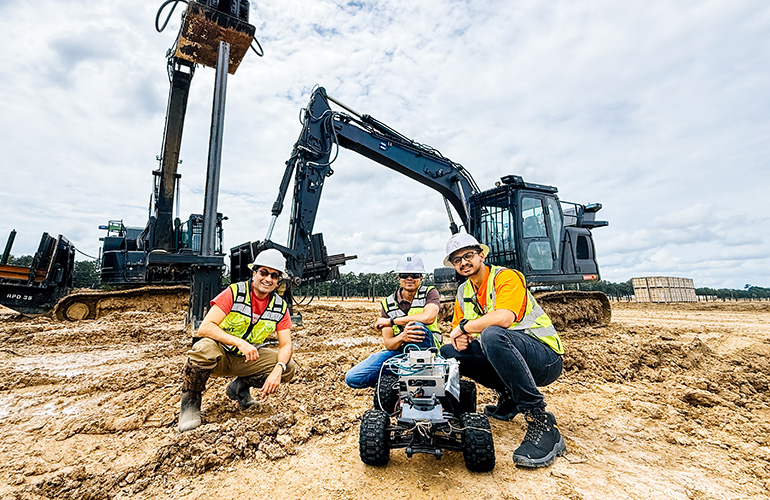
Compact mobile sensors designed by Built will map job sites and create a rich dataset, which will then be studied by researchers from the University of Pennsylvania’s xLAB. | Credit: Built Robotics
The Safe Autonomous Systems Lab (xLAB) at the University of Pennsylvania has formed a partnership with Built Robotics, aiming to transform construction zones into real-world testing environments for “physical AI.” Built intends to apply its extensive collection of construction robotics data, along with a newly developed robot built specifically for gathering information, to create a foundational world model. This framework will help define how machines and humans can work side by side safely in industrial settings.
Founded in 2016, Built Robotics has focused on creating self-driving capabilities for heavy construction machinery. The company made a move into the solar energy sector in 2023 with the launch of its RPD 35 system, also known as the Robotic Pile Driver. So far, the company has logged over 50,000 operational hours, contributed to more than 3 gigawatts of solar installations, and currently operates at more than 40 different locations.
Rahul Mangharam serves as a professor of electrical and systems engineering and leads xLAB as its principal investigator. Noah Ready-Campbell, the founder and CEO of Built Robotics, is a graduate of the University of Pennsylvania, making this collaboration a natural fit. While Mangharam is focused on addressing the complex safety challenges associated with automizing outdoor construction equipment, the alliance will ensure that real-world field data flows back to the university laboratory.
Standard construction robots typically observe only their immediate tasks. Built, however, intends to capture a much wider array of personnel and environmental variables. This involves logging unusual circumstances, such as unexpected worker postures, visual obstructions, variable lighting conditions, and unanticipated human actions.
“At xLAB, our goal is to engineer autonomous systems that are reliable enough for real-world use, and construction work represents one of the most challenging arenas for this research,” explained Mangharam. “The primary hurdle is moving from testing in controlled lab settings to achieving performance that holds up in unpredictable field conditions. Working with Built gives us direct access to live job sites where we can utilize precise mapping and live operational metrics. This will allow us to construct autonomous solutions that address genuine industry needs.”
“The safety infrastructure that xLAB has established is exactly the type of rigorous framework required for advanced physical AI,” stated Ready-Campbell. “We have honed our proprietary edge AI system for identifying personnel through some of the most rigorous work environments in existence—specifically, sprawling, active construction projects covering vast areas with large workforces.”
 Share your proposed session for the 2026 RoboBusiness Conference
By methodically gathering and categorizing these rare events, the team will develop AI systems skilled at spotting workers in irregular or challenging scenarios encountered on construction sites. This sophisticated training aims to push the edge AI model past typical human perception, allowing it to catch subtle, fleeting safety hazards that human eyes often overlook.
During an interview with The Robot Report, Ready-Campbell shared, “We belong to the Association of Equipment Manufacturers (AEM), specifically participating in their Futures Council. This council functions as a forward-thinking committee examining the future of physical AI and autonomous machines for construction. In our view, improved safety benefits the entire sector. An accident involving any robot, not just Built’s, would negatively affect the whole industry. We believe it is our responsibility to help everyone in the field work more safely.”
Ready-Campbell further mentioned that Erol Ahmed, Built’s Vice President of Communications, currently holds the position of chair for the AEM Futures Council.
Liam Osler, Built Robotics’ Director of Engineering for AI, added, “We share the same foundational belief as xLAB: that safety must be the first priority for any physical AI, and that this technology is about to revolutionize construction industry safety standards.”
The initial stage of this research venture will concentrate on spreading Built Robotics’ edge AI technology across a group of survey robots. These machines will be responsible for collecting high-quality sensor readings from active solar construction sites. The gathered information will be used to refine Built’s existing AI models and broaden their application to other types of vehicles and construction tasks.
“Penn Engineering is home to one of the world’s top robotics programs, and as my alma mater, it was the ideal place to start this partnership,” said Ready-Campbell. “The groundbreaking research by Dean Vijay Kumar on drone swarms and multi-robot teamwork at the GRASP Lab was hugely influential when I first launched Built. As our robot fleet has grown in the field, our shared goals with xLAB have become even more apparent. I am thrilled to be working with Professor Mangharam to establish a new standard for how physical AI is created, tested, and put into practice.”
