



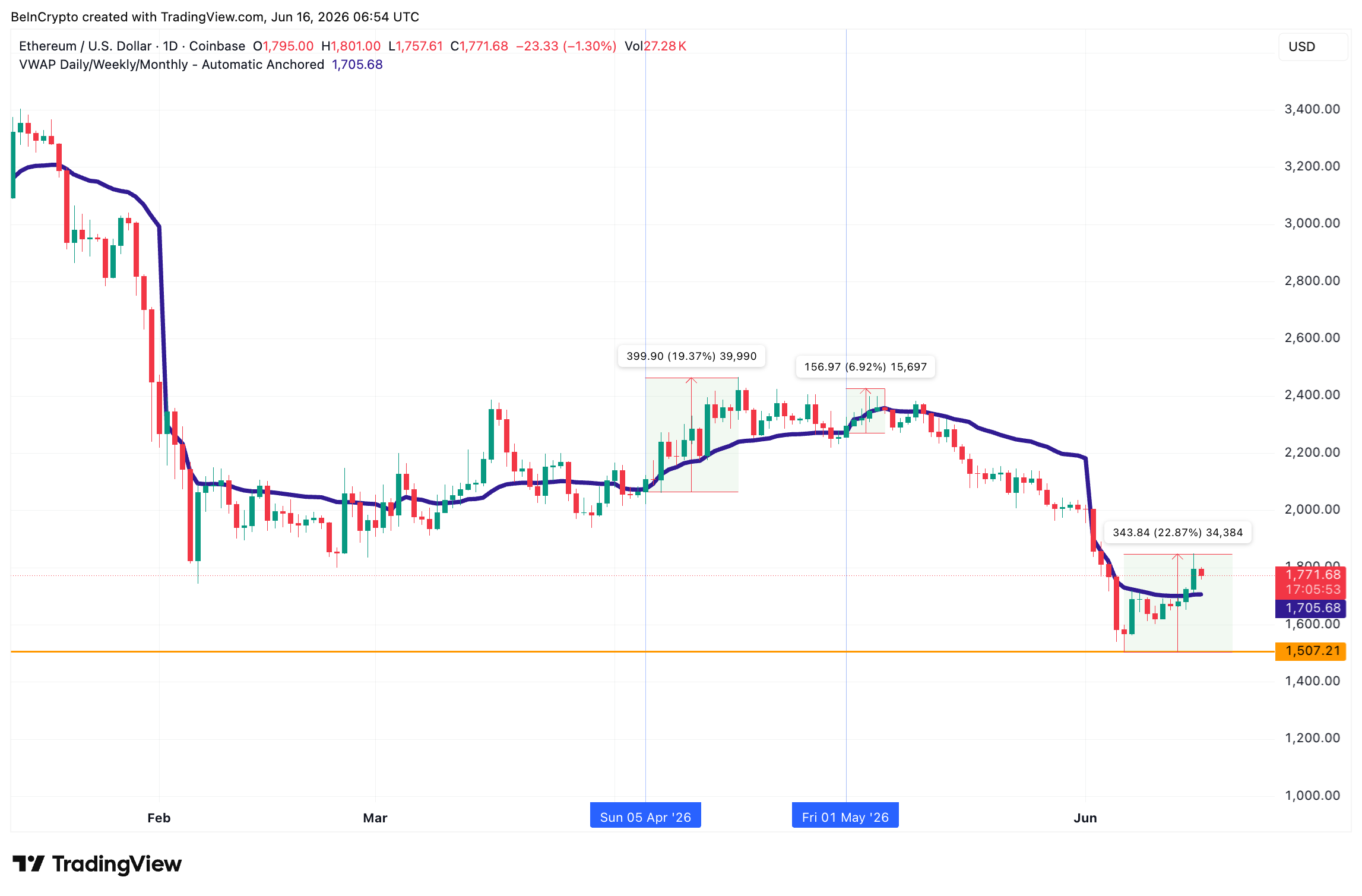
Ethereum (ETH) has bounced back 22% from its June low and crossed a key institutional trend line. This recovery coincides with spot ETF investments returning to ETH after weeks of withdrawals.
Large investors continued buying during the downturn, and on-chain accumulation is picking up again. However, increasing leverage raises a critical question: Is this a genuine market bottom or just another temporary bounce within a broader downtrend?
Ethereum Price Reclaims the Monthly VWAP Line
On June 14, Ethereum’s price closed above its monthly VWAP (Volume-Weighted Average Price), a metric many trading desks use to distinguish between accumulation and distribution phases.
This reclaim is significant because of historical patterns. When ETH crossed this line on April 6, it surged about 19% before pausing. A second reclaim around May 1 led to a smaller 7% gain.

Both previous reclaims shared a common trait: Spot ETF flows turned positive within days, suggesting the price movement attracted institutional money.

Whether this relationship is causal or simply reflects renewed optimism is unclear. Nevertheless, the pattern has repeated consistently.
Looking for more insights like this? Subscribe to Editor Harsh Notariya’s Daily Crypto Newsletter here.
This makes the latest ETF data the first indicator to monitor.
Spot ETF Flows Turn Green After a Brutal Streak
The shift came right on schedule. ETH spot ETF products attracted $22.50 million on June 15, just one day after the VWAP reclaim.
This positive flow breaks a painful streak. From May 11 to June 12, the funds experienced outflows on all but two trading days—a near-constant withdrawal period. The contrast with spring is stark. Early May saw strong inflows, including $101 million on May 1 and $98 million on May 5, before the bleeding began.

Total net assets now stand at approximately $10.04 billion. The return to inflows, though modest, mirrors what happened following the April and May reclaims. May’s extended VWAP reclaim saw multiple inflow days—something that could be expected now if the bottom theory holds.
However, ETF flows alone cannot confirm a bottom. For that, on-chain holder behavior matters more.
Whales Keep Adding as Capitulation Shows Signs of Exhaustion
Major holders believed in ETH even before it crossed the VWAP line. Whale accumulation continued rising throughout the decline. According to Santiment data, tracked addresses increased their holdings from about 124.85 million ETH on June 10 to roughly 125.4 million currently—representing approximately $950 million in purchases within a week.

On-chain flows support this buying activity. Heavy selling appears to have dried up around June 7, one day after the price formed a local bottom. That’s when the exchange net position change—a metric tracking coins moving to and from exchanges—shifted toward net outflows.
This shift indicates holders are moving coins into storage rather than selling them. It aligns with the whale buying mentioned above, as steady accumulation absorbed the last wave of supply hitting exchanges.
The outcome resembles seller exhaustion—the exact condition needed for a bottom call.

The broader context supports a potential bottom. Swissblock’s Altcoin Vector report describes ETH as trapped in a prolonged capitulation phase—a period of deep, sustained stress that often precedes market bottoms.
The firm notes that capitulation only creates bottoms once selling pressure begins to exhaust. It questions whether that exhaustion is approaching now. The exchange net position change metric suggests it might be.
However, one factor complicates the bottom call—and it lies in the derivatives market.
Key Ethereum Price Levels Surface
Here are the critical levels to watch. Ethereum’s price trades near $1,771, back above the monthly VWAP at $1,705 that it reclaimed on June 14. Price has climbed about 22% from the June low near $1,507. However, a confirmed bottom requires more evidence.
The crucial threshold sits at $1,851. A daily close above this level would validate the rebound and open room for further gains toward the previous range.
The complication is leverage. Open interest in ETH futures—the total value of outstanding contracts—has risen sharply. It increased from about $8.86 billion in early June to roughly $9.96 billion, briefly touching $10.27 billion.

A lasting capitulation bottom typically forms after leverage is flushed out and remains low. Here, the opposite is occurring—open interest is rebuilding while price climbs.
This suggests a leverage-driven bounce rather than pure spot demand. These crowded long positions are fragile. A sharp decline could trigger liquidations and force another wave of selling. Therefore, the capitulation may not be fully complete.
On the downside, $1,624 serves as the first support level, followed by the $1,507 low. A daily close below $1,507 would open the possibility of a new bottom.

Reclaiming $1,851 separates a confirmed bottom from another bounce that fades back below the VWAP.
The post Ethereum Whales Add $950 Million as Bottom Hopes Build, but the Story Has a Hole appeared first on BeInCrypto.
