



Follow ZDNET: Add us as a preferred source on Google.
Among all the docking stations I’ve put through their paces, the Baseus Spacemate RD1 Pro stands out as one of the most distinctive, packing in features you rarely encounter on competing docks.
Also: I tested the best laptop docking stations — here’s what I recommend for your office setup
Right away, it sets itself apart with a tilting wireless charging pad on top and a compact, high-resolution screen on the front. The best part? These extras don’t come across as mere novelties — they provide genuinely practical information for demanding work environments, on top of everything you’d expect from a premium docking station.
Best desktops deals of the week
Deals are selected by the CNET Group commerce team, and may be unrelated to this article.
All the ports
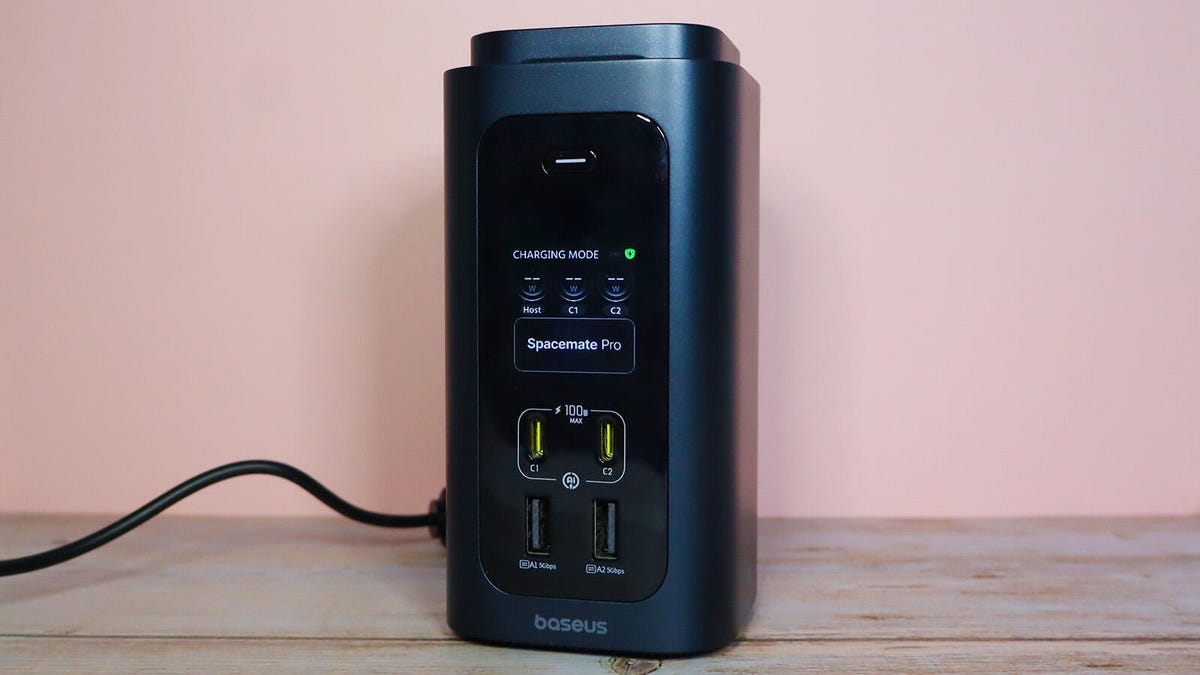
The Spacemate RD1 Pro is a fairly sizable docking station loaded with a comprehensive selection of ports and controls:
Front:
- 2 × USB-C (up to 100W PD)
- 2 × USB-A (5 Gbps)
- 240 x 240 display with control button (resolution TBD)
Back:
Also: MacBook Neo vs. Acer Swift Air 14: I’ve used both budget laptops — this model clearly wins
It’s a fully equipped docking station with rapid USB ports for near-instant file transfers and a full-gigabit Ethernet connection for low-latency networking. For the average user, this is overkill, but for power users, I’d say it’s nearly ideal.
Something you might not notice right away is the heat vents, which are part of its cooling architecture. The Spacemate RD1 employs a graphene-enhanced thermal structure paired with vents to efficiently shed heat. In my testing, the cooling system does a solid job of keeping temperatures in check. It got slightly warm during use, but never uncomfortably hot, and I didn’t observe any signs of instability caused by overheating.
Also: The best laptop cooling pads of 2026: Expert tested
What’s interesting about the dock is that it comes with two swappable power plugs: one for the US standard and one for the European standard. Both attach by sliding over the adapter’s pegs on the front. I found the US plug easy to remove — just press the button on top and it slides off.
The European plug, on the other hand, was surprisingly harder to detach. It uses the same release mechanism, but in my experience, it got caught on the pegs. I had to apply a fair bit of force to remove it.
For all its strengths, my biggest gripe with the Spacemate RD1 Pro is its power adapter. It’s enormous — nearly half the size of the dock itself — and you can’t leave it behind. The device can’t run solely on power drawn from a host laptop; it needs the adapter. Good luck finding room for it. I actually had to unplug my desktop PC from a power strip during testing just to make space for both the adapter and my monitor’s power cable.
You don’t see this every day
Without a doubt, the most eye-catching feature is the Qi 2.2 wireless magnetic charging pad on top. It delivers up to 25W of wireless charging power and can be adjusted to one of three angles: completely flat, roughly 45 degrees, or nearly upright. To take full advantage of this pad, make sure your mobile device supports the Qi standard — otherwise, you’ll be waiting a long time. I placed a 2026 Motorola Razr Ultra on top, which doesn’t support Qi 2.2, and it took roughly four hours to reach 50% charge from a fully depleted battery.
After that, I placed an older iPhone 13 Mini (which supports Qi) on top, and the recharge time to 50% was nearly halved: 2 hours and 14 minutes, to be exact. Faster speeds are possible, provided your mobile device supports Qi 2.2.
These numbers were recorded while the Spacemate was in Charging Mode. In Charging Mode, nearly all of the device’s features are disabled except for charging. You can’t transfer files or output a video signal. If you press and hold the button above the display for two seconds, it switches over to Hybrid Mode.
Operational modes
Hybrid Mode is the default setting and enables all of the dock’s functionality. You can connect external displays, transfer files between devices, and charge connected hardware. However, charging performance is limited compared to Charging Mode since power is being distributed across multiple devices.
Also: The 10 coolest laptops we saw at Computex 2026 — Video
I wanted to see how the Spacemate RD1 Pro handled real-world workloads, specifically multi-monitor setups and file transfers. Unsurprisingly, the dock performed admirably. It had no trouble driving high-resolution video signals. Text looked crisp on my HP Omen gaming monitor, colors appeared accurate, and I didn’t encounter any strange flickering or visual artifacts. It even adjusted the aspect ratio of the laptop’s video signal to match the monitor’s.
File transfer performance was equally impressive. Moving a 22GB movie from a WD_Black SN770M SSD to my laptop took roughly 43 seconds, while a separate 85GB transfer finished in approximately two minutes and 30 seconds.
A neat feature is the small 240 x 240 pixel RGB display on the front. It generates a visual map of your setup, detailing what’s plugged in and how power is being distributed. You’ll see things like the setup’s host device, connected peripherals, active displays, and real-time power delivery.
Also: I trusted Malwarebytes to secure my PC for a month — here’s how it performed
Multi-monitor support varies depending on whether you’re using a Windows or Mac device. Windows users get the most flexibility, since they can mirror a laptop’s screen, extend the video signal across multiple monitors, or have each screen run an independent video signal.
On macOS, you can only mirror content or extend the signal across the monitors, but you can’t have all three be independent from each other.
ZDNET’s buying advice
The Baseus Spacemate RD1 Pro is available from Amazon and Baseus for $300. To help soften the sticker shock, Baseus is currently offering a promotional discount on Amazon with the code BASEUSPR at checkout for $100 off.
Overall, the Spacemate RD1 Pro is one of the better docking stations I’ve used, and certainly the most unique. It’s a great combination of a generous port selection, thoughtful thermal management, and useful extras like its Qi2 wireless charging pad. If you’re looking for a more affordable alternative, consider the Baseus Nomos Air 12-in-1, with similar features, like the charging pad.
