




By Marc Kavinsky, Lead Editor at IoT Business News.
Fresh research from IoT Analytics suggests that unplanned downtime in industrial settings is no longer driven solely by equipment breakdowns — it is increasingly fueled by the erosion of hands-on maintenance expertise as veteran technicians head into retirement. The study highlights AI-powered knowledge capture, prescriptive maintenance strategies, and more comprehensive asset-health data as the emerging solutions to this growing challenge.
For a long time, the industrial IoT maintenance narrative has centered on forecasting: install sensors, track vibration or temperature readings, spot irregularities, and step in before a line goes down. That reasoning still holds, but it overlooks a very human bottleneck now surfacing on factory floors. Spotting an impending failure is only half the battle; understanding how to properly diagnose and resolve it is rapidly becoming just as important.
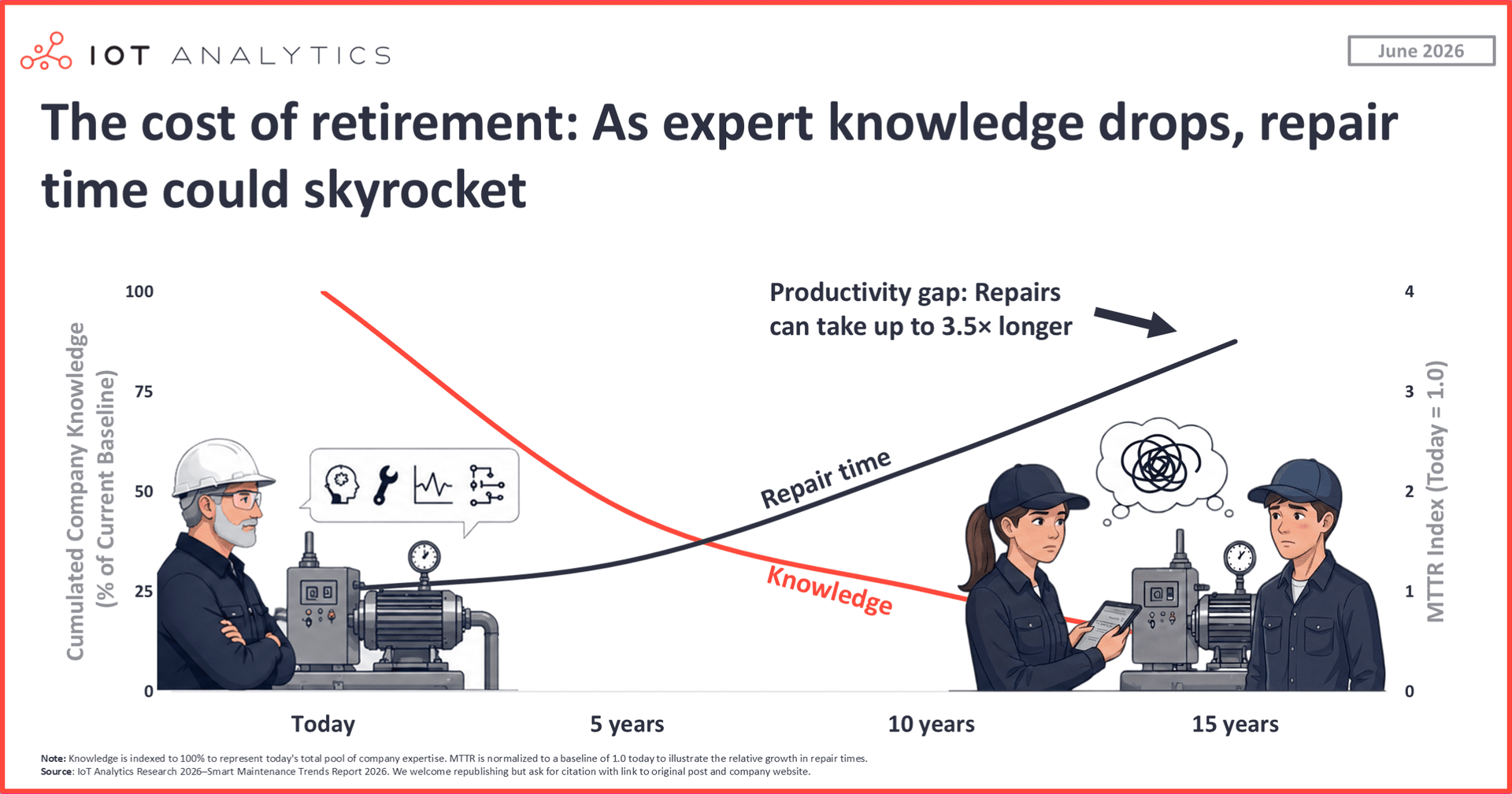
IoT Analytics’ newest study, informed by its forthcoming Smart Maintenance Market Report 2026 and insights gathered at Maintenance Dortmund 2026 and Hannover Messe 2026, frames this evolution in stark terms. The company estimates that unplanned downtime costs manufacturers roughly $1 trillion worldwide each year, yet contends that the next major maintenance hurdle is the loss of institutional knowledge — not just the limits of prediction accuracy.
The difference is significant. Most predictive maintenance conversations revolve around algorithms, sensors, or alert systems. The more nuanced trend identified here is the shift from simply detecting faults toward capturing the expertise of seasoned technicians: repair workflows, machine-specific troubleshooting instincts, calibration logs, standard operating procedures, and the kind of tacit judgment that traditionally resided only in the heads of long-serving maintenance crews.
From predictive alerts to institutional memory
The study highlights several vendors tackling this gap through different approaches. Bassetti Group’s TEEXMA for Maintenance is designed as a flexible CMMS platform with knowledge preservation at its core. Hexagon leverages AI to transcribe and organize video footage of veteran technicians at work, turning practical expertise into searchable content for less experienced team members. Augmented Industries’ Flow Tool transforms static machine manuals and SOPs into dynamic, interactive troubleshooting walkthroughs.
This represents a fundamentally different value proposition than simply boosting a predictive model’s F1 score. The real-world goal is to lessen reliance on any single person being on-site when equipment breaks down. For industrial operators, the logical takeaway is that maintenance AI initiatives will increasingly look like knowledge-management efforts just as much as data-analytics projects. The truly valuable asset isn’t just sensor readings — it’s the contextual understanding that converts an alert into a safe, effective repair.
IoT Analytics also draws attention to the growing adoption of prescriptive systems that go beyond flagging problems to recommending specific fixes. Infinite Uptime’s PlantOS, for instance, builds on predictive maintenance by layering in verified action plans such as swapping out a bearing or recalibrating lubrication. Nanoprecise has rolled out an LLM-driven analysis tier that connects equipment health issues to diagnostic procedures and suggested remedies. Emerson, for its part, is enabling operators to create custom AI agents that sift through available data streams and produce actionable operational guidance, while positioning fully autonomous AI control as a future evolution rather than a present-day standard feature.
Data quality is turning into the real AI challenge
The report’s most valuable caution is that AI cannot make up for shaky industrial data foundations. Disjointed asset hierarchies, inconsistent equipment naming conventions, calibration records trapped in spreadsheets, and scattered documentation all undermine the dependability of AI-assisted maintenance. IndySoft’s strategy of prioritizing clean internal records before layering on external LLM capabilities exemplifies this more measured philosophy. Hexagon, too, is restricting AI access to proprietary customer data until the risk of hallucinated outputs is more tightly managed.
For OEMs and industrial software providers, this reshapes what matters in product development. Competitive edge may come less from bolting on a chatbot and more from helping customers organize asset data, connect documentation to equipment profiles, and archive validated maintenance procedures. For system integrators, the focus shifts to constructing the knowledge bridge between operational technology data, IT systems, and day-to-day frontline processes.
Connectivity providers also have a part to play, especially as wireless sensing makes it cost-effective to monitor assets that were previously impractical to instrument. IoT Analytics points to expanding adoption of wireless vibration monitoring, while offerings from SKF, Status Pro Maschinenmesstechnik, WIKA, and Schaeffler illustrate varied strategies around battery longevity, radio protocols, retrofit monitoring, and broader asset-health ecosystems. The key takeaway isn’t that wireless supplants wired instrumentation — the report is explicit that wired and wireless layers continue to complement each other, particularly where safety requirements, extreme temperatures, or variable loads impose constraints.
Cloud architecture is becoming a maintenance product feature
Another tangible deployment hurdle is reluctance around cloud adoption. Many AI-driven maintenance platforms depend on cloud connectivity, yet European industrial operators in particular may push back against third-party cloud integration due to cybersecurity or data sovereignty concerns. Schaeffler’s approach of using cellular gateways to transmit sensor data straight to the cloud — sidestepping customer IT networks entirely — and Status Pro’s MQTT split configuration for directing data to private servers demonstrate how system architecture is evolving into a selling point in its own right.
For manufacturers, the practical lesson is clear: AI can help safeguard maintenance knowledge and accelerate repair timelines, but only if the underlying information is captured before experienced workers retire, organized into coherent structures, and woven into tools that technicians will genuinely rely on. Organizations that delay until after the expertise has already left the building will still be able to install sensors and run predictive models. What they may be missing is the institutional memory required to act meaningfully on the alerts those systems generate.
