



Today’s security teams face a rapidly shifting threat landscape. Ransomware, advanced persistent threats, and supply chain attacks are growing more sophisticated by the day. At the same time, organizations must secure hybrid environments that span on-premises infrastructure, multiple cloud platforms, containers, and Kubernetes clusters—all while meeting strict compliance standards like PCI DSS, HIPAA, GDPR, NIST 800-53, and CIS Benchmarks.
Security operations centers (SOCs) often deal with thousands of alerts daily, many of which turn out to be false positives. Analysts end up spending the bulk of their time chasing these false alarms instead of investigating genuine threats.
This leads to analyst burnout, longer mean time to detect (MTTD) and mean time to respond (MTTR), and security gaps that attackers can exploit.
Despite heavy investments in security tools, many organizations remain under-protected. Slow deployment means limited visibility during the critical onboarding window. Day-to-day infrastructure management pulls skilled analysts away from proactive threat hunting and toward patching, tuning, and cluster upkeep.
In fast-changing environments, performance issues and expensive re-architecture become routine. Meanwhile, rigid licensing models force teams to either pay for features they don’t use or go without capabilities they actually need.
This post examines these common challenges and shows how Wazuh Cloud addresses them. Wazuh Cloud is a fully managed, cloud-native version of the open-source Wazuh platform. It streamlines operations through automation, intelligent AI-powered analysis, and seamless scalability.
By eliminating infrastructure overhead and improving detection accuracy, Wazuh Cloud lets security teams focus on what truly matters: protecting critical assets in real time.
Challenges in modern security operations
Security teams frequently run into the following operational hurdles when deploying and running SIEM/XDR platforms:
- Lengthy deployment timelines: Setting up infrastructure, deploying agents across diverse endpoints, configuring data ingestion, fine-tuning detection rules, and integrating with existing tools can take weeks or even months. This prolonged onboarding period creates dangerous visibility gaps during an already vulnerable transition phase.
- Ongoing maintenance burden: Self-managed setups demand continuous work—OS patching, indexer performance tuning, rule updates, cluster scaling, and data retention management. These responsibilities eat into the time analysts could otherwise spend on threat hunting and incident response.
- High alert volumes with insufficient context: In busy environments, SIEMs can process millions of events and generate thousands of alerts each day. Without strong correlation and contextual enrichment, teams face overwhelming triage workloads that directly impact MTTD and MTTR.
- Scaling limitations in modern infrastructures: As the number of endpoints grows or organizations adopt cloud-native technologies, performance bottlenecks appear—often requiring expensive hardware upgrades or complete architectural redesigns.
- Rigid consumption models: Inflexible licensing structures and tiered feature sets can result in overpaying for unused capabilities or missing out on essential features. Organizations want solutions that align precisely with their agent volume, data retention, and feature needs—without being locked into rigid constraints.
- Limited support: Many platforms depend on reactive, ticket-based support, with no proactive health monitoring or expert guidance during critical incidents.
These issues typically drive up operational costs and place additional strain on already stretched security teams.
How Wazuh Cloud addresses these challenges
Wazuh Cloud is a managed SIEM/XDR solution built to reduce infrastructure demands while maximizing security effectiveness:
- Fast time-to-value: After a quick sign-up, you can deploy lightweight Wazuh agents across Windows, Linux, macOS, containers, and cloud workloads to gain full visibility. Pre-configured rules and intuitive dashboards are ready to go right away. Core security modules—including File Integrity Monitoring (FIM) for spotting unauthorized file changes, vulnerability detection for uncovering known weaknesses, and Security Configuration Assessment (SCA) for checking compliance against industry benchmarks—are all enabled by default. This out-of-the-box experience delivers comprehensive protection without the usual lengthy setup process.
- Zero-maintenance platform: Wazuh handles all backend operations, including security patches, rule improvements, threat intelligence updates, and version upgrades—keeping the operational impact on your team to a minimum.
- Wazuh AI Security Analyst: This built-in service provides automated, AI-driven security analysis for Wazuh Cloud environments. It examines security alerts, vulnerability data, and endpoint activity to produce actionable insights that help organizations understand their security posture and prioritize remediation. Weekly AI-generated assessments and recommendations surface trends, high-risk activity, and investigation priorities—cutting down on manual analysis, alert fatigue, and triage time while boosting overall operational efficiency.

- Automatic scalability: Wazuh Cloud resources scale dynamically based on agent volume and data ingestion rates, reliably supporting environments ranging from hundreds to thousands of agents with no performance loss.
- Flexible tiering: Choose the tier that matches your current agent count, data retention, and module requirements. Upgrading for extended retention or advanced analytics is simple, though some configuration changes go through a support workflow and may take effect on the next billing cycle.
- Proactive support and monitoring: Continuous health checks on clusters, agents, and ingestion pipelines, plus direct access to Wazuh specialists.
How Wazuh Cloud works
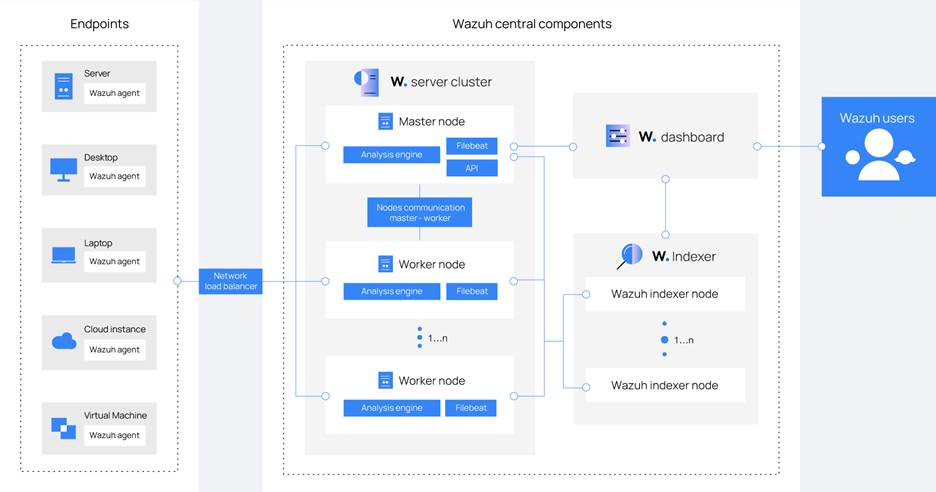
Wazuh Cloud is built on a robust distributed architecture designed for managed delivery.
Agent-Server model
Lightweight Wazuh agents installed on endpoints collect logs, monitor file integrity, assess configurations, and detect rootkits locally. Normalized events are securely transmitted to the managed Wazuh Cloud server over an encrypted channel, minimizing bandwidth usage while maintaining strong visibility across distributed and high-latency environments.
Indexing and data pipeline
A managed Wazuh indexer cluster handles indexing with pre-optimized shards, retention policies, and query performance. Automatic horizontal scaling prevents the performance degradation commonly seen in self-managed setups.
Detection engine
Raw logs are parsed by decoders, then evaluated against thousands of rules organized by severity, category, and MITRE ATT&CK techniques. Advanced rule chaining across multiple data sources enables precise correlation and significantly reduces false-positive rates.
Wazuh AI analyst layer
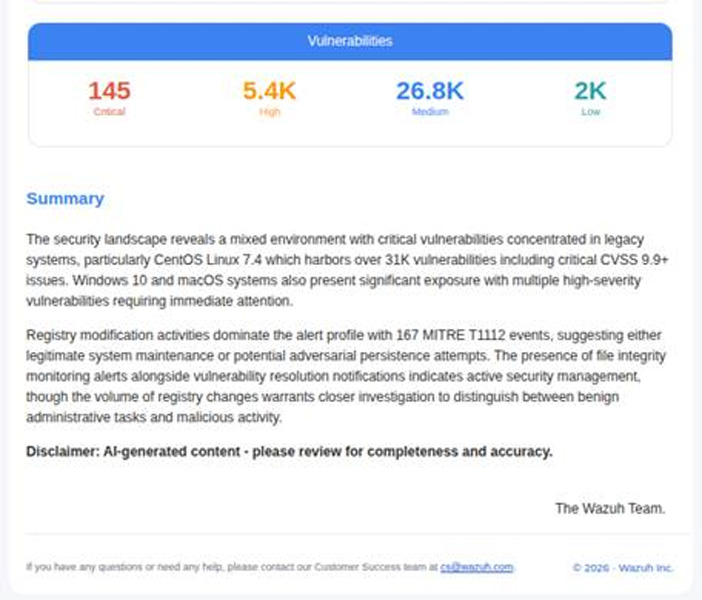
Wazuh AI Analyst sits on top of the core detection engine. It processes security alerts, vulnerability findings, and endpoint activity data to automatically generate weekly reports featuring insights, trend analysis, high-risk highlights, and prioritized remediation recommendations.
This cuts down the manual effort involved in investigations and helps teams concentrate on strategic threat detection and response.
Conclusion
The shortcomings of traditional SIEMs aren’t just inconveniences—they directly lead to slower detection, higher operational costs, and security gaps that adversaries are ready to exploit.
Lengthy deployments mean delayed visibility. Maintenance overhead means distracted teams. Alert fatigue means real threats get buried in the noise.
Wazuh Cloud tackles these problems by simplifying the complexity of managing your security operations. A managed, cloud-native architecture takes care of the infrastructure, maintenance, and scalability challenges that consume security teams in self-managed environments.
The built-in AI analyst lightens the cognitive burden of triage, and a flexible tiering model ensures organizations only pay for what they actually need.
For security teams working in dynamic, hybrid, or multi-cloud environments, the question is no longer whether a managed SIEM is a viable option—it’s whether the cost of sticking with a traditional one still makes sense. Wazuh Cloud makes the answer clear.
Visit Wazuh Cloud to start a free trial and gain immediate visibility and protection in your environment today.
Sponsored and written by Wazuh.
