



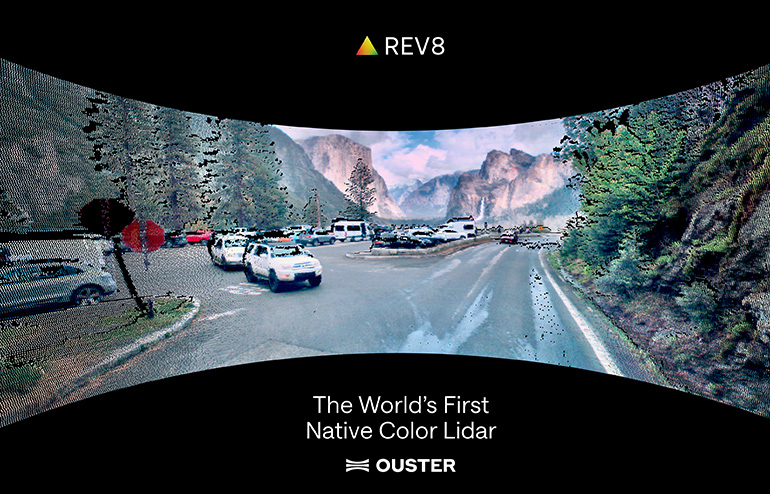
According to Ouster, the Rev8 OS series represents its inaugural lineup of patented sensors featuring point-by-point 3D color vision. Image: Ouster
Today, Oster Inc. unveiled Rev8, its latest range of OS digital lidar sensors powered by the newly developed L4 Ouster Silicon. The company highlighted that these models come equipped with innovative patented native-color lidar sensors, offering twice the range and resolution compared to their predecessors.
“The Rev8 lineup represents the most sophisticated lidar sensors ever launched, raising the bar in the sensing industry,” Oster CEO Angus Pacala remarked. “The introduction of the L4 Ouster Silicon fulfills the potential of our digital architecture, ushering in exponential performance gains. We have doubled our core specifications and simultaneously rolled out the world’s first native-color lidar, granting machines human-like 3D vision for the future of physical AI.”
“Additionally, Rev8 serves as the core technology enabling clients to evolve from prototype to large-scale commercial production, delivering the necessary reliability and cost-effectiveness for widespread autonomous operations across various sectors,” he continued.
In February, Oster completed the acquisition of vision-based perception company StereoLabs in a deal valued at $38 million.
“Oster spent a decade as a specialized lidar provider. This purchase was aimed at transforming into a systems or platform business,” Pacala shared with The Robot Report. “We are catering to a global market of companies creating the next wave of robotic systems.”
L4 Ouster Silicon prioritizes safety, reliability, and scalability
Oster, headquartered in San Francisco, outlined that its L4 architecture is built to ensure functional safety, reliability, affordability, and mass production capabilities. Built on the patented Ouster Silicon incorporating Fujifilm color technology, the L4 chip is designed to handle color information and provides HDR capabilities directly in the hardware.
The firm reported that the technology offers 42.9 GMACs of processing strength, can sense up to 20 trillion photons per second, and features a measurement rate of 40 kHz with picosecond-level accuracy. Oster stated that the system manages up to 10.4 million points per second and can transfer 22.4 gigabits per second of data off-chip. The L4 architecture consists of both the 128-channel L4 and the 256-channel L4 Max variants.
“Our focus has been on leveraging software run on edge compute, placing us at the forefront of physical AI,” Pacala noted. “While some view cameras and lidars as competitors, that isn’t the case for our user base. It’s simply a question of choosing the best sensor for the specific task.”
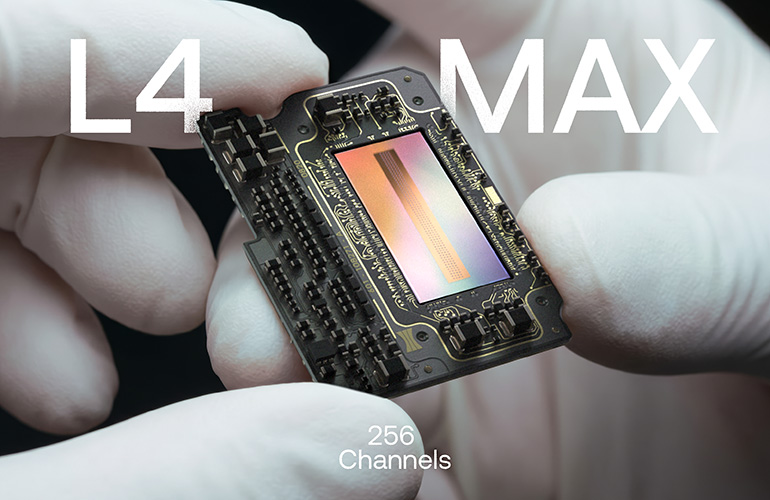
The latest Rev8 OS family of sensors is based on the L4 and L4 Max Ouster Silicon. Image: Ouster
Rev8 merges structural data with native color
“The Rev8 lineup brings a transformative change to AI perception by introducing the world’s first native color lidar sensors,” Oster stated. “Achieving full contextual awareness of the environment requires both structural and color data, and Rev8 is pioneering the combination of both in one device. For the first time, a single sensor can identify road signs, read brake lights, or document the richness of the natural world in high-fidelity, colorized maps.”
The company explained that Rev8 sensors merge data through physical principles rather than software-based processing, yielding megapixel resolution and superior image quality. “Each point is automatically generated with color, guaranteeing extremely low latency and flawless spatial-temporal alignment,” they added.
Oster mentioned that this integrated solution removes the necessity for intricate calibration, providing 3D environment mapping with detailed visual and depth information. Because of its 48-bit color depth and 116 dB dynamic range, the firm emphasized that the native color data performs consistently in lighting conditions spanning from 1 lux to 2 million lux.

Oster highlights key Rev8 specifications
The Rev8 OS series includes fully revamped OS0, OS1, and OSDome sensors, along with the premier 256-channel OS1 Max.
- The Premier OS1 Max: It offers double the range and resolution thanks to its 256-channel design fueled by the L4 Max. The OS1 Max can detect objects up to 200 m (656 ft) at 10% reflectivity, reaching a maximum range of 500 m (1,640.4 ft), coupled with a 45-degree field-of-view. Ideal for high-speed autonomy, intelligent infrastructure, and heavy industry, the OS1 Max provides native color and dependable performance for long-range, high-stakes applications.
- Functional Safety and Reliability Focus: Every sensor meets automotive-grade standards, satisfies ISO 21434 cybersecurity protocols, and aims for ASIL-B ISO 26262, SIL-2, and PLd safety certifications. According to the company, this guarantees uninterrupted operation and durability in even the harshest conditions.
- Affordability and Scalability: These systems are optimized for affordable, high-volume production to drive widespread adoption. Boasting a planned 10-year lifespan, Rev8 sensors offer the enduring stability and scalability essential for worldwide commercial expansion, the company concluded.
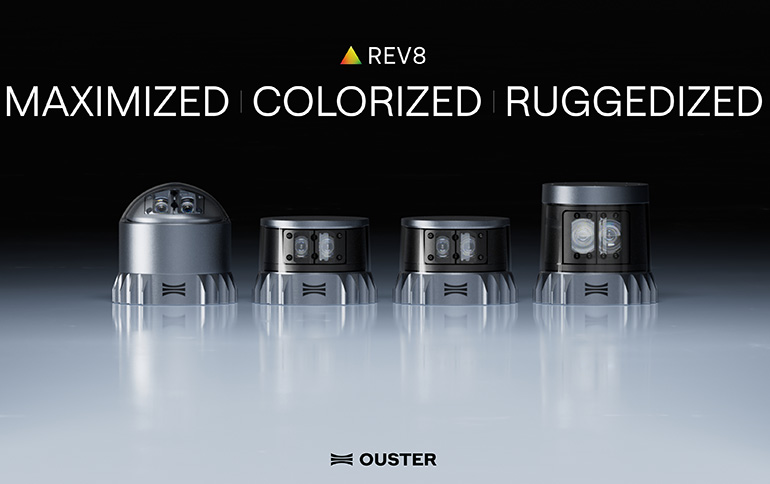
The Rev8 sensor family meets automotive-grade standards, includes built-in cybersecurity, and is engineered with functional safety in mind. Source: Ouster
Next-Gen Lidar Fueling Physical AI, Heading to Global Markets
“The advantages of built-in color for identifying objects and merging sensor signals, plus the exceptional capabilities of the OS1 Max, combined with the robust, safety-focused, and easily scalable design of the entire OS lineup, are transforming how customers develop and enhance their systems,” explained Ouster.
The company noted that the Rev8 sensors capture the precise 3D color imaging required to train cutting-edge physical AI models of real-world environments. By prioritizing cost-effectiveness and the ability to scale, customers can integrate the identical sensor package for both gathering training data and deploying in finished products.
“When I think of physical AI, I picture the AI intelligence running in software, powered by a set of sophisticated sensors and processed by powerful hardware like an NVIDIA edge GPU,” Pacala shared with The Robot Report. “We’re providing the essential tools—a diverse product range adaptable to numerous platforms. These could be mounted on traffic signals, humanoid robots, vehicles, or autonomous delivery units.”
Numerous companies spanning industrial, robotics, automotive, and smart infrastructure sectors have announced plans to integrate the Rev8 OS sensors. Among those named were Google, Volvo Autonomous Solutions, Liebherr, Epiroc, Field AI, Flyability, Skydio, PlusAI, Constellis, Bedrock, Kässbohrer, Third Wave Automation, Burro, Seegrid, Gecko Robotics, Pratt Miller, AIM Intelligent Machines, Cyngn, Freefly Systems, ATI Robotics, and SwarmFarm.
The Ouster Rev8 OS sensors are now open for orders, with shipments beginning this quarter.
