



Bitcoin has surged more than 20% in the last month, yet the underlying mechanics of this rally tell a very different story than the price action implies.
Derivatives traders are predominantly short. Large holders are offloading into the rally. Momentum indicators point to a temporary bounce against the trend, not the start of a sustained upward move. While the price chart looks optimistic, the structural signals beneath it lean pessimistic.
Derivatives Data Signals Caution Despite the Price Surge
Recent market rallies have typically followed a predictable cycle. Bullish traders enter early, leverage builds across perpetual futures, funding rates swing sharply positive, and the rally continues until a sudden spike wipes out overextended longs, resetting the pattern. This sequence is so common that any strong upward move immediately raises concerns about how many overleveraged longs are waiting to be squeezed.
This Bitcoin rally breaks from that pattern. Over the past month, during the 20% advance, bullish positions have been notably scarce.
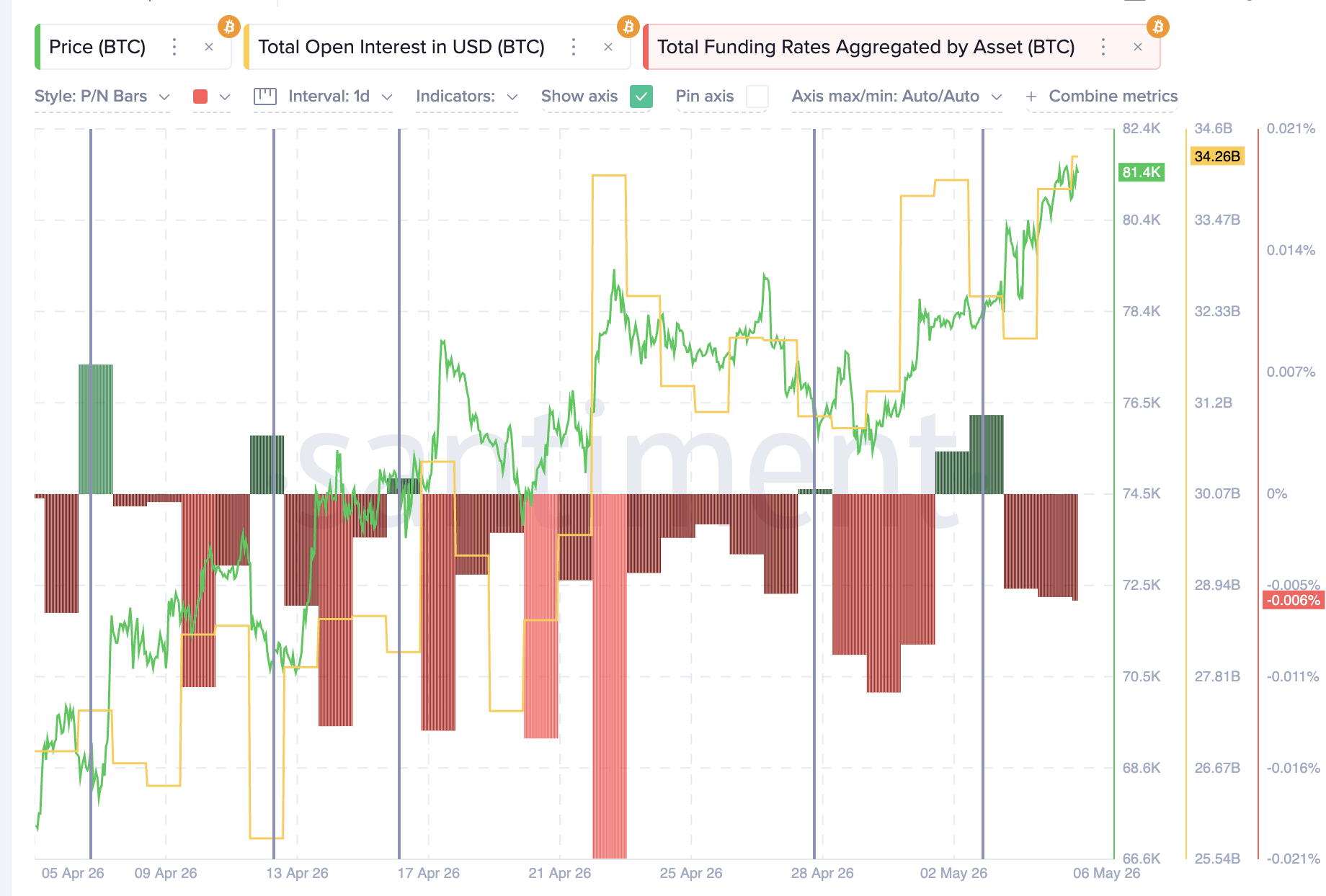
Total Bitcoin open interest has risen from $30.88 billion on April 30 to $34.26 billion by May 6, a gain of over 11% in just six trading sessions. However, the composition of these new positions is what truly matters for interpretation.
Funding rates were at -0.011% on April 30 and remain at -0.006% as of May 6. Sustained negative funding during a 20% rally is unusual, and it confirms that the growing open interest is driven primarily by new short positions rather than new longs.

The 8-hour chart provides further confirmation from spot markets. We rely on the 8-hour timeframe to assess short-term trend dynamics, and the volume profile beneath this rally has been declining. From April 14 to May 6, Bitcoin’s price has climbed steadily while trading volume has fallen consistently. This rally is not fueled by genuine spot buying. It appears to be driven by skepticism and possibly by ongoing short liquidations.

Without an overcrowded long position to unwind, there is no obvious liquidation risk that has capped previous rallies. Yet the absence of enthusiastic bullish positioning also means there is no strong spot demand pushing through resistance levels. The rally’s foundation is structurally weak.
Whale Activity and RSI Divergence Reinforce the Bearish Outlook
The lack of conviction is clearly reflected in two separate on-chain indicators.
Looking for more insights like this? Subscribe to Editor Harsh Notariya’s Daily Crypto Newsletter here.
The group of mid-sized Bitcoin whales, wallets holding between 1,000 and 10,000 BTC, held 4.27 million Bitcoin on April 18, 2026. By May 6, that total had fallen to 4.19 million Bitcoin. The 80,000 BTC decrease over an 18-day period coincides precisely with the rally. These whales are not accumulating during this move. They are taking advantage of the strength to distribute.

The daily chart reveals the third bearish signal. The Relative Strength Index (RSI), a momentum gauge, captures the divergence clearly. From January 5 to May 5, Bitcoin’s price has formed a distinct lower high while the RSI over the same period has formed a higher high.
This formation is known as hidden bearish divergence, which occurs when price makes a lower high but momentum trends upward. Within a broader downtrend, hidden bearish divergence signals that the prevailing downtrend is likely to continue rather than reverse. The 20% bounce from the February low appears to be a counter-trend recovery within a larger corrective pattern. This bearish divergence would be invalidated if Bitcoin’s price moves above $81,854.

Three independent signals align consistently. Derivatives positioning indicates traders are bracing for a pullback. The 80,000 BTC reduction among whale wallets shows spot conviction is absent. RSI hidden bearish divergence confirms the broader trend remains downward. The 20% rally is technically understandable because it lacks the overcrowded long positions that derailed previous rallies, but it also lacks the genuine spot demand needed to confirm a true trend reversal.
The market is showing no signs of euphoria.
Key Bitcoin Price Levels That Will Determine the Bearish Outlook
Bitcoin (BTC) is trading at $81,326, with immediate resistance clustered between $81,810 and $81,854. This zone is the critical threshold that will decide whether the skepticism-driven rally continues or reverses.
A daily close above $81,854 would confirm the rally has enough strength to push higher and sets up $90,460 as the next significant technical target. The $90,460 level aligns with the descending trendline that has capped Bitcoin since its January peak. A breakout above $90,460 would invalidate the broader downtrend structure and signal a genuine trend reversal.

Downside support levels are closely grouped. A rejection at the $81,810 to $81,854 resistance zone would send Bitcoin toward $76,656, the 0.236 Fibonacci retracement level, which serves as the first major support and a likely zone for a retest. Below $76,656, the path opens to $73,467 (0.382 Fib), $70,891 (0.5 Fib), and $68,314 (0.618 Fib). A break below $64,645 would expose the long-term floor at $59,972.
The negative funding environment means any rejection at the resistance band could be amplified. With shorts dominating the perpetual futures market, a failed breakout would not trigger mass long liquidations that might cushion the decline. The move back to $76,656 could happen rapidly.
The level analysis presents a clear binary outcome. A confirmed close above $81,854 opens the door to $90,460. A rejection sends Bitcoin back to $76,656.
The post Why Bitcoin’s 20% Price Rally Reads Bearish Underneath appeared first on BeInCrypto.
