



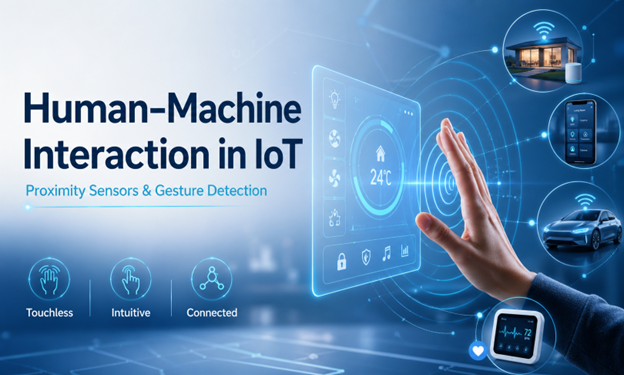
The Internet of Things (IoT) has subtly transformed the way people engage with everyday devices. From smart homes to industrial automation, machines are no longer passive tools – they actively sense and adapt to human behaviour. At the heart of this transformation lies human-machine interaction (HMI), which focuses on making communication between humans and devices more natural and intuitive.
Among the many technologies enabling this shift, proximity sensors and gesture detection stand out. They allow users to interact with machines without physical contact, creating seamless and efficient experiences. These technologies are already part of daily life, often unnoticed, yet they play a crucial role in modern IoT systems.
Understanding human – machine interaction in IoT
Human-machine interaction in IoT refers to how people communicate with interconnected devices that collect and exchange data. Unlike traditional systems that rely on buttons, keyboards, or touchscreens, IoT systems aim to reduce friction in interaction. The goal is simple: make technology respond to humans in the most natural way possible.
Instead of pressing a switch, a light can turn on when someone enters a room. Instead of touching a screen, a simple hand gesture can control a device. These interactions are powered by sensors and intelligent processing, allowing machines to interpret human presence and movement.
What are proximity sensors?
Proximity sensors are devices that detect the presence of an object or person without physical contact. They work by emitting signals such as infrared, ultrasonic waves, or electromagnetic fields and measuring how those signals change when an object is nearby.
There are several types of proximity sensors commonly used in IoT systems:
- Infrared (IR) sensors – detect heat or reflected light
- Ultrasonic sensors – use sound waves to measure distance
- Capacitive sensors – sense changes in electrical fields
- Inductive Sensors – detect metallic objects
These sensors are used because they are reliable, cost-effective, and easy to integrate into smart devices.
Role of proximity sensors in IoT
Proximity sensors play a foundational role in enabling responsive environments. They help devices become context-aware, meaning they can react based on the presence or absence of a user.
In smart homes, proximity sensors are used in automatic lighting systems. For example, when someone enters a room, lights turn on automatically, and they switch off when the room is empty. This not only improves convenience but also saves energy.
In smartphones, proximity sensors detect when the phone is close to the user’s ear during a call. The screen turns off automatically to prevent accidental touches and conserve battery life. This is a simple yet powerful example of HMI improving user experience.
Another real-world example can be seen in public restrooms, where automatic faucets and soap dispensers use proximity sensors. Users do not need to touch anything, making the system more hygienic – an important feature, especially after the COVID-19 pandemic.
Gesture detection: Moving beyond touch
While proximity sensors detect presence, gesture detection takes interaction a step further by recognising human movements. Gesture detection systems interpret motions like waving, swiping, or pointing and translate them into commands.
These systems rely on a combination of sensors and algorithms. Some use depth sensors or computer vision, while others rely on radar-based sensing to track motion.
Gesture detection allows users to control devices without touching them, making interaction faster and more intuitive.
Applications of gesture detection in IoT
Gesture detection is becoming increasingly common in consumer and industrial applications.
One of the most familiar examples is in smart TVs. Users can change channels, adjust volume, or navigate menus using hand gestures instead of a remote control. This is particularly useful when the remote is not nearby.
In the automotive industry, gesture detection enhances driver safety. For instance, drivers can answer calls or adjust music with simple hand movements, reducing the need to look away from the road. This minimises distractions and improves overall driving safety.
Healthcare is another area where gesture detection proves valuable. In operating rooms, surgeons can interact with medical imaging systems without touching screens, maintaining a sterile environment. A surgeon can swipe through MRI scans or zoom in on images using gestures, avoiding contamination.
Integration of proximity sensors and gesture detection
The true power of IoT emerges when proximity sensors and gesture detection work together. Proximity sensors can detect when a user is nearby, activating the system, while gesture detection interprets specific commands.
Consider a smart kitchen setup. As a person approaches the countertop, a proximity sensor activates a display. The user can then scroll through recipes or adjust settings using hand gestures. This combination creates a smooth, touchless experience.
Similarly, in smart retail stores, displays can light up when customers approach, and gesture controls allow them to browse products interactively. This enhances customer engagement and creates a modern shopping experience.
Benefits of touchless interaction
The use of proximity sensors and gesture detection offers several advantages:
- Hygiene: Reduces the need for physical contact, which is essential in public and medical environments
- Convenience: Enables faster and more natural interaction
- Accessibility: Helps people with disabilities interact with devices more easily
- Efficiency: Saves time and energy by automating responses
These benefits explain why touchless interaction is becoming a standard feature in modern IoT systems.
Challenges and limitations
Despite their advantages, these technologies are not without challenges.
Gesture detection systems can sometimes misinterpret movements, especially in complex environments. Poor lighting conditions or background noise can affect accuracy in camera-based systems.
Proximity sensors, while reliable, may have limited range or sensitivity issues. For example, they might fail to detect objects made of certain materials or at certain angles.
Privacy is another concern. Devices that track movement or gestures may raise questions about data security and surveillance. Ensuring user trust is essential for widespread adoption.
Future trends in human-machine interaction
The future of HMI in IoT looks promising. Advances in artificial intelligence and machine learning are making sensors smarter and more accurate. Devices will not only detect presence or gestures but also understand user intent and behaviour patterns.
Touchless interfaces are expected to become more immersive with the integration of augmented reality (AR) and virtual reality (VR). Users may interact with digital objects in physical space using natural gestures.
Another emerging trend is the use of radar-based sensing technologies, which can detect even subtle finger movements. This could lead to precise control systems in compact devices.
Conclusion
Human-machine interaction in IoT is evolving rapidly, driven by the need for more natural and efficient communication between humans and devices. Proximity sensors and gesture detection play a vital role in this transformation by enabling touchless, intuitive interaction.
From automatic lighting and smartphones to smart cars and healthcare systems, these technologies are already shaping the way people live and work. While challenges remain, ongoing advancements promise even smarter and more seamless interactions in the future.
As IoT continues to expand, the importance of designing user-friendly and responsive systems will only grow. Proximity sensors and gesture detection are not just technological features – they are important building blocks in creating a more connected and human-centred world.
