



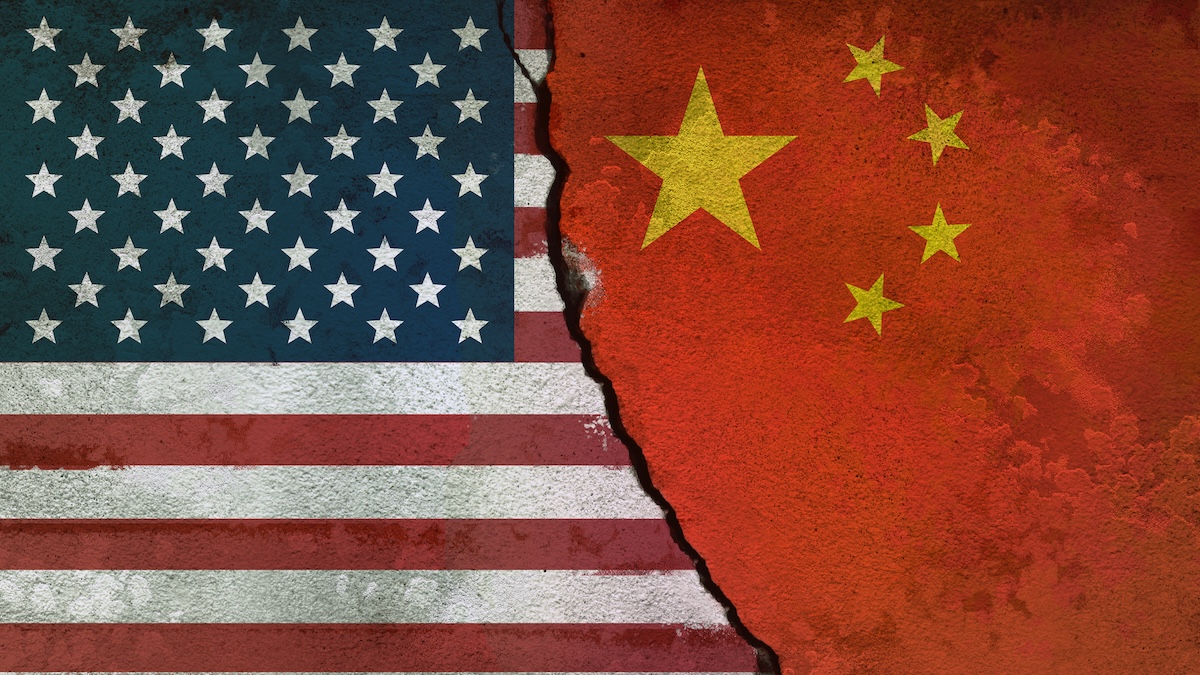
The Trump administration is vowing to crack down on international tech firms’ exploitation of U.S. synthetic intelligence fashions, singling out China at a time that nation is narrowing the hole with the U.S. within the AI race.
In a Thursday memo, Michael Kratsios, the president’s chief science and know-how adviser, accused international entities “principally based in China” of participating in deliberate, industrial-scale campaigns to “distill,” or extract capabilities from, main AI techniques made within the U.S. and “exploiting American expertise and innovation.”
The administration, Kratsios wrote, will work with American AI firms to establish such actions, construct defenses and discover methods to punish offenders.
The memo arrives at a time when China is difficult U.S. dominance in synthetic intelligence, an space the place the White Home says the U.S. should prevail to set world requirements and reap financial and army advantages. However the U.S.-China hole in efficiency of prime AI fashions has “effectively closed,” in response to a latest report from Stanford College’s Institute for Human-Centered AI.
China’s embassy in Washington stated it opposed “the unjustified suppression of Chinese companies by the U.S.”
“China has always been committed to promoting scientific and technological progress through cooperation and healthy competition. China attaches great importance to the protection of intellectual property rights,” stated Liu Pengyu, the embassy spokesperson.
In Beijing, China’s International Ministry spokesperson Guo Jiakun advised reporters Friday that the U.S. claims are groundless and have been smearing the achievements of China’s synthetic intelligence business.
“China firmly opposes this. We urge the U.S. to respect facts, discard prejudice, stop suppressing China’s technological development, and do more to promote scientific and technological exchange and cooperation between the two countries,” he stated.
Kratsios’ memo additionally got here the identical week that the Home International Affairs Committee supplied unanimous, bipartisan assist for a invoice to arrange a course of to establish international actors that extract “key technical features” of closed-source, U.S.-owned AI fashions and to punish them with measures together with sanctions.
“Model extraction attacks are the latest frontier of Chinese economic coercion and theft of U.S. intellectual property,” stated Rep. Invoice Huizenga, R-Mich., who sponsored the invoice. “American AI models are demonstrating transformative cyber capabilities, and it is critical we prevent China from stealing these technological advancements.”
Final yr, the Chinese language startup DeepSeek rattled U.S. markets when it launched a big language mannequin that would compete with U.S. AI giants however at a fraction of the price.
David Sacks, then serving as President Donald Trump’s AI and crypto adviser, steered that DeepSeek copied U.S. fashions. “There’s substantial evidence that what DeepSeek did here is they distilled the knowledge out of OpenAI’s models,” Sacks stated then.
In a February letter to U.S. lawmakers, OpenAI, the developer of ChatGPT, made related allegations and stated China shouldn’t be allowed to advance “autocratic AI” by “appropriating and repackaging American innovation.”
Anthropic, the maker of the Claude chatbot, in February accused DeepSeek and two different China-based AI laboratories of participating in campaigns to “illicitly extract Claude’s capabilities to improve their own models” utilizing the distillation approach that “involves training a less capable model on the outputs of a stronger one.”
Anthropic stated distillation could be a respectable solution to practice AI techniques nevertheless it’s an issue when opponents “use it to acquire powerful capabilities from other labs in a fraction of the time, and at a fraction of the cost, that it would take to develop them independently.”
However it will possibly go each methods. San Francisco-based startup Anysphere, maker of the favored coding software Cursor, lately acknowledged that its newest product was based mostly on an open-source mannequin made by Chinese language firm Moonshot AI, maker of the chatbot Kimi.
Kyle Chan, a fellow on the Washington-based suppose tank The Brookings Establishment and an professional on China’s know-how growth, stated it will likely be like “looking for needles in an enormous haystack” to separate unauthorized distillation from the huge quantity of respectable requests for knowledge. However data sharing and coordination amongst U.S. AI labs might assist, and the federal authorities can play an necessary position in facilitating anti-distillation efforts throughout labs, Chan stated.
It’s arduous to evaluate how far the Home invoice can go, however Chan stated Trump could not wish to rock the boat with Chinese language President Xi Jinping forward of a deliberate mid-Might state go to to Beijing.
Associated: Chinese language Cybersecurity Agency’s AI Hacking Claims Draw Comparisons to Claude Mythos
Associated: AI Can Autonomously Hack Cloud Methods With Minimal Oversight: Researchers
