



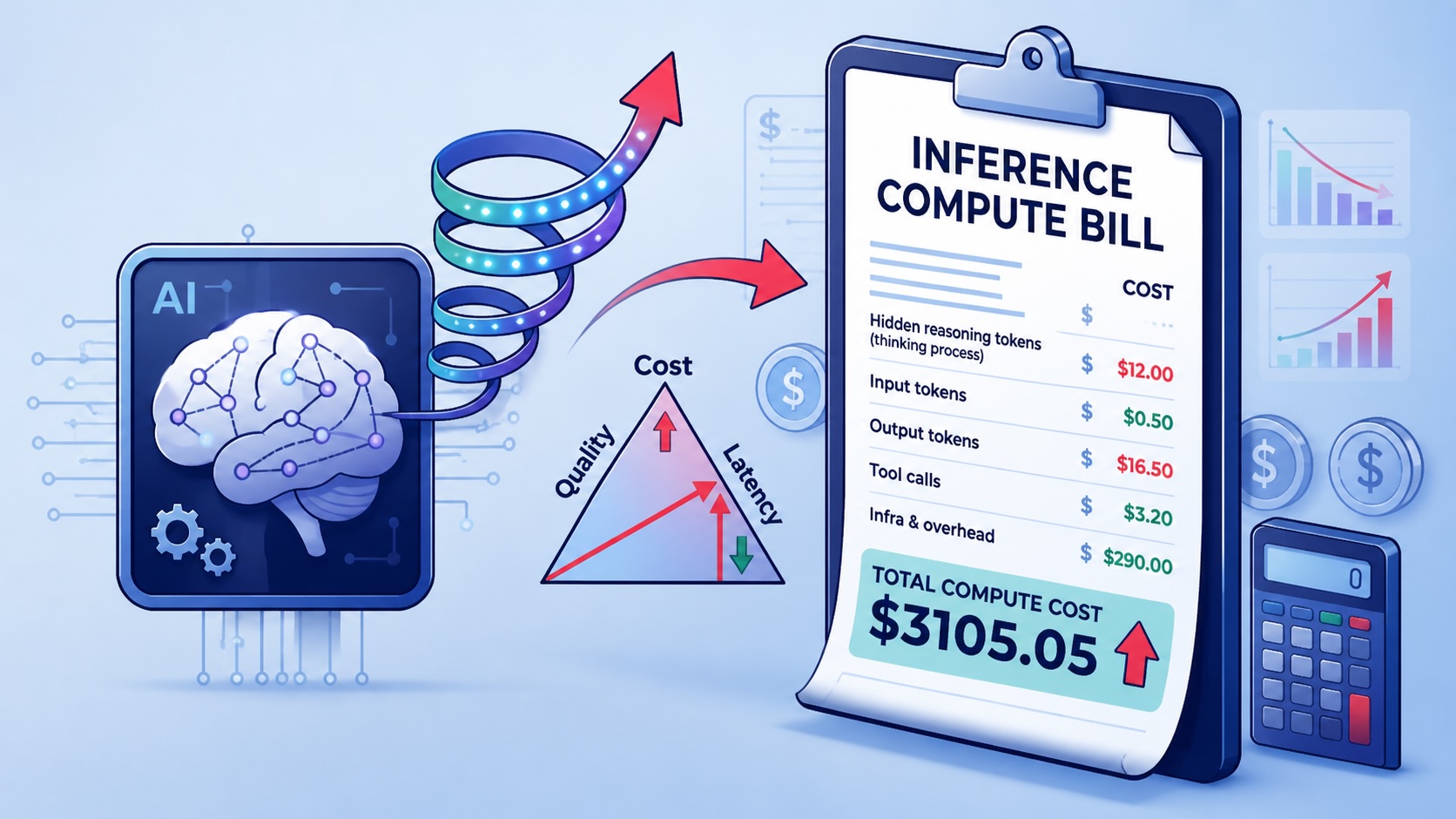
The Inference Scaling Era
For a long time, improving a model’s intelligence meant adding more parameters during its training phase. Today, leading models like GPT 5.5 and the o1 series achieve top-tier performance by dedicating significantly more computational power to generating each individual response.
This approach is called inference scaling or test-time compute. It empowers a model to leverage additional processing capacity while formulating a response, allowing it to scrutinize its own logic and refine its output until it arrives at the most accurate answer. For product development teams, this shifts model selection into a critical operational trade-off. Activating a model’s reasoning capabilities is a deliberate resource commitment, not a simple on/off switch. While the model “thinks,” it produces hidden reasoning tokens. These tokens are invisible in the final user interface, but they represent a substantial, often surprising, increase in the compute costs on your monthly bill.
To manage these complexities, teams must balance the competing priorities of the Cost-Quality-Latency triangle. This framework helps align stakeholders who often have different objectives. Finance departments track shrinking profit margins driven by soaring token costs. Infrastructure engineers work to maintain p95 latency to avoid system timeouts. Product managers must decide if a superior answer justifies a potential thirty-second delay. Risk and compliance teams ensure that enhanced reasoning doesn’t circumvent safety protocols or factual grounding. By implementing a task taxonomy, organizations can classify workloads into “use,” “maybe,” and “avoid” categories. This strategy directs simple, routine tasks to more efficient models, preserving the compute budget for high-stakes, complex logic.
Understanding Inference Scaling: What It Is and What It Isn’t
Historically, a model’s intelligence was locked in during its training phase. This training-time scaling required massive investment in GPUs to create a static neural network. Inference scaling, or test-time compute, shifts this resource allocation to the moment of generation. Instead of performing a single, quick calculation for each request, the model dedicates extra processing power to thoroughly search for the best possible answer while the user waits.
From an operational standpoint, reasoning mode works by generating hidden “thinking” tokens. It employs a chain-of-thought process to work through logic before producing a final response.
- Decomposition: Breaking down complex, multi-step problems into smaller, manageable pieces of logic.
- Self-Correction: Identifying its own internal errors and iterating on its reasoning during the thinking phase.
- Strategic Selection: Generating several potential internal answers and then scoring them to choose the most accurate one.
The outcome is a model of adaptive spending based on the prompt’s complexity. Simple tasks, like basic summarization, remain fast and inexpensive because the model recognizes that no deep logic is required. Complex prompts, such as reviewing a distributed system’s architecture, are allocated a larger compute budget. In these cases, the model may pause to generate thousands of tokens to meticulously verify its reasoning.
It’s crucial to understand the limitations of this technology. Inference scaling is not a magic button for guaranteed accuracy and cannot compensate for flaws in the model’s underlying training data. It is also not a safety feature. A model can successfully reason through a complex logic puzzle while still generating biased or restricted content. As foundational research indicates, while performance improves with more compute, models still perform significantly better on familiar tasks than on problems that fall outside their training distribution.
| Feature | Training-Time Scaling | Inference-Time Scaling |
| Investment Timing | Pre-deployment phase | Moment of generation |
| Operational Logic | Single forward pass through the network | Iterative reasoning loops and self-correction |
| Model Intelligence | Static once training is finished | Dynamic based on prompt complexity |
| Scalability Hook | Requires a new model version | Scales by increasing thinking time |
The Cost–Quality–Latency Triangle Framework
Defining Each Corner with Production Metrics
The Cost-Quality-Latency triangle is the essential framework for making any decision about inference. Teams must define each corner using concrete metrics that bridge the gap between engineering and finance.
- Cost: This encompasses both visible output tokens and the hidden reasoning tokens generated during internal thinking loops, plus any retries used to verify logic. It also measures GPU time per request. Because these models hold onto hardware memory for longer periods, they reduce the total number of requests a system can handle at once, forcing teams to either scale up hardware or limit user access.
- Quality: This is measured through task success rates and defect rates for hallucinations. Teams also employ factuality checks and rubric-based scoring, where a separate “judge” model evaluates the logic or tone of the response.
- Latency: This focuses on p50 and p95 metrics. While p50 represents the typical user experience, p95 monitors the slowest five percent of requests. Delays caused by complex reasoning can trigger timeouts, making applications feel unresponsive or broken.
A latency-critical profile for a chatbot, for example, prioritizes speed and accepts a higher risk of logical errors. Conversely, a quality-critical profile for architectural planning accepts longer delays and higher token expenditure to ensure the results are robust and reliable.
Why Costs Can Skyrocket in Production
Research from Apple Machine Learning Research highlights a dangerous efficiency gap between reasoning models and standard LLMs. Their study found that Large Reasoning Models often fall into a “thinking trap,” burning through thousands of tokens on simple tasks like adding 1 to 9900. For these low-complexity items, standard models provide better accuracy without the extra cost. While heavy token consumption shows an advantage for medium-complexity logic, both model types struggle as tasks reach high complexity. This proves that simply generating more thinking tokens cannot fix fundamental flaws in precise mathematical reasoning. Your compute bill can explode unnecessarily if you apply powerful reasoning to the wrong type of task. To prevent this “overthinking,” teams must match the model’s effort to the task’s complexity using a clear taxonomy.
Reasoning models disrupt traditional linear pricing by introducing two distinct multipliers that impact both budget and infrastructure.
- Per-Request Cost Escalation: Token consumption is no longer linear. Models like GPT 5.5 use interleaved thinking to generate reasoning tokens before and after tool calls. This search-based approach explores multiple logical paths, causing compute usage to scale exponentially relative to task complexity.
- Capacity and Concurrency Drops: Even if the price per token decreases, hardware occupancy remains a major bottleneck. A standard model might generate a response in one second, while a reasoning model can occupy the same GPU memory for thirty seconds. This extended occupancy reduces the total number of users a single server can support simultaneously.
These factors trigger cascading consequences such as system timeouts, forced retry attempts, and greater difficulty meeting Service Level Objectives. Turning on reasoning is not a simple on-off switch. It is a foundational scaling decision that defines the financial and operational boundaries of your entire application infrastructure.
When reasoning mode backfires
Inference scaling is a precision instrument rather than a blanket quality improvement. Enabling reasoning mode for straightforward tasks like summarization or basic explanations amounts to operational overkill. It burns through substantial computational power and budget without delivering any meaningful improvement in output accuracy. This waste introduces specific failure patterns:
- Verbose Wrong Answers: The model expends compute defending a flawed line of reasoning, producing a confident but incorrect response.
- Task Drift: Prolonged internal reasoning cycles can cause the model to drift away from the original prompt constraints or context.
- Timeout Cascades: Unpredictable thinking durations on simple prompts can drain API connections and destabilize the system for every user.
- Token Bloat: Models sometimes produce thousands of hidden reasoning tokens for trivial formatting tasks, triggering unexpected billing surges.
- False Confidence: The existence of internal reasoning steps can make fabricated answers seem more believable and harder for users to challenge.
A real-world example illustrates this trade-off in high-throughput classification.
Consider the prompt to classify dog, paper, cat, eggs, and cheese into categories:
a standard model delivers a structured list in under 200 milliseconds. A reasoning model might generate hundreds of hidden tokens deliberating the evolutionary relationship between pets or the industrial origins of paper. Although the final output is the same, the reasoning model carries dramatically higher latency and token costs. In a production setting, this amounts to an intelligence tax on a task that demands no sophisticated logic.
Controlling these risks demands gating by task type, stakes, and latency budget. Selective routing guarantees you only pay for thinking when the cost of a logic mistake exceeds the cost of added delay. Routine extraction, formatting, and light rewrites should be directed to faster, more predictable models.

Buyer’s guide: when to pay for thinking
To illustrate the effect of a task taxonomy, a development team was building a coding assistant. At first, they directed all traffic to a high-power reasoning model to guarantee quality. But they found that 70% of requests involved simple tasks like code formatting, syntax checking, and basic completions. These tasks produced identical results on faster, cheaper models.
By introducing a routing policy, the team achieved these outcomes:
| Metric | Before Routing | After Routing |
| Simple Tasks (70%) | $2,100 / day | $70 / day |
| Reasoning Tasks (30%) | $900 / day | $900 / day |
| Total Daily Cost | $3,000 | $970 |
| Annualized Spend | $1,095,000 | $354,050 |
By reserving reasoning tokens for high-stakes logic, the team cut monthly expenses by 68%. This saved over $740,000 annually without degrading the quality of the coding assistant.
Using reasoning mode well requires shifting from general prompt engineering to deliberate resource management. Decisions should hinge on the logical complexity of the task and the business impact of a mistake.
Task Taxonomy for Test-Time Compute
| Policy | Task Types | Business Justification |
| Use | Math, multi-step planning, complex trade-offs | Error cost is high; logic must be verified. |
| Maybe | Code architecture, high-stakes synthesis | Structural accuracy outweighs latency needs. |
| Avoid | Extraction, classification, formatting, rewrites | High volume, low complexity; speed is priority. |
Decision Cues:
The key signal is the cost of error versus the cost of latency. If a logic mistake in your pipeline leads to a failure that costs more in manual remediation than the added compute, pay for the reasoning tokens.
You also need to assess your tolerance for p95 increases. If your user interface or downstream services cannot absorb 30-second delays, reasoning mode will make the product feel broken no matter how good the output is. Finally, use reasoning when you need strong explainability, since the internal chain of thought offers a trace for diagnosing complex failures.
Operational Governance
Governance transforms inference scaling from an experiment into a production policy.
- Route First: Deploy a fast, inexpensive classifier to gauge prompt complexity. Only escalate prompts that demand multi-step logic to reasoning models.
- Selective Application: Do not apply reasoning across an entire workflow. Use it only at the specific logical nodes where accuracy is paramount.
- Hard Caps: Enforce strict limits on maximum reasoning tokens, retries, and total request duration to prevent logic loops from causing unpredictable billing surges.
- The Success Metric: Stop tracking dollars per million tokens. Start measuring cost per successful task, which factors in the compute needed to hit a specific quality rubric.

The bottom line for AI teams is that reasoning is a high-cost metered resource. It should be reserved for specific high-stakes tasks rather than applied to general processing. Every reasoning token represents a direct operational trade-off where profit margins shrink to buy greater logical precision.
Conclusion
Entering the era of inference scaling means we must stop treating LLMs like magic boxes and start managing them like any other costly engineering resource. Reasoning models are extraordinarily capable for high-stakes planning and complex math, but they are excessive for basic formatting or classification.
The teams that thrive in this new landscape will not be those with the biggest compute budgets, but those with the sharpest governance. By adopting a clear task taxonomy and selective routing, you can protect your margins without sacrificing product quality. Treat reasoning tokens as a scarce resource, deploy them where they genuinely add value, and let your fast models handle everything else.
To put these frameworks into practice and manage your compute spending effectively, consult the following official documentation and engineering guides:
Thanks for reading. I’m Mostafa Ibrahim, founder of Codecontent, a developer-first technical content agency. I write about agentic systems, RAG, and production AI. If you’d like to stay in touch or discuss the ideas in this article, you can find me on LinkedIn here.
