



Picture by Creator
# Introduction
So, you’re a pupil or somebody simply beginning to be taught the operational aspect of constructing functions. You’ve gotten already taken step one by growing and testing your software regionally. Now, you wish to deploy it to the cloud so it may be accessed from anyplace. The issue is that cloud internet hosting can really feel difficult and costly when you’re simply getting began.
On this article, we are going to have a look at a few of the best free platforms that allow you to host your Python net or software programming interface (API) software with out paying upfront. Whereas these providers include restricted compute, they’re often greater than sufficient for a primary toy venture, a private demo, or just experimenting with deployment, monitoring, and primary software administration.
# 1. Share AI Apps with Hugging Face Areas
Hugging Face Areas is one among my favourite choices for internet hosting Python functions, particularly in case you are engaged on synthetic intelligence tasks. It is extremely beginner-friendly and makes deployment really feel a lot much less intimidating. You’ll be able to launch a Gradio software simply by importing your information, pushing the Git commits, and even utilizing the Hugging Face command line interface (CLI).
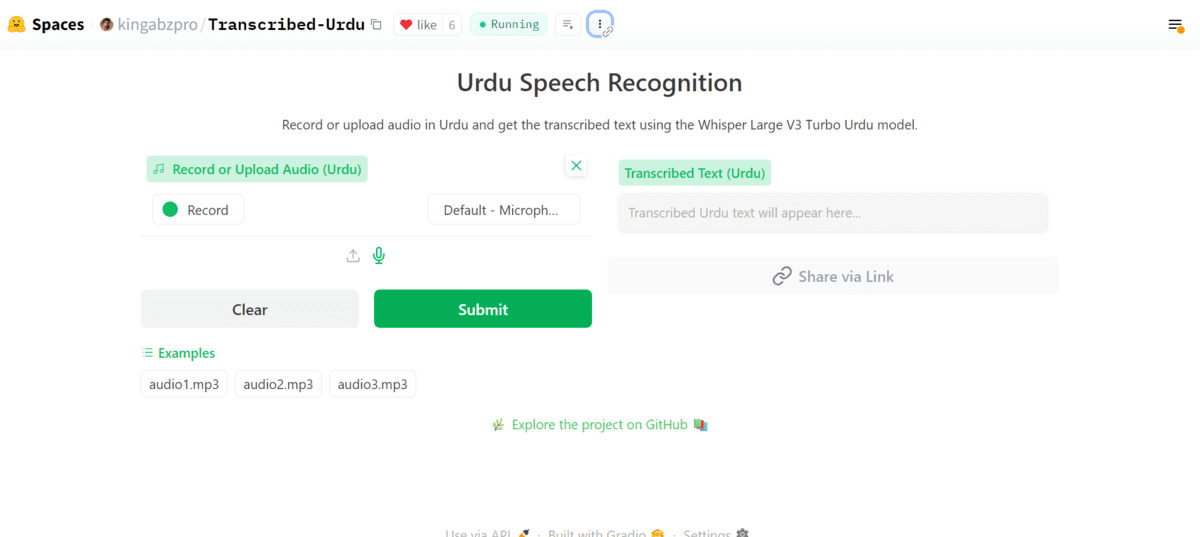
It’s particularly helpful for machine studying and huge language mannequin (LLM) tasks, but it surely additionally helps Streamlit and Docker-based functions. That provides you some flexibility relying on how easy or customized your software is.
The default free {hardware} on Hugging Face Areas provides you 2 CPU cores, 16 GB of RAM, and 50 GB of non-persistent disk house, which is greater than sufficient for a lot of demos, prototypes, class tasks, and small experiments.
One factor to remember is that Areas on the free CPU-basic tier will robotically fall asleep after about 48 hours of inactivity, however they restart when somebody visits the applying once more.
# 2. Deploy Information Apps with Streamlit Group Cloud
Streamlit Group Cloud was one of many first platforms I used once I was studying the way to deploy Python net functions. Alongside Heroku, it made the entire course of really feel a lot simpler to know. It’s a nice start line for rookies as a result of you’ll be able to go from a neighborhood venture to a reside software with out coping with an excessive amount of setup.
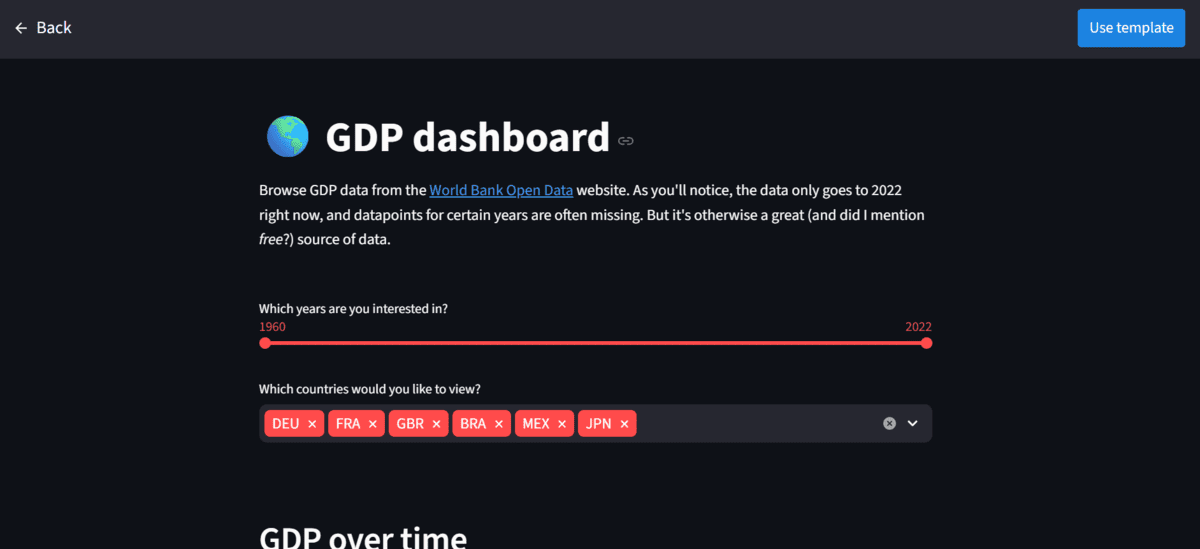
Although many individuals nonetheless consider Streamlit as only a dashboard device, it has turn into a versatile strategy to construct knowledge functions, inside instruments, and light-weight interactive net functions in Python. The deployment expertise is one among its largest strengths as a result of your GitHub repository acts because the supply of fact, and pushes to the repository are mirrored within the software robotically.
For the free tier, Streamlit says all Group Cloud customers share the identical pool of assets, with approximate limits of 0.078 to 2 CPU cores, 690 MB to 2.7 GB of reminiscence, and as much as 50 GB of storage. One essential factor to know is that functions with no visitors for 12 hours fall asleep, however they are often woken up once more when somebody visits the applying.
# 3. Deploy Backend APIs with Render
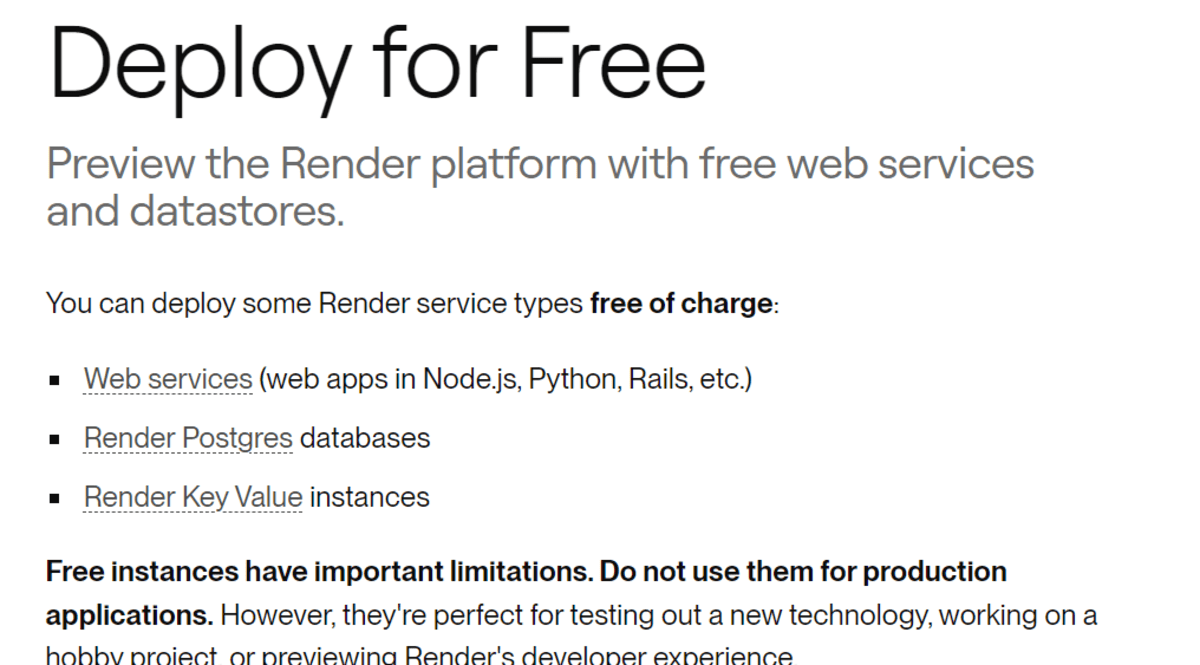
Render is a extra full internet hosting platform that allows you to deploy all types of net functions, together with Python, Node.js, Ruby on Rails, and Docker-based providers. It’s a robust choice if you wish to host a Flask or FastAPI backend with out organising servers your self.
The deployment circulation may be very easy. You connect with a GitHub repository — though Render additionally helps GitLab and Bitbucket — and the platform handles the construct and deployment course of for you. That makes it a really beginner-friendly strategy to get a Python API on-line.
Render does provide a free tier for net providers, which is helpful for testing concepts, interest tasks, and small demos. One essential factor to know is that free net providers spin down after quarter-hour of inactivity, and when somebody visits once more, the service can take as much as a minute to wake again up.
# 4. Run Python Apps with Modal
Modal is one among my favourite fashionable platforms for working Python functions, particularly when the venture is a little more superior than a easy demo. I’ve used it for Mannequin Context Protocol (MCP) backends, AI brokers, and extra complicated functions the place I needed one thing quick with out having to handle the infrastructure myself. One of many nicest elements is that you just outline the infrastructure in Python, so the entire developer expertise feels far more pure in case you already work within the Python ecosystem.
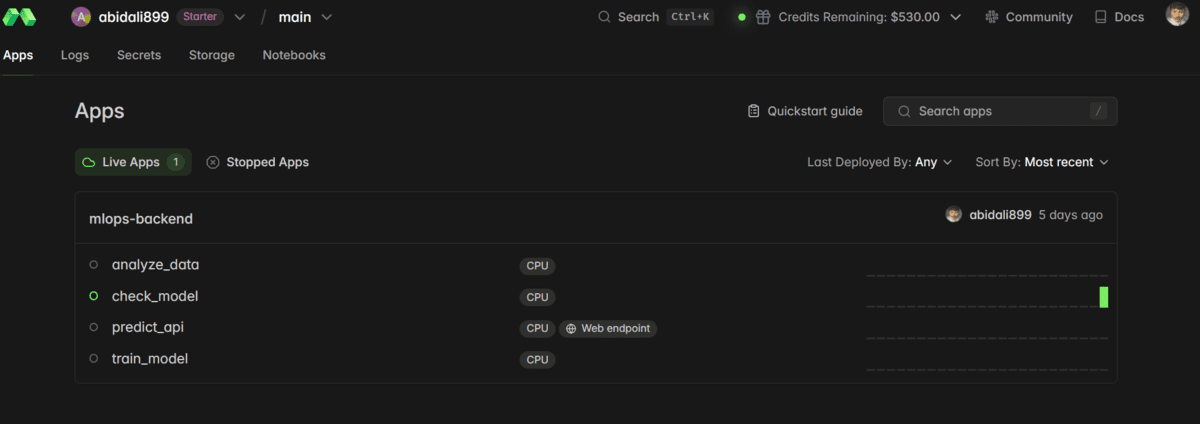
It’s particularly robust for machine studying workloads, background jobs, and backend providers. You’ll be able to run Python features, scheduled jobs, and net endpoints, which makes it versatile sufficient for APIs, async processing, and mannequin inference.
The free tier is kind of beneficiant for getting began. Modal’s Starter plan contains $30 per 30 days in free credit, together with restricted net endpoints and cron jobs, which is often sufficient for small experiments, private tasks, and early prototypes.
# 5. Host Full Python Apps on PythonAnywhere
PythonAnywhere is among the most well-known platforms for Python internet hosting. It does really feel a bit extra old-school in contrast with newer instruments, but it surely nonetheless will get the job performed. One cause individuals hold coming again to it’s that it’s constructed particularly for Python, so you’ll be able to write code, handle information, open consoles, and deploy an online software from the browser with out organising your individual server.
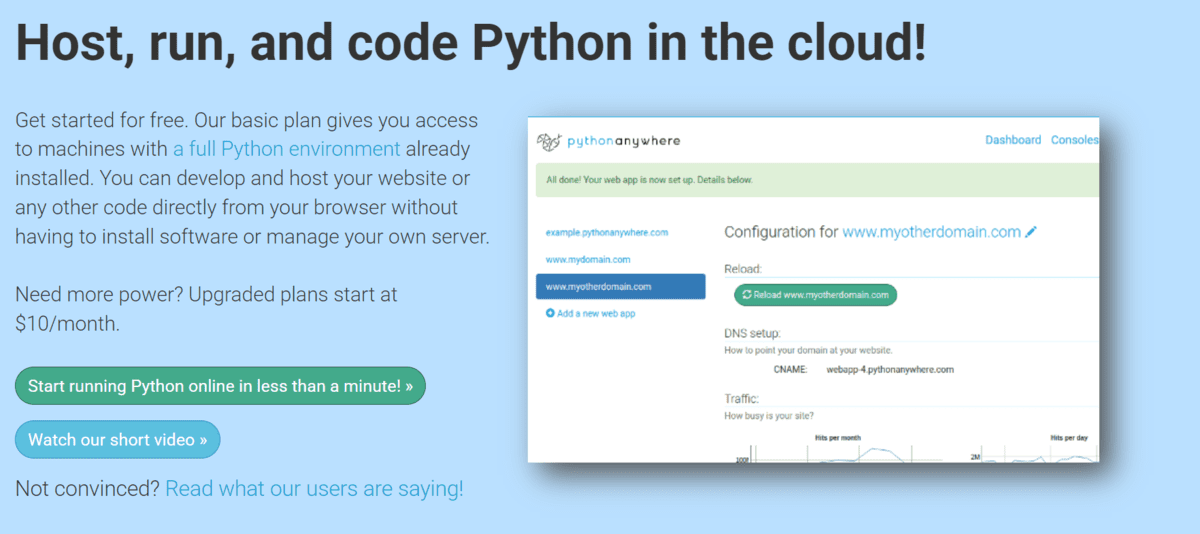
It’s a good choice for easy Flask and Django tasks, particularly if you need an all-in-one surroundings as a substitute of connecting a lot of separate providers. For rookies, that may make the training curve really feel a lot simpler.
The free account is genuinely usable for studying and small tasks. Proper now, free accounts embody:
- One net software with one net employee.
- Two consoles.
- 512 MiB of disk house and 100 CPU seconds.
- Functions run on a
yourusername.pythonanywhere.comsubdomain, and free accounts have restricted outbound web entry.
# Wrapping Up
Here’s a fast side-by-side comparability that will help you select the fitting platform primarily based on the form of Python software you wish to deploy.
| Platform | Greatest For | Free Tier Model | Good for Freshmen |
|---|---|---|---|
| Hugging Face Areas | AI demos, Gradio, Streamlit | Free group internet hosting with CPU assets | Sure |
| Streamlit Group Cloud | Information apps, dashboards, inside instruments | Free app internet hosting from GitHub | Sure |
| Render | Flask and FastAPI backend APIs | Free net service with sleep after inactivity | Sure |
| Modal | AI backends, brokers, jobs, serverless apps | Month-to-month free credit | Average |
| PythonAnywhere | Flask and Django apps | Free newbie plan with one net app | Sure |
Abid Ali Awan (@1abidaliawan) is an authorized knowledge scientist skilled who loves constructing machine studying fashions. At present, he’s specializing in content material creation and writing technical blogs on machine studying and knowledge science applied sciences. Abid holds a Grasp’s diploma in expertise administration and a bachelor’s diploma in telecommunication engineering. His imaginative and prescient is to construct an AI product utilizing a graph neural community for college kids fighting psychological sickness.
