



The dream of recursive self-improvement in AI—the place a system doesn’t simply get higher at a job, however will get higher at studying—has lengthy been the ‘holy grail’ of the sector. Whereas theoretical fashions just like the Gödel Machine have existed for many years, they remained largely impractical in real-world settings. That modified with the Darwin Gödel Machine (DGM), which proved that open-ended self-improvement was achievable in coding.
Nonetheless, DGM confronted a major hurdle: it relied on a set, handcrafted meta-level mechanism to generate enchancment directions. This restricted the system’s progress to the boundaries of its human-designed meta agent. Researchers from the College of British Columbia, Vector Institute, College of Edinburgh, New York College, Canada CIFAR AI Chair, FAIR at Meta, and Meta Superintelligence Labs have launched Hyperagents. This framework makes the meta-level modification process itself editable, eradicating the belief that job efficiency and self-modification abilities have to be domain-aligned.
The Downside: The Infinite Regress of Meta-Ranges
The issue with current self-improving techniques is commonly ‘infinite regress’. You probably have a job agent (the half that solves the issue) and a meta agent (the half that improves the duty agent), who improves the meta agent?. Including a ‘meta-meta’ layer merely shifts the difficulty upward.
Moreover, earlier techniques relied on an alignment between the duty and the advance course of. In coding, getting higher on the job usually interprets to getting higher at self-modification. However in non-coding domains—like poetry or robotics—bettering the task-solving ability doesn’t essentially enhance the flexibility to investigate and modify supply code.
Hyperagents: One Editable Program
The DGM-Hyperagent (DGM-H) framework addresses this by integrating the duty agent and the meta agent right into a single, self-referential, and absolutely modifiable program. On this structure, an agent is outlined as any computable program that may embody basis mannequin (FM) calls and exterior instruments.
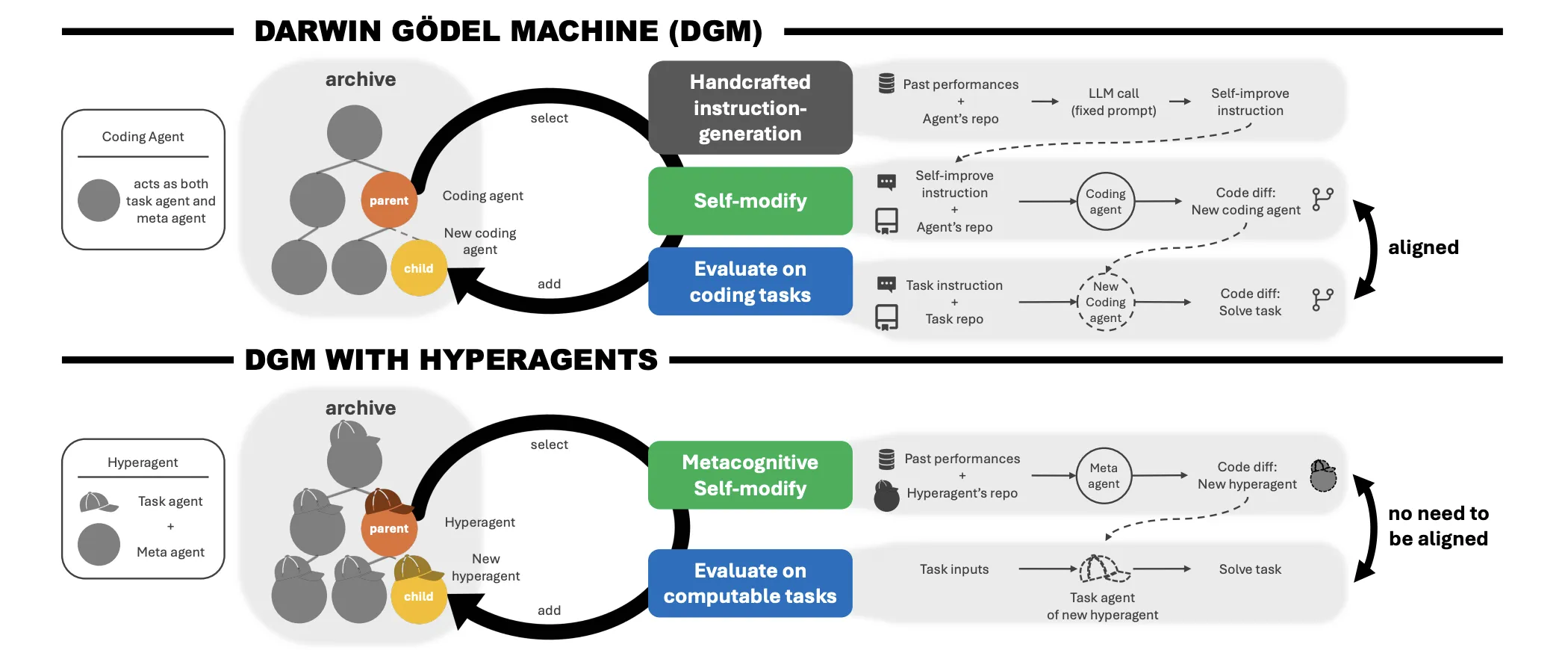
As a result of the meta agent is a part of the identical editable codebase as the duty agent, it will probably rewrite its personal modification procedures. The analysis workforce calls this metacognitive self-modification. The hyperagent doesn’t simply seek for a greater answer; it improves the mechanism liable for producing future enhancements.
Comparability of Self-Enchancment Architectures
| Element | Darwin Gödel Machine (DGM) | DGM with Hyperagents (DGM-H) |
| Meta-level Mechanism | Fastened and handcrafted | Absolutely editable and modifiable |
| Area Alignment | Required (primarily coding) | Not required (any computable job) |
| Modification Sort | Job-level solely | Metacognitive (job + meta) |
Outcomes: Past Native Optima in Robotics and Evaluate
The analysis workforce examined DGM-H throughout numerous domains: coding, paper assessment, robotics reward design, and Olympiad-level math grading.
In robotics reward design, the hyperagent was tasked with designing Python reward capabilities to coach a quadruped robotic within the Genesis simulator. Throughout the coaching section, brokers have been required to design rewards for strolling ahead. For held-out testing, the brokers needed to zero-shot generate reward capabilities for a unique job: maximizing the robotic’s torso peak.
The DGM-H considerably improved efficiency, rising from an preliminary rating of 0.060 to 0.372 (CI: 0.355–0.436). It efficiently found non-myopic reward capabilities that induced leaping habits—a extra optimum technique for peak than the native optimum of merely standing tall.
Within the paper assessment area, DGM-H improved test-set efficiency from 0.0 to 0.710 (CI: 0.590–0.750), surpassing a consultant static baseline. It moved past superficial behavioral directions to create multi-stage analysis pipelines with express checklists and choice guidelines.
Transferring the ‘Capacity to Enhance‘
A essential discovering for AI researchers is that these meta-level enhancements are normal and transferable. To quantify this, the analysis workforce launched the enchancment@ok (imp@ok) metric, which measures the efficiency acquire achieved by a set meta agent over ok modification steps.
Hyperagents optimized on paper assessment and robotics duties have been transferred to the Olympiad-level math grading area. Whereas the meta brokers from human-customized DGM runs did not generate enhancements on this new setting (imp@50 = 0.0), the transferred DGM-H hyperagents achieved an imp@50 of 0.630. This demonstrates that the system autonomously acquired transferable self-improvement methods.
Emergent Infrastructure: Monitoring and Reminiscence
With out express instruction, hyperagents developed subtle engineering instruments to help their very own progress:
- Efficiency Monitoring: They launched lessons to log metrics throughout generations, figuring out which adjustments led to sustained features versus regressions.
- Persistent Reminiscence: They carried out timestamped storage for synthesized insights and causal hypotheses, permitting later generations to construct on earlier discoveries.
- Compute-Conscious Planning: They developed logic to regulate modification methods based mostly on the remaining experiment price range—prioritizing basic architectural adjustments early and conservative refinements late.
Key Takeaways
- Unification of Job and Meta Brokers: Hyperagents finish the ‘infinite regress’ of meta-levels by merging the job agent (which solves issues) and the meta agent (which improves the system) right into a single, self-referential program.
- Metacognitive Self-Modification: Not like prior techniques with fastened enchancment logic, DGM-H can edit its personal ‘improvement procedure,’ basically rewriting the principles of the way it generates higher variations of itself.
- Area-Agnostic Scaling: By eradicating the requirement for domain-specific alignment (beforehand restricted principally to coding), Hyperagents reveal efficient self-improvement throughout any computable job, together with robotics reward design and educational paper assessment.
- Transferable ‘Learning’ Abilities: Meta-level enhancements are generalizable; a hyperagent that learns to enhance robotics rewards can switch these optimization methods to speed up efficiency in a wholly completely different area, like Olympiad-level math grading.
- Emergent Engineering Infrastructure: Of their pursuit of higher efficiency, hyperagents autonomously develop subtle engineering instruments—equivalent to persistent reminiscence, efficiency monitoring, and compute-aware planning—with out express human directions.
Try the Paper and Repo. Additionally, be at liberty to comply with us on Twitter and don’t overlook to hitch our 120k+ ML SubReddit and Subscribe to our E-newsletter. Wait! are you on telegram? now you may be part of us on telegram as properly.
