




Picture by Creator
# Introduction
Agentic AI programs, which use massive language fashions (LLMs) to purpose, plan, and execute multi-step duties, promise a brand new period of automation. Nevertheless, their non-deterministic nature — producing a distinct end result every time the identical piece of knowledge is entered — introduces distinctive challenges, like LLMs being unpredictable, multi-step workflows failing in the course of execution, and brokers shedding necessary context. Constructing programs that aren’t simply practical however able to dealing with failures and managing state reliably is the important thing to transferring from prototype to manufacturing.
On this article, you’ll study the 5 important design patterns that deal with these basic challenges. Utilizing LangChain and its LangGraph extension as our reference framework, we are going to take a look at patterns that present construction, resilience, and observability to your agentic purposes. The next desk offers a fast overview of those patterns and their major advantages.
| Sample | Core Thought | Key Mechanism for Robustness | Splendid Use Case |
|---|---|---|---|
| Single Agent with ReAct Loop | An autonomous agent that plans and acts iteratively | Self-correction by way of an built-in “thought” step | Open-ended duties requiring dynamic software use (e.g., analysis, evaluation) |
| Multi-Agent Sequential Workflow | A sequence of specialised brokers passing output linearly | Modularity isolates failures and clear information contracts | Structured, reproducible pipelines (e.g., information extract, clear, load) |
| Multi-Agent Parallel & Collect | A number of brokers work concurrently; outputs are synthesized | Latency discount and various perspective gathering | Duties with impartial sub-tasks (e.g., multi-source evaluation, validation) |
| Supervisor-Controller with State Checkpointing | A central controller manages a persistent, resumable state graph | Fault tolerance through state snapshots and human-in-the-loop intervention | Lengthy-running, advanced, or mission-critical workflows |
| Reviewer-Critic Suggestions Loop | A generator’s output is validated by a devoted critic agent | High quality management by way of impartial, goal validation | Outputs requiring excessive accuracy or adherence to guidelines (e.g., code, content material era) |
# Implementing Single Agent with ReAct Loop
The foundational sample for agentic programs is a single agent outfitted with instruments and guided by the Motive and Act (ReAct) framework. This agent operates in a loop; it causes in regards to the job and its present state, decides on an motion (usually utilizing a software), acts, after which observes the end result earlier than repeating the cycle.
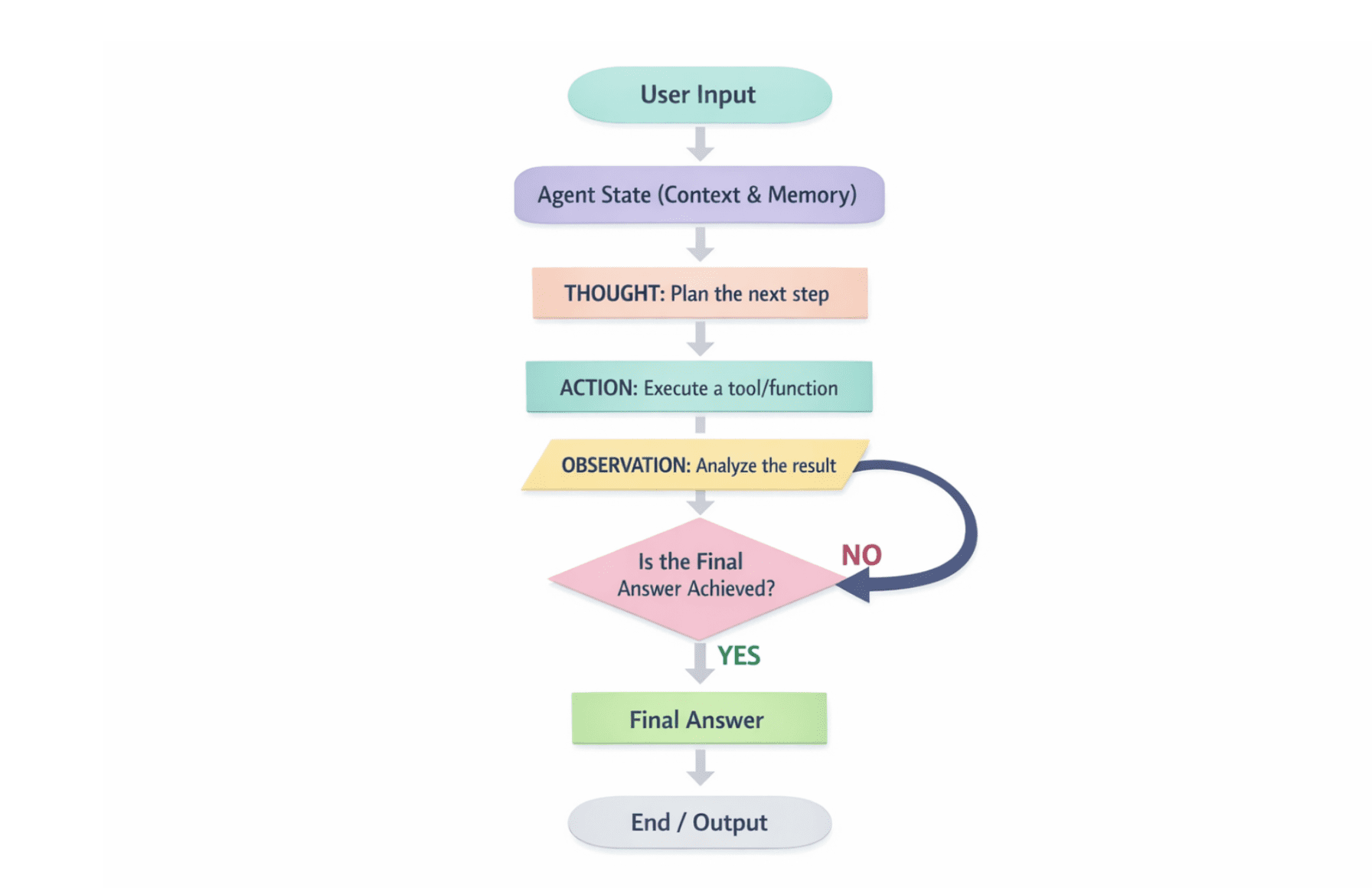
Single Agent with ReAct Loop | Picture by Creator
In LangChain, that is normally applied utilizing an AgentExecutor. The robustness of this sample comes from the agent’s potential to adapt its plan primarily based on observations, offering a fundamental type of error restoration. Nevertheless, its most important impediment is complexity limitations. As duties develop extra advanced, a single agent’s efficiency can decline.
Implementation give attention to LangChain exhibits robustness right here relies upon closely on immediate engineering and power design. Clear software descriptions and a well-structured system immediate that instructs the agent to “think step-by-step” are important for dependable reasoning.
# Managing Multi-Agent Sequential Workflow
For advanced, structured duties, the work could be damaged down and assigned to a sequence of specialised brokers. Every agent is an knowledgeable in a particular subtask, and the output of 1 agent turns into the enter for the subsequent in a predefined, linear pipeline.
This sample will increase robustness by way of modularity and clear contracts. A failure in a single agent is contained and simpler to debug than a fancy failure in a monolithic agent’s logic. For instance, in an information pipeline, a “Data Extractor” agent may go uncooked information to a “Data Cleaner” agent, which then passes it to a “Data Loader” agent.
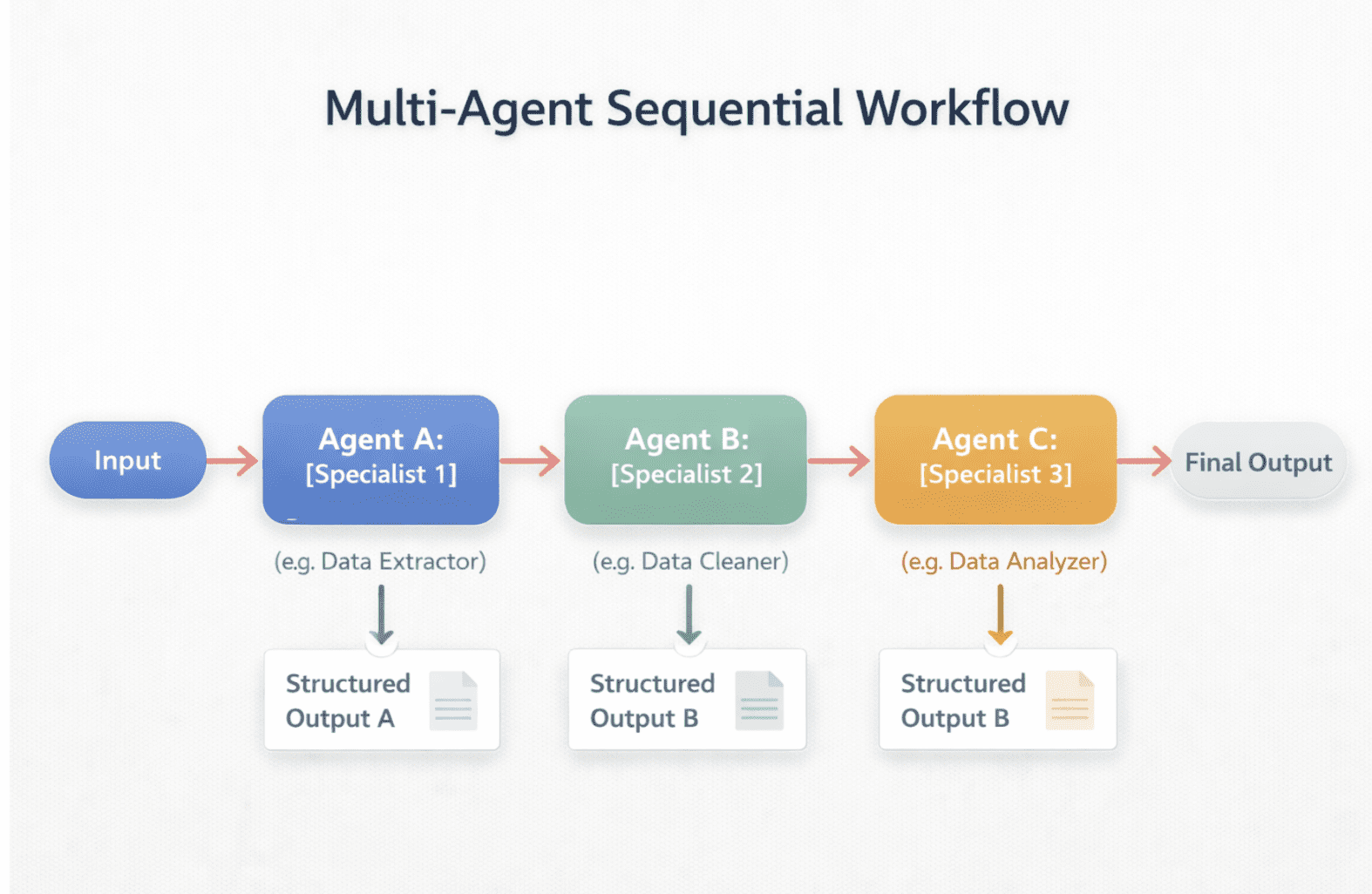
Multi-Agent Sequential Workflow with structured information handoffs | Picture by Creator
The problem right here is the first danger is context loss or corruption in the course of the switch of management. Stop this by implementing structured output schemas (e.g. JSON) between brokers and utilizing a shared state object (as in LangGraph) to go context cleanly, fairly than counting on unstructured pure language.
# Coordinating Multi-Agent Parallel and Collect
When a job could be damaged into impartial sub-tasks, the parallel sample can considerably scale back latency. A number of specialised brokers are invoked concurrently, and their outputs are later gathered and synthesized by a ultimate agent.

Multi-Agent Parallel And Collect | Picture by Creator
A basic use case is analyzing a buyer help ticket the place one agent analyzes sentiment, one other extracts key entities, a 3rd categorizes the problem, and a ultimate agent writes a abstract primarily based on all these parallel analyses.
The problem this sample introduces is coordination complexity and the chance of the synthesis step failing as a result of conflicting inputs. Implement timeouts and circuit breakers for every parallel department to forestall one sluggish or failing agent from blocking the complete course of. The synthesis agent’s immediate should be designed to deal with lacking or partial inputs gracefully.
# Using Supervisor-Controller with State Checkpointing
It is a meta-pattern for establishing advanced, long-running, or conditional workflows, finest applied with LangGraph. Right here, a central StateGraph defines completely different nodes (which could be brokers, instruments, or logic) and the conditional edges (transitions) between them. The graph manages a persistent state object that flows by way of the system.
The cornerstone of robustness on this sample is the checkpoint. LangGraph robotically persists the state object after every node execution. If the workflow crashes or is deliberately paused, it may be resumed precisely from the final accomplished node with out repeating work or shedding context. This additionally permits human-in-the-loop patterns, the place a human can approve, modify, or redirect the workflow at particular factors.
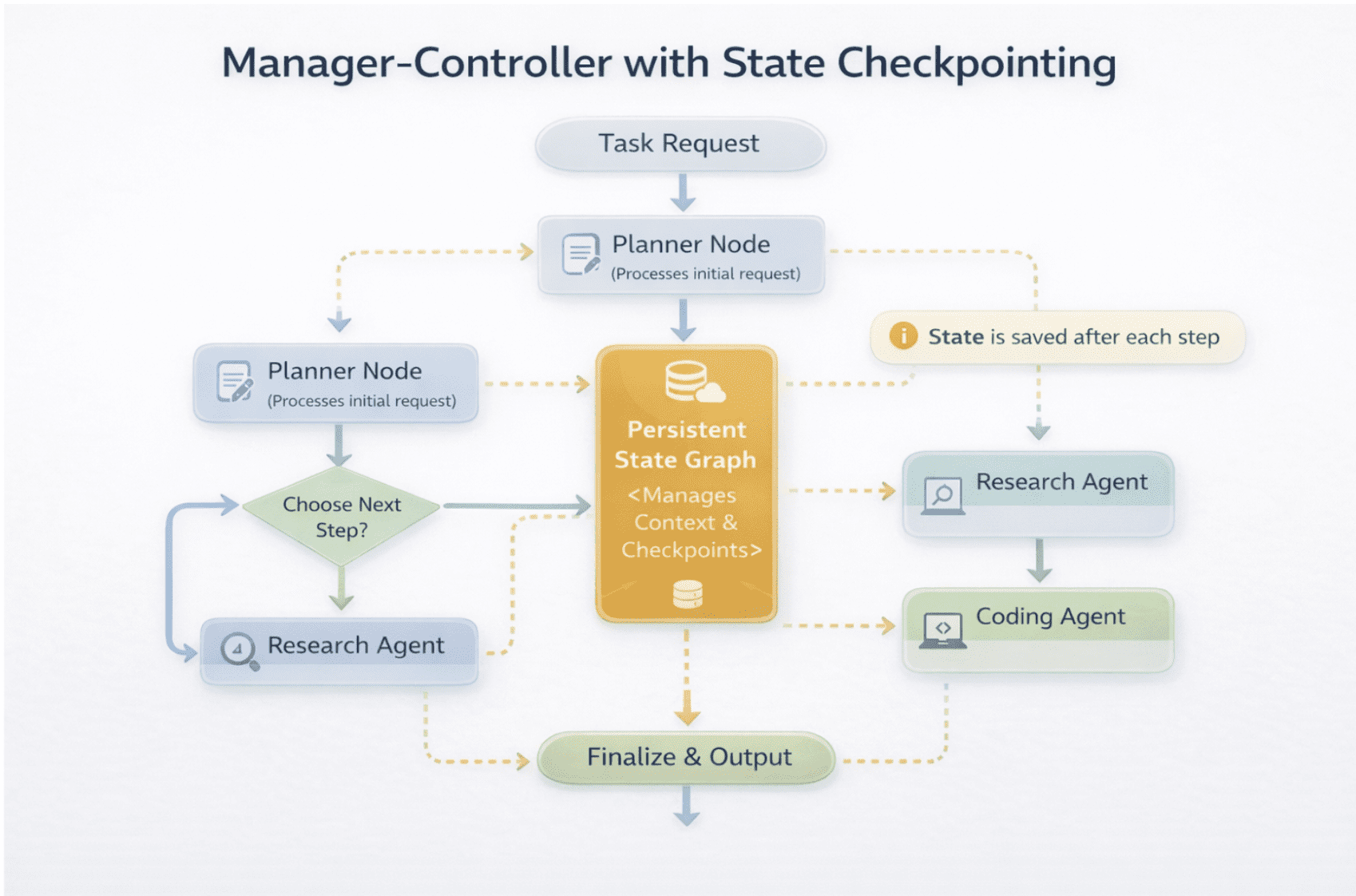
Supervisor-Controller sample with a central State Graph for persistence and checkpointing | Picture by Creator
// Implementation Focus (LangGraph)
Design your state schema fastidiously, as it’s the single supply of fact for the workflow. Use LangGraph‘s built-in persistence and interrupt capabilities to construct traceable, restarting programs which are dependable sufficient for manufacturing.
# Making use of Reviewer-Critic Suggestions Loop
High quality assurance could be hard-coded into the system by way of the reviewer-critic (or generator-critic) sample. That is usually a specialised implementation of a loop sample. One agent (the Generator) creates an output, which is then evaluated by a separate, impartial agent (the Critic or Reviewer) in opposition to particular standards (accuracy, security, fashion).
This sample is essential for producing high-stakes content material like code or authorized textual content. The critic offers an goal, exterior validation layer, dramatically decreasing hallucinations and specification drift.

Reviewer-Critic Suggestions Loop | Picture by Creator
The critic should be genuinely impartial. It ought to use a distinct system immediate, and probably even a distinct massive language mannequin, to keep away from sharing the generator’s assumptions or reasoning blind spots. At all times implement a most iteration restrict to forestall infinite analysis loops.
# Summarizing Sturdy Design Patterns
These patterns will not be essentially separate; among the most strong manufacturing programs mix them. You may need a Supervisor-Controller graph (Sample 4) that orchestrates a sequential workflow (Sample 2), the place one step includes a parallel collect (Sample 3) of knowledge, and a ultimate step includes a Reviewer-Critic loop (Sample 5) to make sure high quality.
The trail to robustness begins with acknowledging that failures are inevitable in agentic programs. By adopting these structured patterns, particularly these enabled by stateful, checkpointed orchestration with LangGraph, you progress from constructing fragile chains of prompts to engineering resilient programs that may deal with uncertainty, get better from errors, and supply the transparency wanted for steady enchancment and person belief.
I hope this detailed information offers a stable basis for designing your strong agentic programs.
Shittu Olumide is a software program engineer and technical author captivated with leveraging cutting-edge applied sciences to craft compelling narratives, with a eager eye for element and a knack for simplifying advanced ideas. You may as well discover Shittu on Twitter.
