



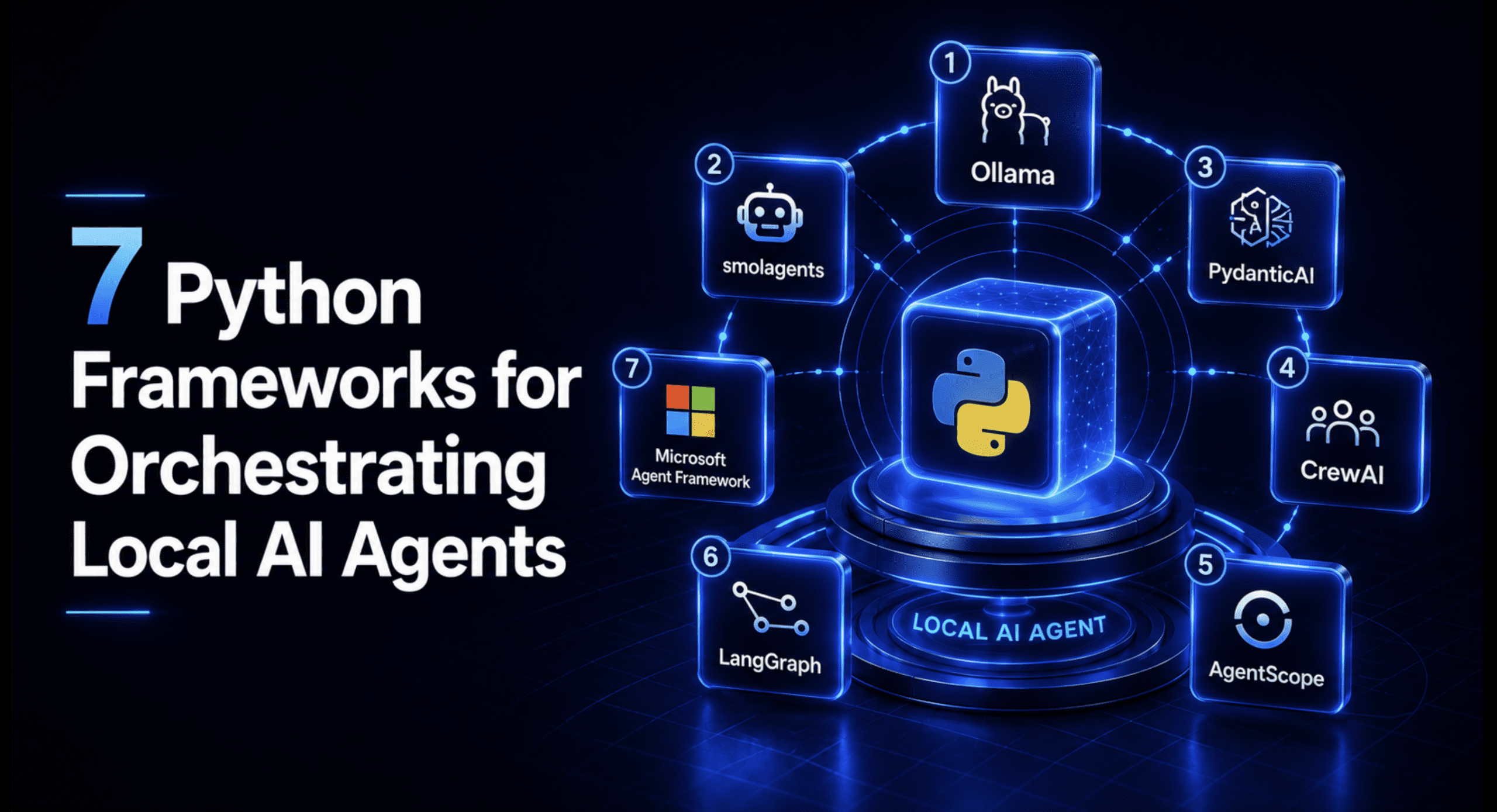
**Running Local AI Agents: 7 Python Frameworks for 2026**
In the rapidly evolving world of artificial intelligence, the architecture of agent-based systems has shifted significantly. Modern developers face a crucial choice: rely on cloud APIs that charge per token and potentially expose sensitive data, or build agent systems that run entirely on local infrastructure. The latter approach offers privacy, cost control, and network security—but demands robust orchestration frameworks that can effectively manage local models. This article explores seven Python tools that engineering teams are actively using in 2026 to build, coordinate, and deploy intelligent agents on local infrastructure.
## 1. Ollama: The Foundation Layer
Before orchestrating anything locally, you need something to actually run the models. **Ollama** serves as the foundational runtime for executing open-source large language models (LLMs) directly on your machine—often described as “Docker for language models.” With simple command-line operations for pulling models and serving them via local APIs, Ollama eliminates complex Python environment configurations and manual CUDA driver installations.
The key architectural insight behind Ollama’s dominance is its OpenAI-compatible API design. This allows seamless integration with virtually all agent frameworks without custom adapters. Beyond compatibility, Ollama provides significant advantages: your data never leaves your machine, and every inference request is free once models are downloaded. While designed for development simplicity rather than high-concurrency production workloads, teams often pair Ollama’s developer-friendly interface with specialized serving solutions like vLLM when scaling becomes necessary.
## 2. Smolagents: Minimalist Agent Architecture
For teams that need complete transparency into agent behavior, **smolagents** from Hugging Face offers a radically different approach. With an entire agent logic stack of approximately 1,000 lines of code, smolagents maintains minimal abstractions above raw code execution. The framework is model-agnostic, supporting local transformers, Ollama installations, and dozens of cloud providers through a unified interface.
Smolagents’ signature feature is its first-class support for CodeAgents—agents that write executable code rather than merely generating code as output. These agents can execute their actions in secure sandboxed environments via Docker, E2B, or Modal, providing crucial safety boundaries. However, this security comes with performance tradeoffs: testing shows significant degradation with models under 7 billion parameters, making smolagents ideal for teams running capable local models rather than resource-constrained deployments.
## 3. PydanticAI: Type-Safe Agent Development
When data integrity becomes non-negotiable, **PydanticAI** emerges as the framework of choice. Developed by the team behind the popular Pydantic library, this framework uses Python type hints to enforce strict schema validation across all agent inputs, outputs, and tool calls. The automatic validation and self-correction capabilities prevent malformed JSON or structural errors from compromising downstream pipelines.
This type-safe approach proves particularly valuable for regulated industries like finance and healthcare, where compliance demands cannot tolerate structural errors. PydanticAI’s compatibility with any OpenAI-compatible endpoint means migrating to local Ollama servers requires minimal code changes rather than complete rewrites. As of April 2026, the project has reached version 1.85.1, with active development emphasizing type safety and minimal dependencies as core design principles.
## 4. CrewAI: Rapid Multi-Agent Prototyping
The transition from single agents to collaborative multi-agent systems becomes dramatically simpler with **CrewAI**. This framework excels at rapid prototyping of agent collectives, where you define specialized roles and goals for individual agents, assemble them into crews, and allow coordinated collaboration. CrewAI’s particular strength is making local model integration feel native rather than bolted-on.
CrewAI deliberately avoids dependencies on external frameworks like LangChain, positioning itself as a self-contained solution. While defaulting to OpenAI as its primary model provider, it offers explicit local runtime support through Ollama and embraces the Model Context Protocol (MCP) across multiple transport layers. This architecture enables local CrewAI deployments to access standardized tool servers while maintaining local model execution—a crucial capability for organizations needing both local control and tool integration.
## 5. AgentScope: Production-Ready Infrastructure
Where other frameworks optimize for development speed, **AgentScope** was engineered from the ground up for production deployment. This framework treats local deployment as a first-class capability rather than an edge case, supported by comprehensive workspace and sandbox management. AgentScope 2.0 delivers production-ready agent execution through isolated tool and code environments with backends for local execution, Docker, and E2B.
The framework’s impressive GitHub star count (over 27,300) and backing from peer-reviewed research papers reflect its enterprise focus. Privacy and data control are explicit design goals: agents run entirely within your infrastructure with no data transmission to external servers. The model abstraction layer supports seamless switching between local and private models without code rewrites—a critical advantage for sensitive workloads. AgentScope introduces message-based communication between agents rather than shared context, providing transparent, auditable interactions essential for debugging complex multi-agent systems.
## 6. LangGraph: Stateful Orchestration Backbone
**LangGraph** has emerged as the default choice for stateful, branching, and recoverable agent workflows. Its local model support deserves specific emphasis: because LangGraph works with any OpenAI-compatible backend, connecting graph-based agents to local Ollama instances requires essentially a single configuration change. The same checkpointing capabilities that make LangGraph reliable in cloud environments—pause/resume functionality, time-travel debugging, and multi-instance scaling—operate identically whether models run locally or through cloud APIs.
This consistency matters profoundly for local agents performing complex tasks beyond single interactions. LangGraph provides the structural predictability needed for agent loops that must plan, execute tool actions sequentially, observe results, and determine subsequent steps. When these workflows must survive crashes or extended pauses between operations, LangGraph’s persistence layer prevents the frustrating scenario of starting from scratch after interruptions.
## 7. Microsoft Agent Framework: Enterprise Governance
Organizations requiring enterprise-grade governance alongside local execution capabilities should examine the **Microsoft Agent Framework**. As the unified successor to AutoGen and Semantic Kernel, announced in October 2025, this framework combines conversational multi-agent abstractions with enterprise features including session-based state management, middleware support, and comprehensive telemetry.
The distinguishing characteristic is native support for running models locally alongside major cloud providers. Out-of-the-box compatibility spans Microsoft Foundry, Azure OpenAI, OpenAI, Anthropic, Amazon Bedrock, Google Gemini, and Ollama—allowing teams to standardize on a single framework while maintaining flexible deployment options. However, this flexibility comes with caveats: community reports indicate provider adapter issues outside Azure OpenAI’s implementation, requiring thorough validation before adoption by teams primarily using non-Microsoft infrastructure.
## Framework Comparison and Selection Criteria
These seven frameworks aren’t competing solutions targeting identical use cases. Instead, they occupy distinct positions along the development continuum:
– **Ollama** serves as the essential foundation that most other frameworks build upon
– **smolagents** and **PydanticAI** represent contrasting approaches to agent interaction—minimal abstraction versus type safety
– **CrewAI** enables the fastest path to functional multi-agent systems
– **AgentScope** and **Microsoft Agent Framework** deliver production-grade structure suitable for enterprise deployment
– **LangGraph** provides durable orchestration capabilities that enhance any of the above frameworks when persistent state becomes necessary
The optimal choice depends less on theoretical superiority and more on your specific constraints:
– Need rapid prototyping? Consider CrewAI or smolagents
– Require strict data validation? PydanticAI offers unmatched type safety
– Building production systems? AgentScope provides the most comprehensive governance
– Need stateful workflows? LangGraph’s checkpointing is unmatched
The good news is that running locally no longer means sacrificing capability. Modern frameworks have evolved to the point where local deployment represents a deliberate architectural choice rather than a compromise. The key is identifying which constraint matters most for your specific application—whether that’s development speed, data governance, production resilience, or persistent state management—and selecting the framework optimized around that priority.
## Frequently Asked Questions (FAQ)
**Q: What is the primary advantage of running AI agents locally versus using cloud APIs?**
A: Local execution eliminates API key requirements, per-token costs, and data transmission outside your network. You maintain complete control over your models and data while avoiding ongoing cloud service fees after the initial model download.
**Q: Which framework provides the fastest path to multi-agent collaboration?**
A: CrewAI specializes in rapid multi-agent prototyping with its role-and-goal-based architecture, making it the quickest way to get multiple agents working together on complex tasks.
**Q: How does PydanticAI ensure data integrity in agent workflows?**
A: PydanticAI uses Python type hints to enforce strict schema validation across all agent inputs, outputs, and tool calls, automatically correcting structural errors before they can impact downstream systems.
**Q: Are these frameworks compatible with open-source models only, or do they support commercial APIs?**
A: Most frameworks support both approaches. While some like Ollama focus exclusively on open-source models, others like CrewAI, AgentScope, and Microsoft Agent Framework support hybrid deployments mixing local models with cloud APIs.
**Q: Which framework would be most suitable for a small development team with limited ML expertise?**
A: Ollama combined with LangGraph provides the gentlest entry point, as Ollama handles model execution complexity while LangGraph offers intuitive stateful workflows without requiring deep ML knowledge.
## Conclusion
The landscape of local AI agent orchestration has matured remarkably, with 2026 offering seven robust Python frameworks that address different aspects of the deployment challenge. From foundational model runners like Ollama to production-grade systems like AgentScope, teams now have unprecedented flexibility in balancing development speed, data governance, and operational requirements.
The key insight isn’t identifying a single “best” framework, but rather understanding which constraints drive your specific needs. Whether you prioritize rapid prototyping, strict data validation, enterprise governance, or persistent state management, there’s now a mature solution that allows you to run locally without sacrificing capability.
As organizations increasingly prioritize data privacy and cost control, local agent execution transitions from niche experimentation to mainstream deployment strategy. The frameworks reviewed here represent the current state of that evolution—each addressing distinct aspects of the local agent challenge while contributing to a comprehensive ecosystem that makes on-premise AI agent deployment accessible to teams of all sizes.
The choice ultimately depends on your specific requirements, but the encouraging reality is that none of these frameworks force you to compromise on capability simply because you’ve chosen to run locally. In fact, many teams find that local execution provides surprising advantages in control, cost predictability, and development velocity once they’ve identified the right framework match for their needs.
*Shittu Olumide is a software engineer and technical writer passionate about leveraging cutting-edge technologies to craft compelling narratives, with a keen eye for detail and a knack for simplifying complex concepts. You can also find Shittu on [Twitter](https://twitter.com/Shittu_Olumide).*
