



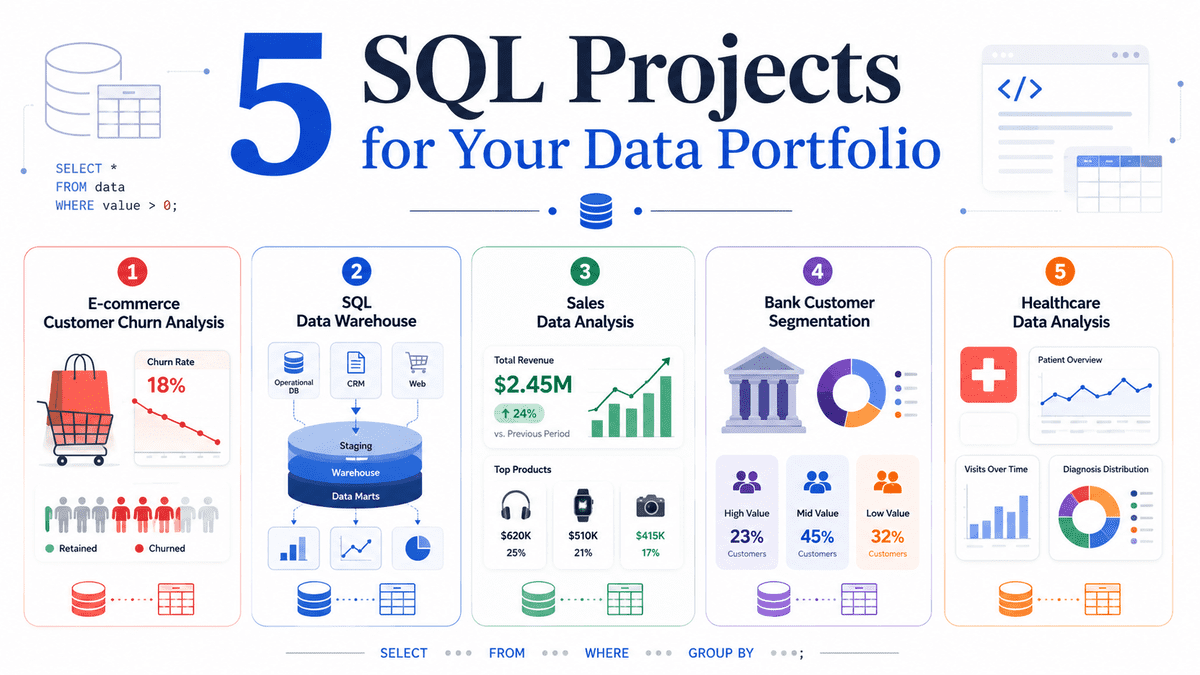
**5 Real-World SQL Projects to Build Your Data Portfolio**
SQL remains a cornerstone skill for data analysts, data scientists, business intelligence analysts, and analytics engineers. However, merely learning SQL syntax is just the beginning. To truly stand out in the field, you must demonstrate your ability to use SQL to solve real business problems. This is where portfolio projects become essential. A strong SQL project should showcase not only your querying abilities but also your skills in data cleaning, trend exploration, answering business questions, and communicating insights effectively.
In this article, we explore five practical, real-world SQL projects designed to help you build a compelling data portfolio. Each project includes a realistic use case, key learning outcomes, and links to GitHub or Kaggle projects for deeper exploration.
—
### 1. E-commerce Customer Churn Analysis Using SQL
Customer churn is a critical issue for e-commerce businesses, as losing customers directly impacts revenue. This project focuses on analyzing customer behavior to identify reasons behind churn.
You will examine variables such as complaint history, order frequency, satisfaction scores, payment methods, coupon usage, tenure, and time since the last order. The objective is to uncover patterns that drive churn and suggest actionable strategies for improving customer retention.
**Skills learned:**
– `GROUP BY` and aggregation
– `CASE WHEN` logic
– Data filtering and segmentation
– Churn rate calculations
– Connecting SQL insights to business decisions
🔗 [Project Link](https://www.kdnuggets.com/wp-content/uploads/awan_5_realworld_sql_projects_build_data_portfolio_1.png)
—
### 2. SQL Data Warehouse Project
Ideal for those moving beyond basic analysis, this project teaches how to build a modern data warehouse using SQL Server. It covers the full ETL lifecycle—extracting, transforming, and loading data—along with data modeling and reporting.
You’ll work through a Bronze-Silver-Gold architecture: storing raw data initially, cleaning and transforming it, and finally modeling it into fact and dimension tables suited for reporting. This project demonstrates your understanding of how real-world data systems are structured and maintained.
**Skills learned:**
– ETL pipeline development
– Data cleaning and transformation
– Data modeling (star schema)
– Fact and dimension table design
– SQL-based reporting and analytics
🔗 [Project Link](https://www.kdnuggets.com/wp-content/uploads/awan_5_realworld_sql_projects_build_data_portfolio_1.png)
—
### 3. Sales Data Analysis Using SQL
Sales analysis is one of the most direct ways to showcase SQL’s business value. In this project, you’ll analyze sales data to uncover insights about product performance, revenue trends, customer behavior, and seasonality.
You might explore questions such as:
– Which products contribute most to revenue?
– How does sales performance vary over time?
– Which customer segments are the most valuable?
**Skills learned:**
– Table joins
– Aggregations and date functions
– Sorting and filtering
– Data visualization basics
– Translating data into business narratives
🔗 [Project Link](https://www.kdnuggets.com/wp-content/uploads/awan_5_realworld_sql_projects_build_data_portfolio_1.png)
—
### 4. Bank Customer Segmentation Analysis
Customer segmentation helps organizations tailor their services and marketing efforts. In this project, you’ll analyze a simulated banking dataset to identify different customer groups based on behavior, transaction patterns, and geography.
You’ll use SQL to detect high-value customers, active and dormant accounts, top transaction channels, and regional banking activity.
**Skills learned:**
– Common Table Expressions (CTEs)
– Window functions
– Advanced joins and aggregations
– Ranking and segmentation logic
– Domain-specific analysis for finance
🔗 [Project Link](https://www.kdnuggets.com/wp-content/uploads/awan_5_realworld_sql_projects_build_data_portfolio_1.png)
—
### 5. Healthcare Data Analysis Using SQL
Healthcare data analysis offers meaningful insight into real-world challenges. This project involves analyzing patient records, medical conditions, hospital performance, insurance details, admission types, and billing information.
You might investigate questions such as:
– Which conditions are most frequently treated?
– Which hospitals have the highest admission rates?
– How do billing amounts vary by condition or admission type?
**Skills learned:**
– Multi-table joins
– Aggregate functions and filtering
– Domain-specific analysis
– Building executive-style insights dashboards
– Communicating complex data clearly
🔗 [Project Link](https://www.kdnuggets.com/wp-content/uploads/awan_5_realworld_sql_projects_build_data_portfolio_1.png)
—
### FAQ
**Q1: Do I need to include all projects in my portfolio?**
Not necessarily. It’s better to thoroughly complete one or two projects than to rush through many. Focus on clean code, clear documentation, and insightful conclusions.
**Q2: Where should I host my SQL projects?**
GitHub is the most common platform. You can also include projects in your personal website or LinkedIn profile to increase visibility to recruiters.
**Q3: What if I don’t have access to real datasets?**
Public datasets on platforms like Kaggle, Google BigQuery, or government open-data portals are excellent alternatives. Many SQL projects use simulated but realistic data.
**Q4: How can I make my projects stand out?**
Add visualizations, write clear README files, document your SQL logic, and include a “Business Insights” section that explains what the results mean for decision-makers.
**Q5: Are these projects suitable for beginners?**
Yes, though some projects (like the data warehouse) are more advanced. Start with sales or churn analysis if you’re new to SQL, then gradually tackle more complex topics.
—
### Conclusion
The most valuable SQL projects go beyond writing queries—they tell a story. They show that you can transform raw data into actionable business intelligence. Whether you’re analyzing customer churn, building a data warehouse, exploring sales trends, segmenting bank customers, or diving into healthcare analytics, the goal is the same: demonstrate that you can think like a data analyst.
Start with one project, document your process thoroughly, and focus on clarity and insight. Even a small, well-explained project can make a strong impression. As Abid Ali Awan notes, the journey to becoming a data professional is built one project at a time—and each SQL project you complete brings you closer to your goal.
