



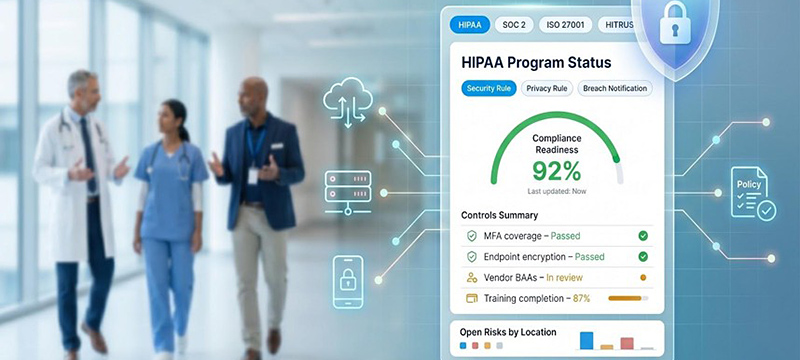
This piece evaluates five top-rated HIPAA compliance software solutions designed for healthcare organizations.
1. Vanta: best for automation-first healthcare tech teams (especially Business Associates)
Vanta serves as a trust management and compliance automation platform crafted for teams that prefer HIPAA to function as a continuous system monitor rather than an annual stressful rush. It is an ideal match for cloud-based healthcare SaaS providers and other Business Associates managing ePHI who may also want to expand into SOC 2, ISO 27001, or HITRUST down the line.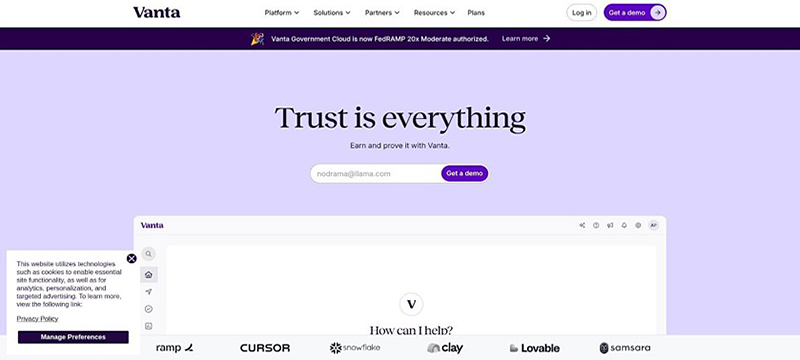
HIPAA coverage note: Vanta fulfills the requirements of the HIPAA Security Rule and Breach Notification Rule, yet it lacks support for the HIPAA Privacy Rule. This difference is crucial. If you operate as a Covered Entity (such as a hospital network, health insurer, or clearinghouse) and require Privacy Rule procedures within the platform, you will probably need to look for an alternative tool.
Vanta truly excels in its depth of automation. It links with over 400 cloud and DevOps platforms, executing tests on a regular cycle (roughly every 1 to 2 hours). It utilizes a HIPAA framework aligned with 73 controls, featuring about 123 automated and manual checks. In real-world terms, this allows you to constantly confirm standard demands like MFA, encryption, access setup, and device health. You’ll get immediate warnings if any control test fails—a process outlined in Vanta’s risk tracking module—and you can funnel these problems into platforms like Jira for fixing.
Vanta also handles the administrative tasks that usually consume a lot of time:
- Policies: A total of 18 policies, with 6 tailored specifically for HIPAA, complete with tools to tailor and handle revisions.
- Training: Comes with integrated HIPAA training, plus the choice to link with KnowBe4 for more comprehensive security awareness materials.
- Vendor and BAA tracking: Business Associate Agreements and vendor risks can be overseen via Vanta’s vendor risk management workflows, ensuring third-party compliance isn’t scattered across various folders.
- Breach readiness: Provides templates and procedures that match the breach-notification duties for Business Associates.
If you are juggling multiple frameworks, Vanta’s control mapping can significantly cut down on redundant work. For many groups, HIPAA has considerable overlap with SOC 2, ISO 27001, and HITRUST, letting you recycle evidence and controls instead of starting your program from the ground up.
Implementation and audit readiness: HIPAA compliance within Vanta is self-attested, eliminating the need to handle an external HIPAA audit schedule. Teams building from scratch usually get up and running in a few weeks to a few months. Organizations that already have a SOC 2 program can often accelerate this process since some controls are already met.
Pricing: HIPAA can be bundled as a framework or added on for $5,000 annually. Total costs for the first year generally fall between $10,000 and $15,000 or more, varying based on the organization’s size and selected extra modules.
Pros: offers the most extensive automation on this list (over 400 integrations and regular testing), excellent cross-framework sharing if you’re tackling HIPAA alongside SOC 2 or HITRUST, and self-attestation removes audit expenses and scheduling delays.
Cons: lacks Privacy Rule support (a significant drawback for many Covered Entities), doesn’t offer native integrations for EHR systems like Epic or Cerner from the start, and might be excessive for small clinics lacking a heavy cloud infrastructure.
Customer proof: Hummingbird Healthcare secured SOC 2 Type 1 and HIPAA in just 3 months. Other reported successes include Modern Health saving over 100 hours each year, Vibrent Health cutting vendor review time from 100 hours down to a handful of hours weekly, and ITx Companies finding 41 percent of HIPAA controls already filled in from an existing SOC 2 program.
2. Compliancy Group (The Guard): best for clinics that want hands-on coaching
The Guard, Compliancy Group’s platform, is designed for healthcare organizations seeking a guided route to HIPAA compliance with actual human assistance. If your main obstacle isn’t the technology, but rather figuring out your next steps and how to properly record them, this stands out as one of the simplest solutions available.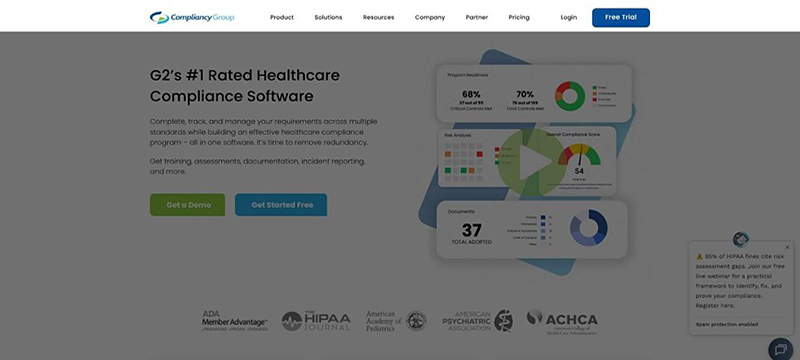
Best for: small to medium-sized medical practices desiring a step-by-step process and continuous support, particularly those lacking specialized IT or compliance personnel.
Unlike numerous “compliance automation” tools that concentrate mostly on gathering technical proof, Compliancy Group focuses on comprehensive HIPAA program coverage. The Guard handles the Security Rule, Privacy Rule, and Breach Notification Rule, and it also provides an OSHA add-on tailored for healthcare entities.
Its core features revolve around assisting you in creating and sustaining the administrative structure that HIPAA demands:
- Security Risk Analysis (SRA): assisted risk evaluations with plans for corrective actions, usually finished in 30 days or less on average (per vendor case studies), with your coach helping you maintain progress.
- Policies and procedures: a collection of over 500 templates that you can adapt to your specific setup.
- Workforce training: built-in educational modules with progress tracking, ensuring training records aren’t stuck in spreadsheets.
- Vendor and BAA tracking: features to oversee vendors and contracts, along with alerts for upcoming renewals.
- Incident management: procedures to log and monitor incidents as well as possible HIPAA breaches.
Automation depth: very high for documentation processes, tracking training, and managing the program. However, it isn’t built for live technical surveillance of your infrastructure (for instance, constantly checking MFA, encryption setups, or cloud configuration shifts). If your primary aim is gathering automated technical proof across cloud environments, you’ll still require extra security tools or a different type of platform.
Implementation and rollout: many organizations rely on the coach-led process to finish their first SRA rapidly, then broaden their scope to include policies, training, vendor oversight, and incident logging over the following 1 to 3 months, depending on their scale and intricacy.
Pricing: Compliancy Group rolled out modular pricing in May 2025 starting at $99 monthly, allowing practices to select only the components they require. Earlier “complete package” rates were typically in the mid-hundreds per month, making this new structure a notable change for smaller clinics.
Pros: dedicated coach assistance throughout the journey, complete HIPAA coverage including the Privacy Rule, and an extensive policy template collection supported by extensive healthcare compliance background.
Cons: few technical integrations and no ongoing infrastructure control checks, plus a coach-based approach that might feel sluggish for teams favoring a completely self-driven process.
Stand-out differentiator:
The provided text is an excerpt from a comparison article evaluating different HIPAA compliance software platforms. It focuses on three specific tools: Compliancy Group, Accountable HQ, and HIPAA One (by Intraprise Health).
Here is a summary of the key points for each:
### 1. Compliancy Group
* **Best For:** Organizations that need hands-on guidance and a “done-for-you” approach.
* **Key Feature:** Assigns a dedicated live compliance coach to help clinics navigate the process.
* **Customer Proof:** Claims to serve over 4,000 organizations with a 100% client audit pass rate.
### 2. Accountable HQ
* **Best For:** Small to mid-sized practices and startups looking for a self-service portal that scales as they grow.
* **Key Features:**
* Covers all HIPAA rules (Security, Privacy, and Breach Notification).
* Includes an AI Compliance Copilot.
* The “Plus” tier offers high-value proactive security features like phishing simulations and vendor discovery.
* **Pricing:** Tiered subscriptions starting at $169/month (Basic) up to $679/month (Pro), with per-seat add-ons.
* **Pros/Cons:** Great value and clear pricing, but lacks multi-framework support (like SOC 2 or ISO) and deep technical cloud integrations.
### 3. HIPAA One (Intraprise Health)
* **Best For:** Hospitals, health systems, and multi-site networks that require a defensible, audit-grade Security Risk Analysis (SRA).
* **Key Features:**
* Aligns closely with OCR audit protocols and NIST methodology.
* Strong enterprise reporting with “roll-up” visibility across different business units and affiliates.
* Streamlines year-over-year assessments by carrying forward previous data.
* **Pricing:** Typically quote-based enterprise pricing.
* **Pros/Cons:** Excellent for complex, multi-site risk management, but the automation is focused on assessment workflows rather than continuous technical control testing across infrastructure.
Cons:
- Enterprise-level packaging and services can drive up costs for smaller clinics and independent practices
- Monitoring focuses mainly on compliance processes and assessments rather than real-time infrastructure scanning
- Some features may be modular depending on your chosen package, which can add complexity during the purchasing process
Key differentiator: HIPAA One is specifically designed to produce a Security Risk Assessment (SRA) in the exact format and level of detail that auditors require. If your top priority is an “audit-ready SRA with enterprise-level reporting,” this is one of the most straightforward matches on this list.
Customer validation: Intraprise Health reports that HIPAA One serves 16,000 users across more than 10,000 healthcare organisations, and claims a 100% OCR acceptance rate, along with documented case studies showing improved SRA efficiency (vendor-reported figures).
5. Clearwater IRM|Pro: best for enterprise-level risk governance (with managed security)
Clearwater IRM|Pro is designed for healthcare organisations that need more than a simple HIPAA checklist. It’s the right fit when your program spans thousands of assets, multiple facilities, medical devices, and third-party vendors—and you want a single partner that can provide both the platform and the expertise to manage it.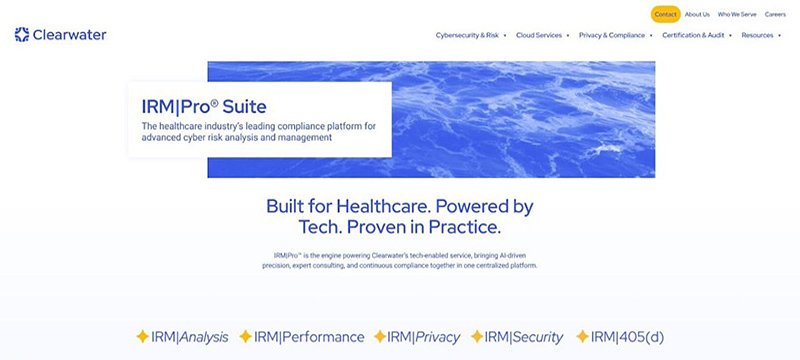
Best for: large health systems, integrated delivery networks (IDNs), hospital chains, and major practice management groups that need healthcare-specific risk modelling along with the option to add advisory services and managed security.
Clearwater’s HIPAA coverage is delivered through a set of modules built to reflect the real structure of a healthcare compliance and security program:
- IRM|Analysis: Security Risk Assessment (SRA) aligned with NIST standards and designed to meet OCR expectations, covering ePHI assets and medical devices.
- IRM|Security: Security Rule compliance assessment workflows.
- IRM|Privacy: Privacy Rule and Breach Notification Rule coverage.
- IRM|405(d) HICP: alignment with the industry-recognised cybersecurity practices published under HICP.
What sets Clearwater apart from lighter HIPAA tools is its approach to “continuous monitoring.” The platform supports organisation-wide risk calculation, prioritisation, and executive-level reporting, but the always-on component comes from Clearwater’s broader service model. Clearwater also provides managed security services with a 24/7 Security Operations Centre (SOC), as well as managed cloud services for Azure environments. For CISOs, this means you can bring together compliance reporting, risk remediation planning, and active security operations under a single vendor relationship.
Automation depth: high for enterprise risk modelling and reporting, and operationally continuous when combined with the managed services layer. This isn’t a self-serve compliance automation tool built around hundreds of ready-made integrations. It’s a healthcare-focused platform that delivers the most value when used alongside Clearwater’s advisory and managed security capabilities.
Multi-framework support: Clearwater’s platform is centred on healthcare and HIPAA, with additional alignment to NIST and 405(d) HICP. Broader frameworks like HITRUST and SOC 2 are typically supported through Clearwater’s compliance services rather than through built-in cross-framework control mapping.
Implementation: plan for a multi-month rollout for enterprise organisations. Deployment typically includes discovery and asset inventory, risk analysis, remediation planning, and setting up ongoing governance processes. Managed services operate continuously once engaged.
Pricing: Clearwater is positioned at a six-figure total cost of ownership and is sold through a consultative process. Expert research estimates an annual investment in the $150,000 to $500,000+ range for a mid-size health system, depending on scope, modules, and services selected.
Pros:
- Detailed healthcare-specific risk modelling across servers, IoMT devices, third-party portals, and medical equipment
- Comprehensive HIPAA program coverage through dedicated modules, including Privacy and Breach Notification support
- Ability to combine compliance governance with a 24/7 SOC and managed security services for a unified operating model
Cons:
- Cost and scope make it impractical for small clinics and early-stage startups
- Value is realised over time and through active engagement—it’s not a “set it and forget it” solution
- Less focused on plug-and-play cloud evidence collection compared to automation-first compliance platforms
Key differentiator: Clearwater is the only option on this list that combines enterprise compliance software with a full managed security practice, including a 24/7 SOC. If you’re looking for both a platform and a partner to help run the program, that’s the defining advantage.
Customer validation: Clearwater reports more than 500 customers, over 20 years dedicated to healthcare cybersecurity, and recognition including 2026 Best in KLAS for Security & Privacy Consulting, Black Book #1 (based on a survey of approximately 2,000 executives), and MSSP Alert Top 250, along with a claimed 100% OCR success rate (vendor-reported figures).
Quick-scan comparison
Use this table to quickly narrow your shortlist, then confirm the right fit through demos based on your HIPAA rule coverage needs (especially Privacy Rule), automation expectations, and budget.
| Platform | Ideal for | Key strength | Deployment | Starting price* |
| Vanta | Cloud-native health-tech teams and Business Associates | 400+ integrations, frequent automated testing | SaaS | HIPAA included as a package framework or $5,000/year add-on (total varies by add-ons) |
| Compliancy Group (The Guard) | Clinics that want a dedicated human coach | Assigned coach plus full HIPAA coverage (including Privacy Rule) | SaaS | from $99/month (modular pricing) |
| Accountable HQ | Practices that want self-serve, tiered HIPAA | Tiered plans with AI Copilot and robust Plus-tier add-ons | SaaS | 7-day free trial, then from $169/month (annual) |
| HIPAA One (Intraprise Health) | Multi-site hospital networks | OCR-aligned, audit-ready SRA with consolidated reporting | SaaS | Quote required |
| Clearwater IRM|Pro | Large IDNs and enterprises | Enterprise risk governance plus managed security options | SaaS or hybrid | Quote required |
*Prices reflect publicly listed rates where available, otherwise vendor quotes. Figures can vary by modules, organisation size, and service level.
Conclusion
HHS’s January 2026 draft HIPAA Security Rule update would require full encryption and multi-factor authentication (MFA) for every system that handles ePHI. The final rule is expected later this year, with a 180-day compliance window—so you’ll need documented evidence fast, not just promises.
The threat landscape is evolving just as quickly. Ransomware attacks against small providers occurred six times more frequently in 2025 than in 2021, and the average healthcare breach now exceeds USD 10.9 million. Continuous monitoring is often far less expensive than a single incident response.
Practical steps to stay ahead:
- Build in continuous risk monitoring. Connect your compliance platform to EHRs, cloud accounts, and mobile-device managers so that any deviation triggers an alert—not a post-breach report.
- Conduct quarterly reviews. Set aside two hours each quarter to review the live risk dashboard, address critical items, and export an audit snapshot. Four focused sessions are far more effective than one frantic year-end scramble.
- Audit your MFA and encryption coverage now. When the Security Rule is finalised, you’ll need proof that every endpoint and user meets the standard.
- Map HIPAA controls to a second framework. Aligning with NIST CSF or HITRUST today earns “recognised security practices” safe-harbour credit if an OCR investigation follows a breach.
Next step: use the evaluation checklist above, select two platforms that match your organisation’s size and technology stack, and schedule demos this week. A modest investment now can help you avoid seven-figure losses—and many sleepless nights—later in 2026.
