



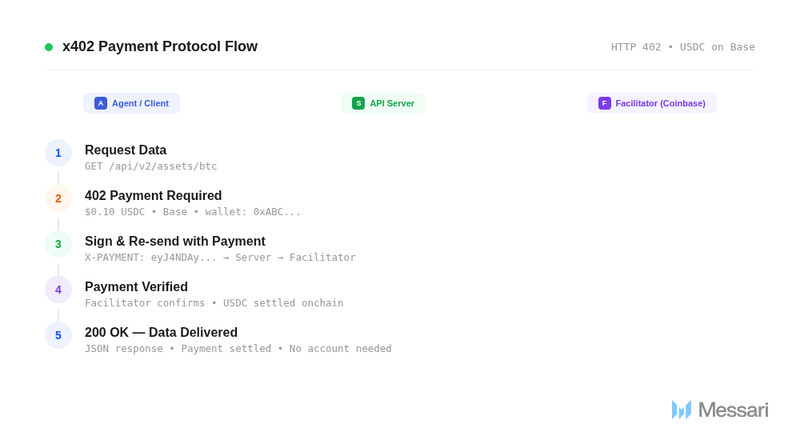
BLUF: x402 is a ridiculously easy solution to pay for an API by simply making an HTTP request. No bank card, no Stripe setup, no logins — a pockets with USDC is all that’s wanted. That simplicity makes it excellent for agent-to-agent funds. At Messari, we have adopted x402 to carry our institutional-grade crypto intelligence to each builder and agent on the web.
Messari + x402: Institutional Knowledge for Each Builder
At Messari, our APIs have lengthy served establishments and enterprises in crypto — hedge funds, VCs, analysis desks, and protocol groups who want complete market intelligence to make selections. We cowl 40,000+ belongings and supply deep analytics on market information, on-chain information, token unlocks, fundraising, X mindshare, trending subjects, and extra.
However traditionally, accessing this information meant signing up for an account, speaking to gross sales, signing a contract, and establishing billing. That is an affordable course of for an enterprise buyer. It is a large hurdle for a weekend builder, a pupil experimenting with crypto information, or — critically — an AI agent that wants market intelligence to finish a job.
We see x402 because the bridge. It brings Messari’s institutional-grade information onto a wider set of builders with out compromising the depth or high quality that our enterprise prospects depend on. A developer in Lagos can question Messari’s AI chat endpoint for a crypto market abstract and pay $0.10 in USDC. An autonomous agent managing a DeFi portfolio can pull real-time asset information, token unlock schedules, and market alerts — paying per request, no contract wanted.
This is the pricing breakdown for Messari’s x402 endpoints.
The philosophy is easy: entry to Messari’s enterprise-grade information, paid in a means that brokers and builders can use natively, dynamically with low-friction.
What’s x402?
Each developer is aware of HTTP standing codes. 200 means success. 404 means not discovered. However there’s one code that is been sitting dormant within the HTTP spec since 1997: 402 Cost Required. For practically three a long time, the spec merely stated “reserved for future use.”
The longer term arrived in 2025.
x402 is an open, internet-native fee protocol developed by Coinbase that revives that long-dormant standing code and turns it into one thing actual: a standardized means for purposes, APIs, and AI brokers to ship and obtain immediate stablecoin funds instantly over HTTP. No accounts, no classes, no legacy billing rails required.
The protocol was co-founded by Coinbase and Cloudflare, and has since been adopted by Google, Vercel, Stripe, and Solana as a part of the rising agentic funds stack. It really works on Base, Solana, and an increasing set of EVM chains.
This is the great thing about it: x402 is simply HTTP with a fee header. If you hit an x402-enabled endpoint, the server responds with a 402 Cost Required standing code together with the worth, pockets tackle, and chain. Your consumer indicators a USDC fee authorization, attaches it to the request header, and re-sends. The server verifies the fee via a facilitator (Coinbase being the commonest), collects the USDC, and returns your information. Achieved.
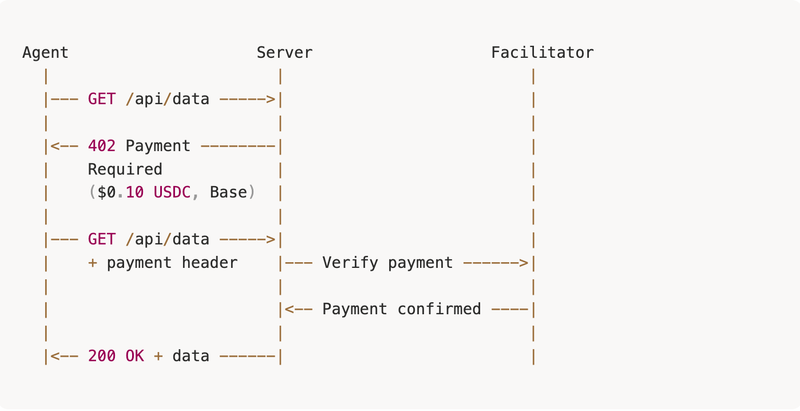
That is it. If you can also make an HTTP request, you can also make an x402 fee. Most customers do not want to consider the fee stream in any respect — the libraries deal with it. However it’s price appreciating how seamlessly x402 interfaces with the prevailing request/response sample that powers the whole web.
What Drawback Does x402 Resolve?
The web was constructed on a easy mannequin: request, response. A consumer asks for one thing, a server sends it again. HTTP made this so dependable that it turned the spine of each digital interplay — net pages, APIs, streaming, and now brokers.
Brokers are hungry to interface with the world, however with out the power to make funds, an agent is restricted within the actions it might probably take. Right here’s the present paradigm for funds on the net: once you and I (people) needs to purchase one thing on-line, we get redirected to a checkout web page, enter a bank card quantity, authenticate via a financial institution, watch for a service provider processor to approve the transaction, after which lastly get routed again to the merchandise we bought. Moreover, conventional fee rails weren’t constructed for micropayments. Stripe has a minimal threshold of $0.50+ per transaction and prices $0.30 + 2.9% in charge, making small funds impractical. That is effective for people doing e-commerce. It is impractical for brokers.
Stablecoin funds on blockchain do not have these constraints. They don’t seem to be beholden to fastened charge buildings — the one value is fuel, which on Base averages round $0.015 and on Solana is nearer to $0.003. They settle near-instantly with finality. And native programmability allows conditional funds: fee is made provided that a selected situation, like a sound API response, is met.
However low cost settlement alone is not sufficient. You additionally want a protocol — a standardized means for any consumer to find {that a} service prices cash, study the worth, pay, and obtain the products.
Again to the ubiquity of HTTP. x402 is an HTTP protocol with HTTP code 402. It augments the potential of HTTP and makes fee native to the best way software program already communicates. No OAuth flows, no billing dashboards. Simply an HTTP header.
The result’s that the “pay” motion turns into so simple as the “HTTP GET” motion. And when paying is as frictionless as fetching, brokers can function via of micro-decisions and micro-transactions.

Now that’s not to say that an agent can simply go rogue and spend all of the fund it has. That is the place guardrails on the agent degree and the pockets degree are vital. [more on this later]
Getting Began with Messari x402
Okay, that’s sufficient background data. Let’s stroll via utilizing x402 in apply.
Custodial vs Non-custodial Wallets
There are a number of methods to connect with Messari’s x402-enabled APIs relying in your setup and preferences. I will stroll via every one. The principle consider your alternative of integration is whether or not you like a custodial or non-custodial pockets. For a custodial pockets, a 3rd celebration like Coinbase or AgentCash manages your personal keys. Whereas for non-custodial wallets, you might have full accountability for handle and securing your personal keys.
Coinbase Funds MCP
The quickest solution to get began with out managing personal keys is by leveraging Coinbase’s Funds MCP. This offers you simple hosted pockets authenticated together with your Coinbase account. Funds MCP offers Claude (and different MCP-compatible brokers) a pockets and the power to find and pay for x402 companies autonomously. Authenticate together with your e-mail, fund the embedded pockets with USDC on Base via Coinbase Onramp, and also you’re dwell. Your agent can now uncover x402 endpoints, consider pricing, make funds, and retrieve information — all with out you lifting a finger after the preliminary setup.
1. Coinbase Funds MCP + Claude Desktop
1.1 Set up the Coinbase Cost MCP
Shut Claude Desktop whether it is open and run the next command in your terminal
npx @coinbase/payments-mcp@newest --client claude --auto-config
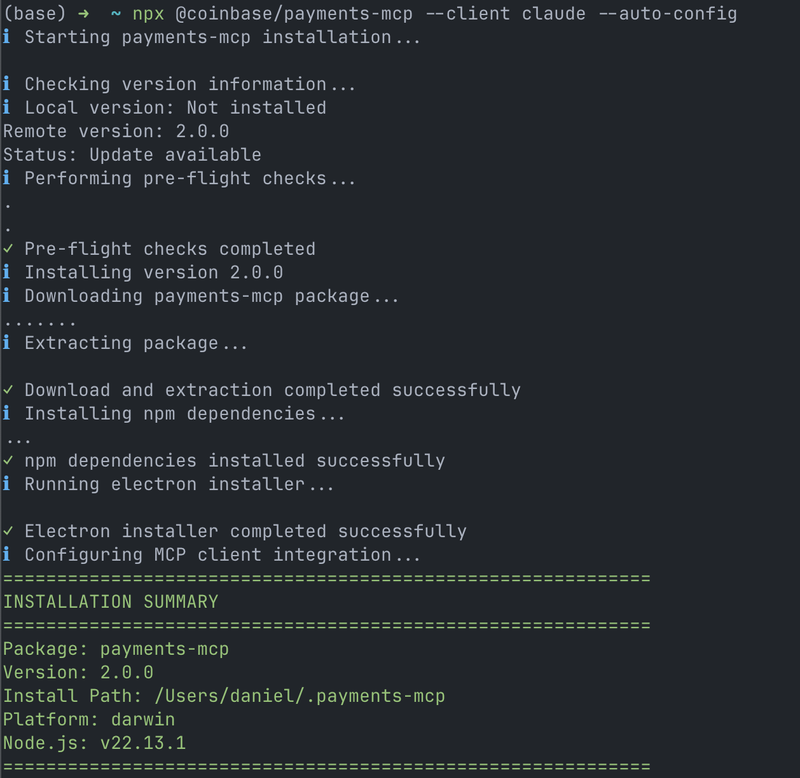
Now when you launch Claude Desktop it is best to see the payment-mcp listed underneath “Local MCP Servers”
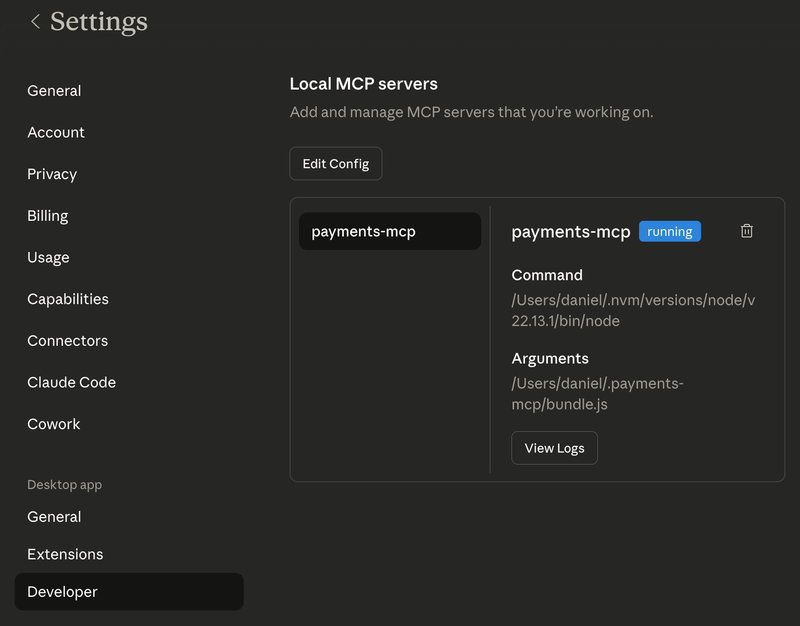
1.2 Authenticate together with your x402 pockets
Now you may ask Claude to Open the payments-mcp pockets
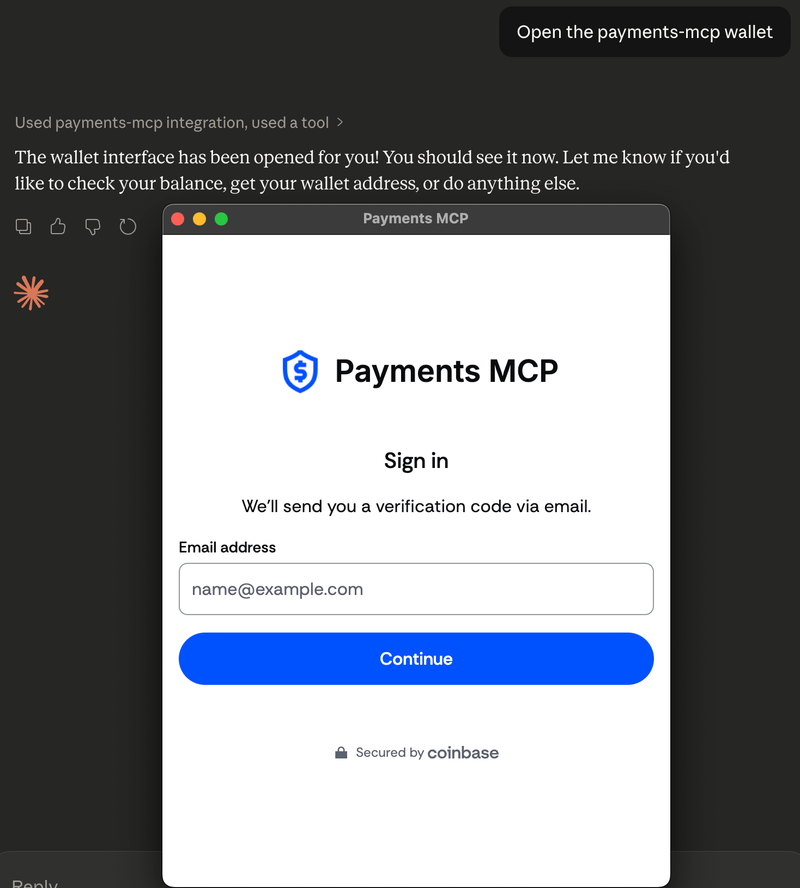
Signal together with your coinbase e-mail and your pockets is able to use. Add USDC to the pockets with the “Fund” or “Receive” buttons
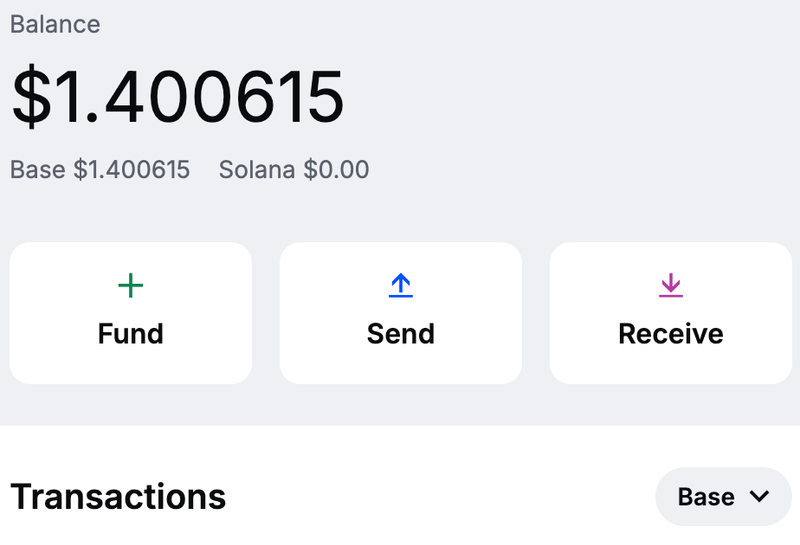
1.3 Get the Messari Talent
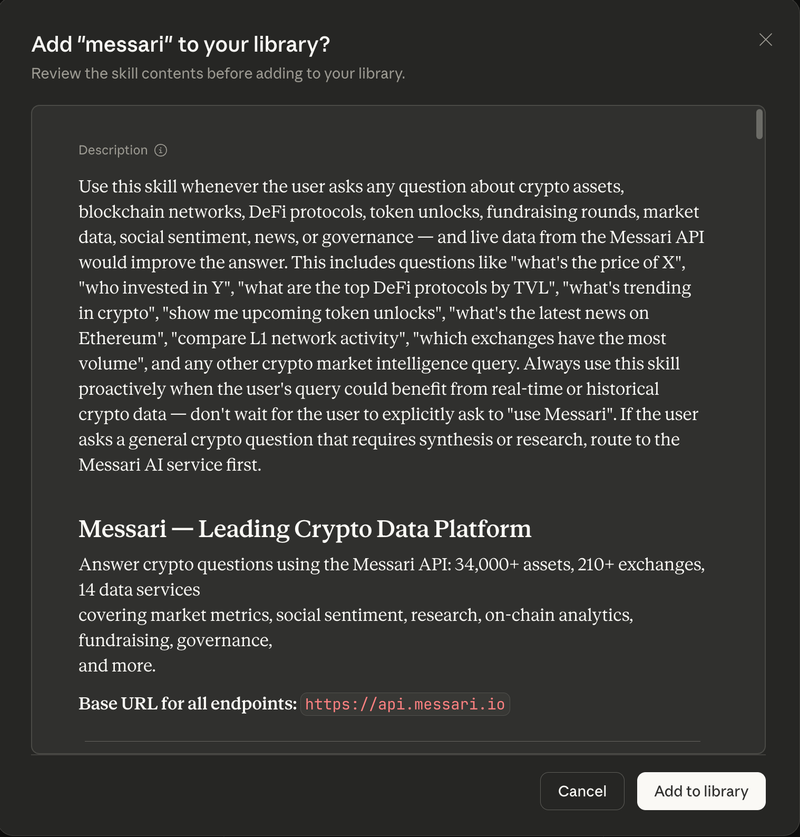
Now you’re all set pockets clever, we have to set up the Messari Talent (a markdown doc to let Claude know find out how to work together with our APIs)
- Obtain this messari.talent file
- Click on the file to open it with Claude Desktop
- Click on “Add to Library”
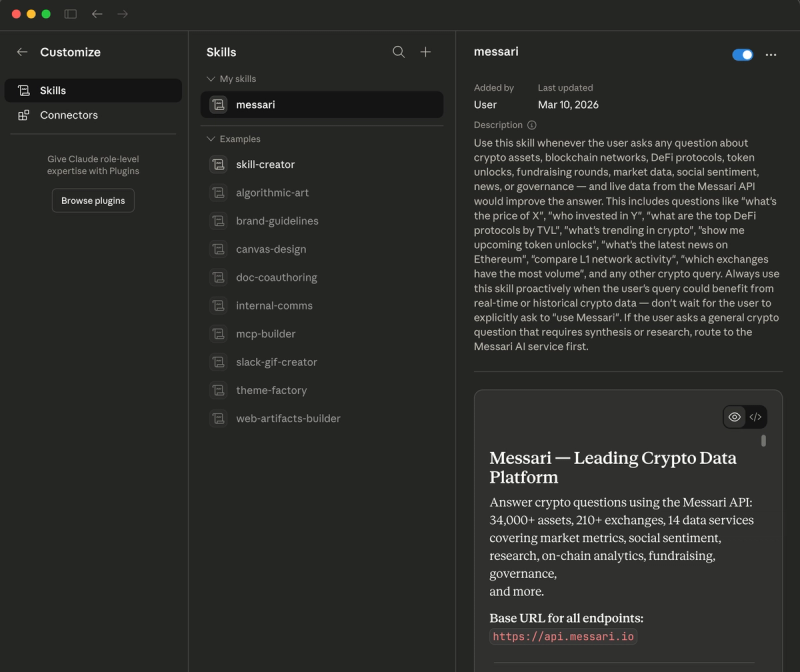
1.4 Utilization
And also you’re executed! Now you can ask Messari something about crypto instantly from Claude
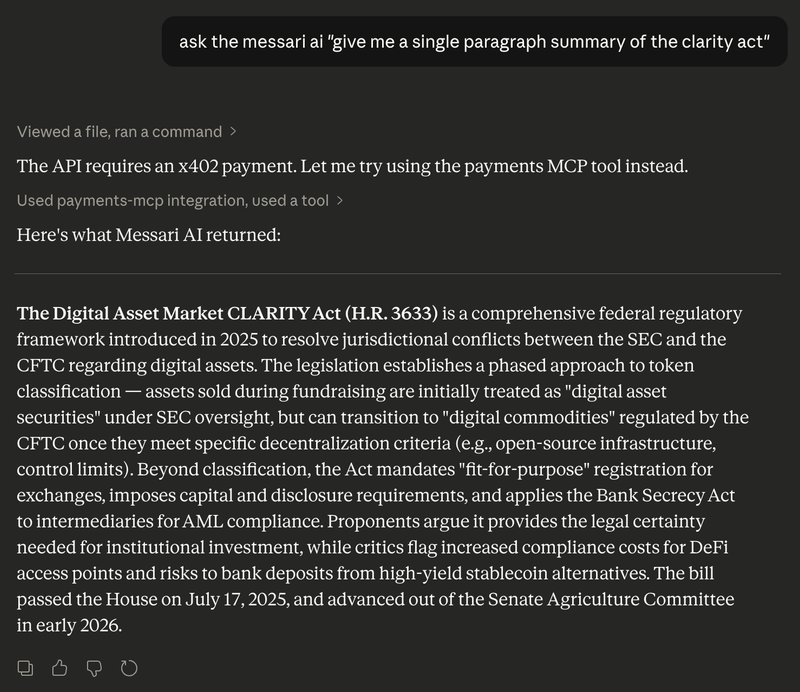
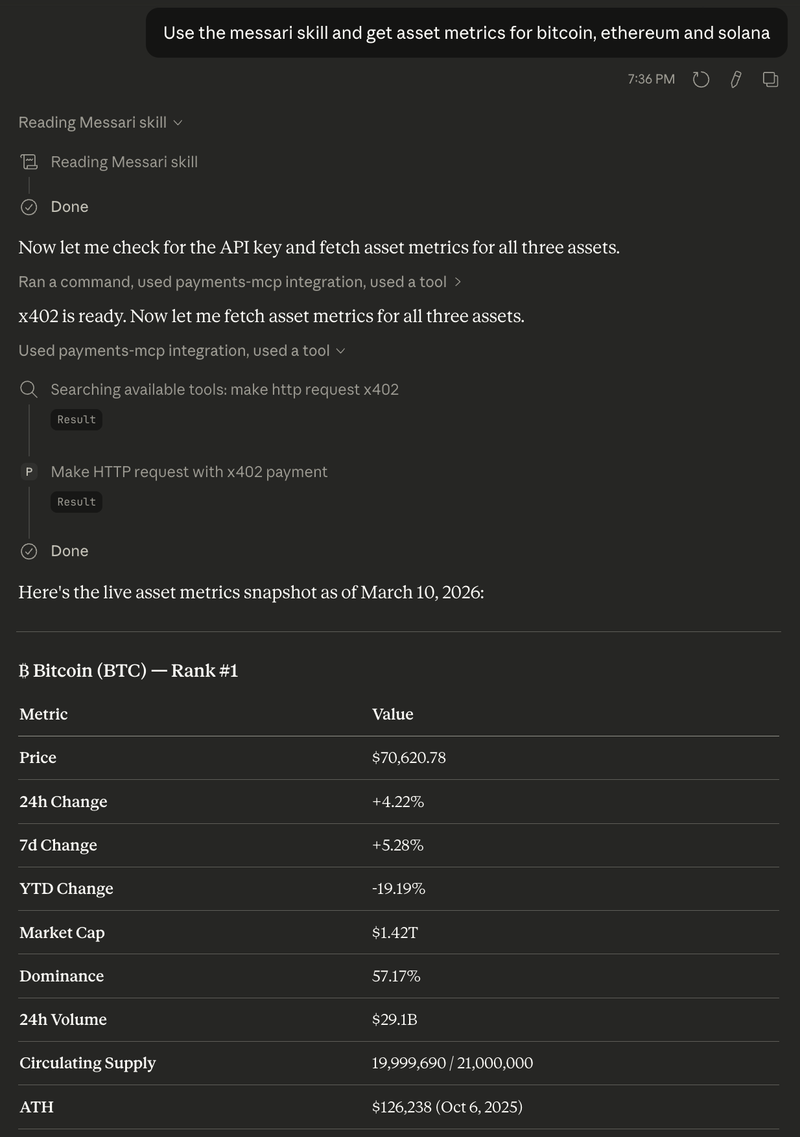
2. Coinbase Funds MCP + Claude Code (Command-line)
For Claude Code customers as an alternative of Claude Desktop, the setup course of may be very related however there are some small variations.
2.1 Set up the Coinbase Cost MCP
Shut any open Claude Code classes and run the next command in your terminal:
npx @coinbase/payments-mcp@newest --client claude-code --auto-config
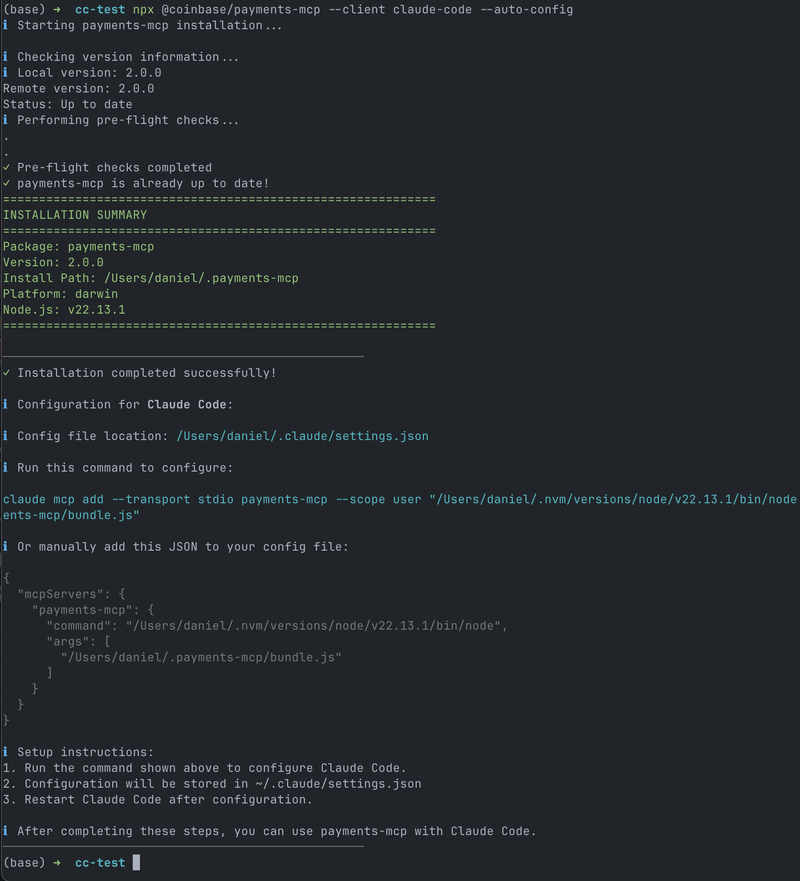
Run the command proven to you.
IMPORTANT: Double examine the quotes when copying the command, it ought to be claude mcp add --transport stdio payments-mcp --scope consumer "COMMAND" "ARGS"
not
claude mcp add --transport stdio payments-mcp --scope consumer "COMMAND ARGS"
As soon as executed, begin a Claude Code session and examine the standing of the MCP server with /mcp command, it is best to see the payments-mcp server related
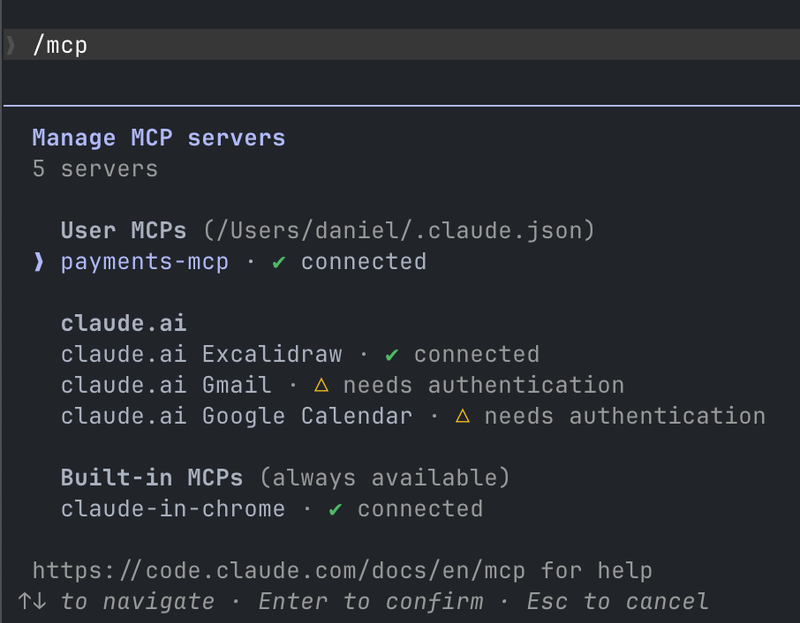
2.2 Authenticate together with your x402 pockets
Now you may ask Claude to Open the payments-mcp pockets
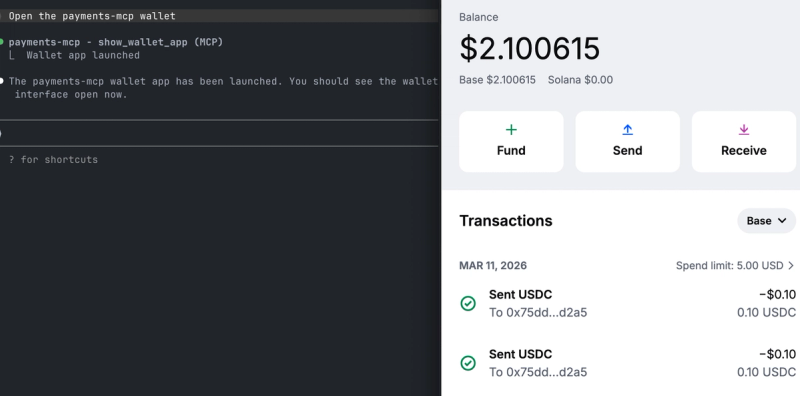
You’ll be able to then signal into your coinbase account and add USDC to the pockets with the “Fund” or “Receive” buttons.
2.3 Get the Messari Talent
Now that your pockets is prepared, you may add the Messari Talent
npx abilities add messari/abilities -a claude-code
Claude Code ought to now have the Messari Talent accessible
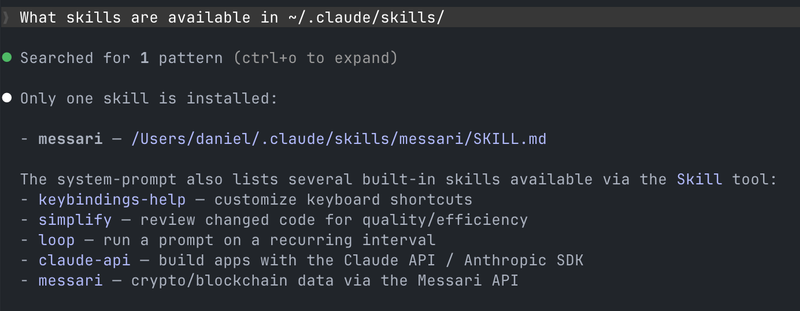
2.4 Utilization
And now you’re able to ask Messari something about crypto
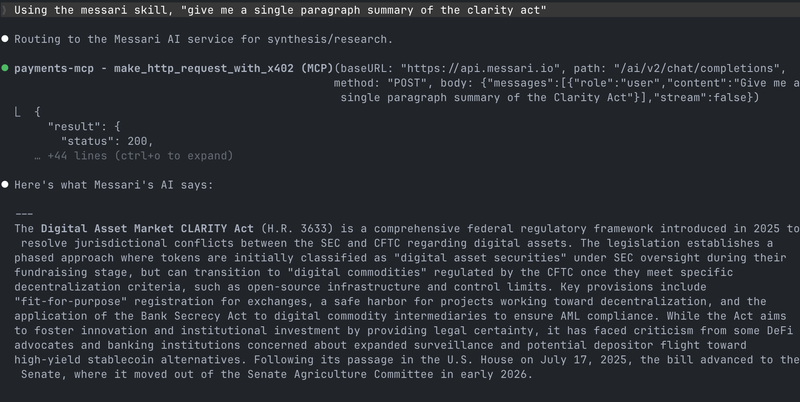
3. With OpenClaw
OpenClaw (the open-source autonomous agent previously often called Moltbot) is an very fashionable AI Agent framework.
3.1 Set up the Messari Talent
It’s very simple so as to add the Messari talent to your OpenClaw. Within the challenge listing, run the next command:
mkdir -p abilities/messari && curl -o abilities/messari/SKILL.md https://raw.githubusercontent.com/messari/skills/refs/heads/master/openclaw-skill/SKILL.md
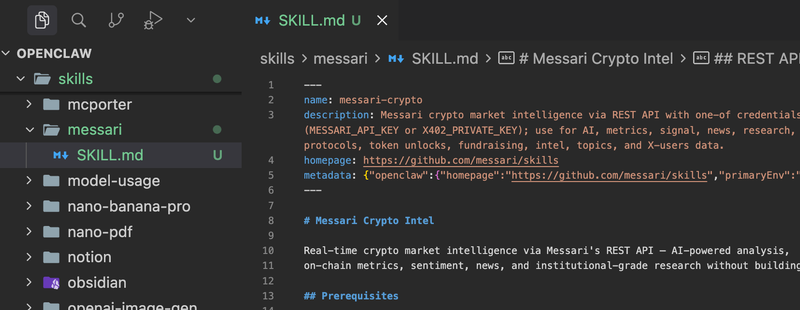
3.2 Add the Setting Variables
As an alternative of utilizing a custodial pockets like Coinbase, we’ll be utilizing a self-hosted pockets with a personal key. Add the important thing to your ~/.openclaw/openclaw.json file.
🚨 IMPORTANT SECURITY NOTICE 🚨: The OpenClaw agent framework shouldn’t be thought-about a safe system. Secrets and techniques and personal keys are probably vulnerable to leaking as a consequence of immediate injection, malicious third celebration authored abilities and different safety vulnerabilities. Earlier than saving a pockets personal key, it is best to create a brand new pockets and contemplate it insecure. Maintain solely the minimal quantity of USDC required in it. Learn extra about OpenClaw safety right here
{
    "skills": {
        "install": {
        "nodeManager": "npm"
        },
        "entries": {
        "messari": {
            "enabled": true,
            "env": {
            "X402_PRIVATE_KEY": ""
            }
        }
        }
    }
}
Restart OpenClaw to use the modifications. And examine that the talent is put in.
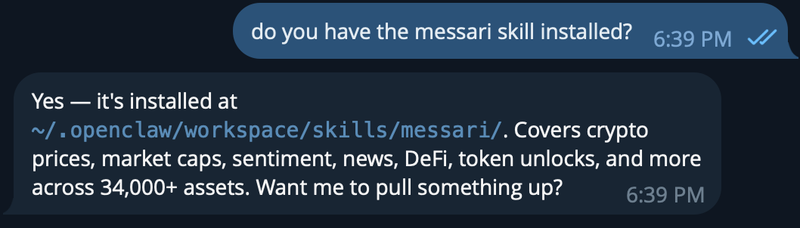
3.3 Utilization
And now you are able to ask Messari something about crypto via your OpenClaw.
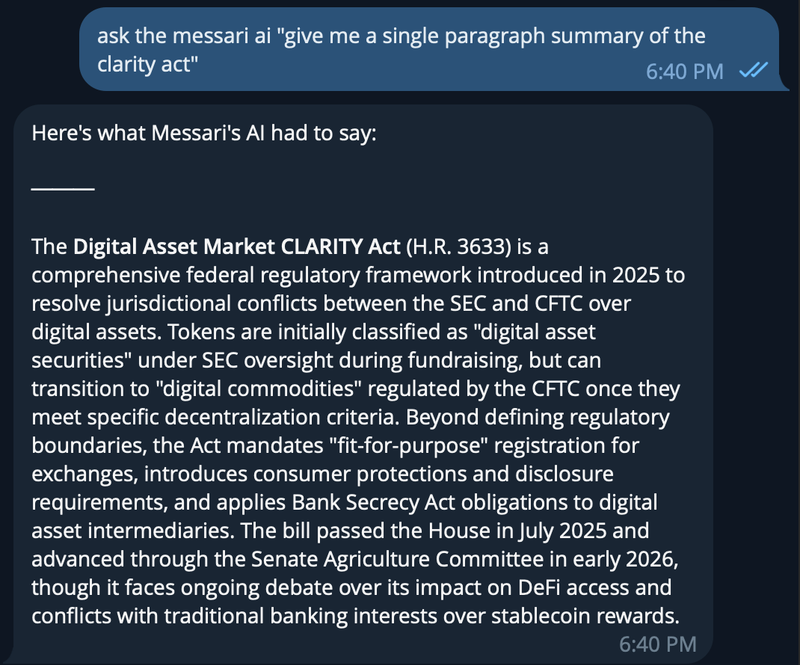
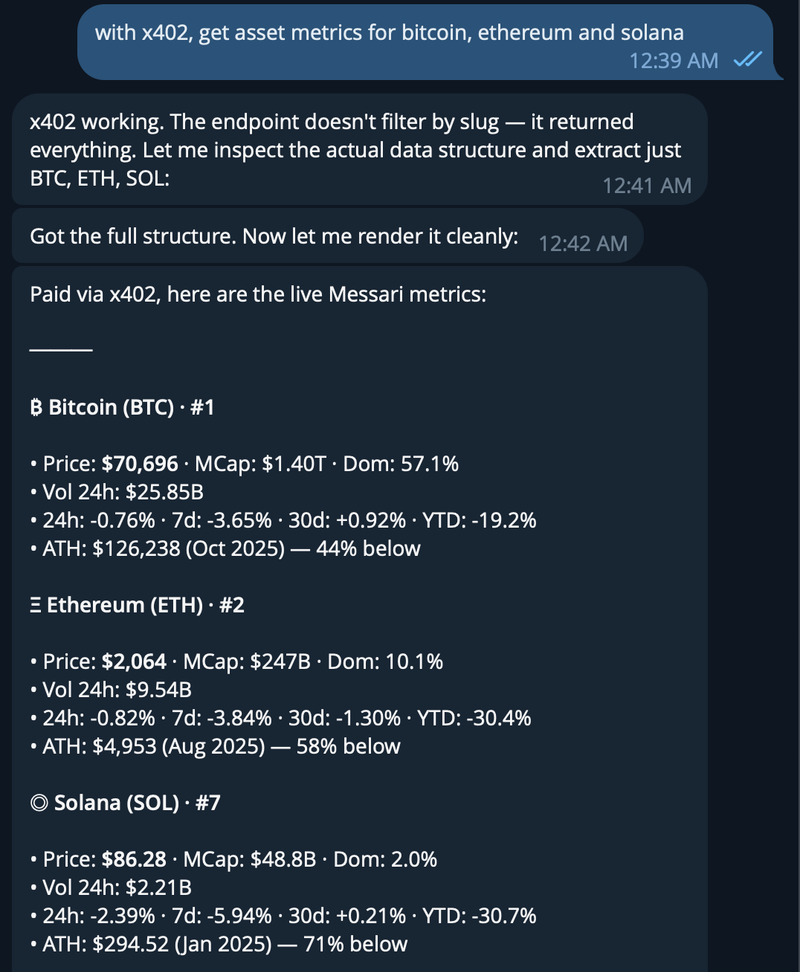
4. With TypeScript / Python + Pockets
For builders seeking to name the our APIs instantly. x402 has handy packages that deal with the signing in Typescript, Python and Golang, some examples under. See [docs.messari.io/api-reference/x402-payments](< for the total catalog of obtainable endpoints.
TypeScript:npm set up @x402/fetch @x402/evm viem
import { wrapFetchWithPaymentFromConfig } from '@x402/fetch';
import { ExactEvmScheme } from '@x402/evm';
import { privateKeyToAccount } from 'viem/accounts';
const account = privateKeyToAccount(course of.env.PRIVATE_KEY as `0x${string}`);
const fetchWithPayment = wrapFetchWithPaymentFromConfig(fetch, {
  schemes: [{ network: 'eip155:8453', client: new ExactEvmScheme(account) }],
});
const response = await fetchWithPayment(
  '<
  {
    methodology: 'POST',
    headers: { 'Content material-Sort': 'software/json' },
    physique: JSON.stringify({
      messages: [{ role: 'user', content: 'What is happening in crypto today?' }],
      verbosity: 'succinct',
      response_format: 'markdown',
      stream: false,
    }),
  }
);
const information = await response.json();
console.log(information);
Python:
pip set up x402-python
import os
from x402 import PaymentClient
consumer = PaymentClient(
    private_key=os.environ["PRIVATE_KEY"],
    community="base"
)
response = consumer.fetch(
    "<
    method="POST",
    json={
        "messages": [{"role": "user", "content": "Top crypto news today?"}],
        "verbosity": "succinct",
        "response_format": "markdown",
        "stream": False,
    }
)
print(response.json())
The steps to get going are easy:
- Ship a small quantity of USDC to a pockets on Base ($1 is greater than adequate)
- Export your personal key as an atmosphere variable (by no means hardcode it)
- Run the script above
The fee transaction will get logged onchain on Base. You’ll be able to confirm it on Basescan.
5. Video Demos
We’re constructing out video walkthroughs for every integration path. Test the Messari docs for the newest demos and tutorials — we replace these regularly because the ecosystem evolves.
The x402 Ecosystem
x402 is not simply Messari. The ecosystem is increasing quickly, and it is price understanding the panorama.
x402scan
x402scan is the ecosystem explorer for x402 — suppose Etherscan however for x402 funds. It tracks dwell transaction quantity, energetic facilitators, high assets, and community breakdowns throughout the protocol.
The numbers are nonetheless early days. However the trajectory is what issues. Transaction volumes have surged 700%+ in current months, and the common transaction dimension has declined from $2.50 at launch to round $0.06 — a transparent sign that the protocol is discovering its footing in true micropayment territory reasonably than one-off experiments.
The x402 Basis (established by Coinbase and Cloudflare) maintains an ecosystem listing that continues to develop. Present contributors embrace facilitators like Dexter, PayAI, and Heurist; chains like Base, Solana, and Polygon PoS; and a rising roster of API suppliers, agent frameworks, and tooling.
Discoverability by Brokers: Untapped Potential
This is the factor that excites me most about x402: discoverability.
Proper now, most APIs require a developer to know they exist, learn the docs, enroll, get an API key, and combine. That is a human-driven discovery course of. With x402, an agent can uncover a paid service on the protocol degree. It hits an endpoint, will get a 402 response with pricing, and decides in actual time whether or not the info is price paying for.
This inverts the API discovery mannequin. As an alternative of builders discovering APIs and wiring them into brokers, brokers can discover APIs themselves and pay on the spot. Google’s integration of x402 into its Agentic Funds Protocol (AP2) is an early sign of this route — brokers that may autonomously uncover, consider, and pay for companies.
We’re nonetheless early on the discoverability entrance. The tooling for brokers to browse, evaluate, and choose x402 companies is nascent. However the basis is laid: a standardized fee interface signifies that constructing agent-native service marketplaces turns into a lot less complicated. That is an space Messari is watching carefully and actively constructing towards.
The Future: What can this develop into?
Three foundational protocol layers are converging: x402 for funds, ERC‑8004 for identification and repute, and autonomous agent frameworks resembling OpenClaw. Collectively, these protocol layers outline the infrastructure for an economic system wherein autonomous brokers and people transact facet by facet.
This imaginative and prescient is starting to materialize via our x402 launch, which permits brokers to question Messari for market intelligence and generate an institutional‑high quality crypto briefing.
Powered by x402’s integration of funds and information alternate, autonomous brokers can now function as energetic contributors in monetary markets. Think about, as an example, a portfolio supervisor who wakes up every morning, pulls Messari for a market briefing, runs a sentiment evaluation API for social alerts, references an onchain analytics service for whale exercise, then synthesizes these inputs to rebalance a portfolio. Every interplay is an agent‑to‑agent fee, and every service is found and evaluated with out human involvement.
Or contemplate an agent that manages a treasury for a DAO. It displays governance proposals throughout protocols, pays for authorized evaluation on regulatory implications, pays for monetary modeling on treasury allocation eventualities, and presents suggestions to token holders, all autonomously.
We’re on the early days and are seeing an inkling of whats potential for an autonomous financial actor on x402 and Base. Brokers deploying good contracts, publishing code, managing capital, and delivering companies to different brokers. Whereas experimental, it’s illustrating a broader sample wherein brokers earn, spend, and compound repute via actual financial exercise.
The infrastructure required to unlock this mannequin is taking form. x402 offers brokers the power to pay for digital assets. ERC-8004 offers them persistent identification and verifiable repute. Merchandise like Funds MCP, AgentCash, Bankrbot, and Clanker give them entry to wallets and capital. MCP and Agent2Agent (A2A) give them communication requirements.
At Messari, our analysis and information have all the time been constructed for decision-makers, and more and more these decision-makers will embrace machines. x402 is how we meet brokers on the API layer: paying per request by way of frictionless protocol.
For deeper evaluation, our analysis crew has revealed a number of items that map out the agent economic system:
- Enterprise Observe: Exploring the Way forward for Agentic Commerce: explores how x402’s micropayment infrastructure competes with conventional fee rails, the facilitator panorama, and which networks will win the agentic commerce race.
- When Machines Develop into Financial Actors: examines the convergence of x402 funds, onchain identification (ERC-8004), and autonomous brokers like OpenClaw. The thesis: the following customers onchain are machines.
- Evaluating the Way forward for Web Cost Protocols: a broader have a look at how internet-native fee protocols will reshape commerce.
In case you are constructing with brokers and wish to combine Messari’s information, begin right here: docs.messari.io/api-reference/x402-payments. Tell us what you wish to see from us subsequent! Attain out to us at api@messari.io or
