



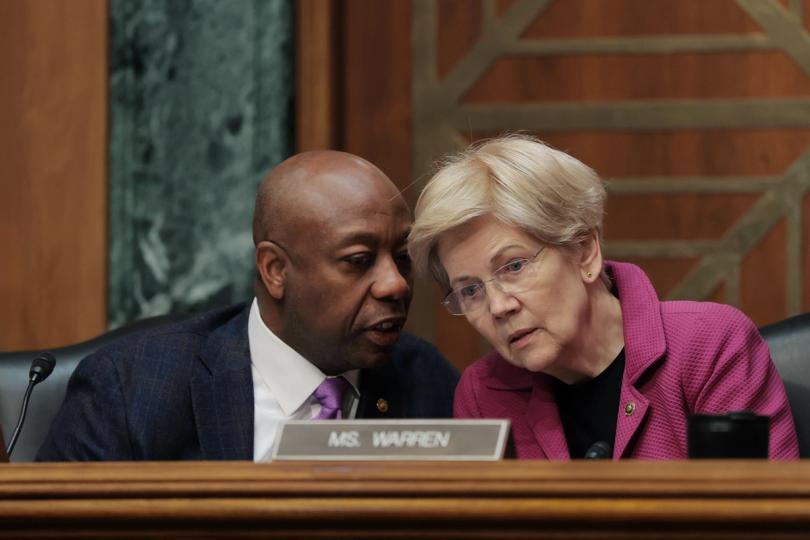
{"paraphrased_html":"<img src="https://cdn.sanity.io/images/s3y3vcno/production/f1c260d4361809906edf5431978e6a0befdf6c2d-3764×2509.jpg?fm=jpg&w=1920&h=1080&crop=focalpoint&fit=clip" /><br><div><p>During the recent Senate Banking Committee’s review of the Digital Asset Market Clarity Act (CLARITY), Senator Angela Alsobrooks (D-MD) shared a personal story that should strike a chord with every parent nationwide. She spoke about her twenty-year-old daughter and her peers—how naturally drawn they are to digital assets and how eager they are for an updated financial system that balances opportunity with safety.</p><p>This highlighted the increasing seriousness and urgency around digital asset policy in Washington. “The digital revolution is here,” Senator Alsobrooks noted. “It’s happening whether we participate or not. We must regulate it and establish clear rules.”</p><p>Her comments reflected a growing realization that the U.S. can no longer afford to address digital assets reactively. This legislation isn’t just about today’s America—it’s about tomorrow. We owe it to our children and younger generations to get these policies right.</p><p>Chairman Tim Scott framed the discussion around opportunity, values, and the American dream for working families. Senator Cynthia Lummis, one of Congress’s earliest Bitcoin advocates, stressed the bipartisan effort behind the bill. Even senators who did not yet back the measure, like Senator Lisa Blunt Rochester, spoke thoughtfully about how deeply involved her constituents are with this technology and the need for safeguards.</p><p>The key question now is whether the U.S. will take the lead in shaping the future or ignore that duty.</p><p>The 15-9 vote to advance Clarity to the Senate floor highlights three key truths about the American economy’s future.</p><p>First, meaningful bipartisan policy on digital assets is not only possible—it’s already underway. The markup demonstrated that thoughtful discussion and serious policy can still move Washington ahead. Even senators who voted against the bill, such as Senator Mark Warner (D-VA), expressed their commitment to continue working toward a productive solution.</p><p>Leaders including Senators Scott, Lummis, Tillis, Alsobrooks, Gallego, Hagerty, Moreno, and others are determined to find common ground—even on complex issues like stablecoin yield—proving that a bipartisan approach is the only lasting solution.</p><p>Second, digital assets and blockchain are permanent. As senators from both parties stated throughout the hearing, the debate over digital assets’ validity is settled. The only question is whether the U.S. will guide digital finance’s future or let others take the lead.</p><p>Nearly 68 million Americans, or about 1 in 5, already hold digital assets. Recent Harris polling shows this number grew by 12 million in the past year, moving closer to 1 in 4. They include teachers, construction workers, veterans, entrepreneurs, and small business owners—one-third Gen Z and another third millennials. They use digital assets to send money to family, make purchases, and plan their financial futures. 83% of American holders agree stronger regulation is needed for consumer protection. Yet 88% of global crypto trading happens on exchanges outside U.S. supervision. Americans deserve the oversight and certainty only a federal framework can provide.</p><p>Third, Congress must complete the task. The time is urgent. The full Senate must act quickly.</p><p>The GENIUS Act set the foundation with stablecoin rules, but without Clarity to establish market structure, trading platform oversight, and asset classification, the U.S. risks leaving the work incomplete. As Treasury Secretary Scott Bessent has said, stablecoins without broader market structure are a “foundation without walls.” If we don’t act, we risk driving the next wave of American innovation—and the talent, investment, and technology that comes with it—to overseas.</p><p>This critical work is also our responsibility as an industry. Full market structure won’t come because we demanded it; it will come because we match the seriousness Congress has shown. Now is the time to keep engaging thoughtfully with lawmakers’ concerns. This is not an obstacle—it’s the work.</p><p>The markup proved momentum is on our side. The determination in that room showed Washington understands the stakes for American competitiveness and digital finance’s future. We have the support, bipartisan backing, and duty to ensure digital finance’s future is unmistakably American.</p><p>America has always led by embracing innovation, open markets, and the rule of law. The door is open. The only question is whether we’ll shut it on our terms.</p><p>A vote for Clarity is a vote for regulation—the rules this generation needs and the next will inherit. Congress now has the chance to guide this technology instead of chasing it. Let’s finish the job on the Senate floor.</p></div>"}
Trending
- Four REVSTEALER-Driven Modules Bypass Windows Security to Unleash Hidden Crypto Mining
- GPT-6 Astra Has Arrived: OpenAI’s Boldest Leap Toward Artificial General Intelligence
- Contractors Demand Transparency: What Data Is Missing from the Continuous Vetting Clearance Model?
- Beyond the Portal: The Evolution Revolutionizing IoT Connectivity Management
- Inside Perplexity’s GPU Embedding Engine: Ivy, Tulip, and ROSE Power pplx-embed
- CUA-Lite Unleashed: UC Berkeley’s Open Platform Unifying Sandboxes, Data, Evaluation, and RL for the Future of Computer-Use Agents
- Drone Defense: Is Military Tech Winning the High-Stakes Arms Race?
- Attackers Ride Unpatched TeamCity Flaw to Plunder AWS Credentials from JetBrains Cadence
