



**The Future of AI Agents: Why Sandboxing Alone Isn’t Enough**
The landscape of agentic AI is evolving at a breathtaking pace. Security and efficiency are paramount as these autonomous systems become more integrated into our infrastructure. A recent deep dive into two groundbreaking Kubernetes-native projects, **agent-sandbox** and **agent-substrate**, reveals a clear path forward: securing agents is just the first step, and true scalability requires a smarter runtime model.
**Beyond the Sandbox: Securing Agent Execution**
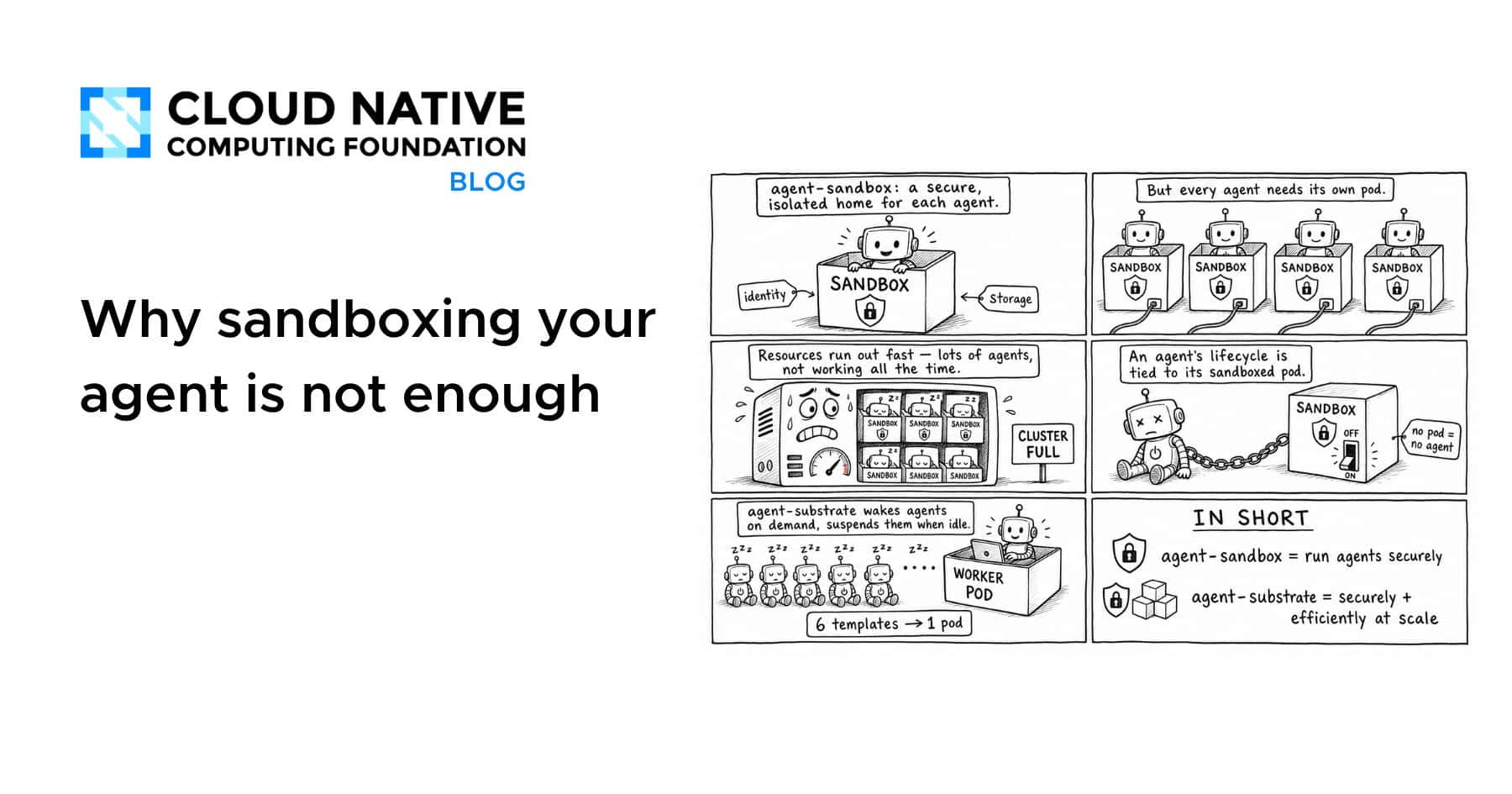
The initial reaction to AI agent risks is often to build a tighter sandbox. Projects like **agent-sandbox** do exactly this, providing a Kubernetes Sandbox CRD and controller. Its primary mission is to ensure security and manageability through strong agent identities, persistent storage, and lifecycle management. In short, it makes agent execution a secure, Kubernetes-native first-class citizen, preventing unwanted side effects like data loss or system modification.
**The Scalability Challenge: From Sandbox to Substrate**
While sandboxing answers *”How do we run agents securely?”*, it doesn’t address the critical question of *”How do we run them efficiently at scale?”* This is where **agent-substrate** comes in. Instead of binding an agent to a persistent pod, agent-substrate decouples the agent’s “actor” from its execution environment. Agents become ephemeral, on-demand workloads that execute in secure, lightweight sandboxes (like gVisor or Kata Containers) and then suspend, freeing up resources.
This shift from persistent pods to dynamic, serverless-like execution is a game-changer. It solves the fundamental trade-off between resource waste (keeping idle agents running) and operational overhead (constantly spinning pods up and down).
**A Powerful Synergy: kagent and the Substrate Model**
The true power of this architecture is realized when combined with tools like **kagent**. kagent’s declarative, YAML-driven simplicity provides clear visibility into the cluster’s desired state. Integrating agent-substrate allows this simplicity to scale dramatically. Instead of a one-pod-per-agent model, a shared worker pool can dynamically execute hundreds of agents on demand.
For instance, multiple AIRE agents, each with distinct skills, can map to different actor templates yet share a single worker pod when not running concurrently. This creates an economically viable system where agent fleets are not just safe, but also dense and efficient.
**The Path Forward: Efficient, Ephemeral, and Secure**
The future of agentic AI in Kubernetes isn’t about choosing between security and scale. Projects like agent-sandbox and agent-substrate demonstrate that we can have both. As AI adoption grows, the industry must move beyond treating agent lifecycle management as an afterthought tied to Kubernetes pods. The goal is a dual focus:
1. **Security & Identity:** Ensuring every agent runs in a controlled, policy-enforced environment.
2. **Efficiency & Ephemerality:** Treating agents as transient, serverless workloads to optimize resource use and reduce costs.
The transition to scalable, efficient, and ephemeral agents is not just a technical improvement; it’s a necessity for the sustainable and economic adoption of AI in cloud-native environments.
—
**Original Article:**
Lin Sun (Solo.io) | CNCF Ambassador. (July 7, 2026). *Why sandboxing your agent is not enough*. CNCF. Retrieved from https://www.cncf.io/blog/2026/07/07/why-sandboxing-your-agent-is-not-enough/
