



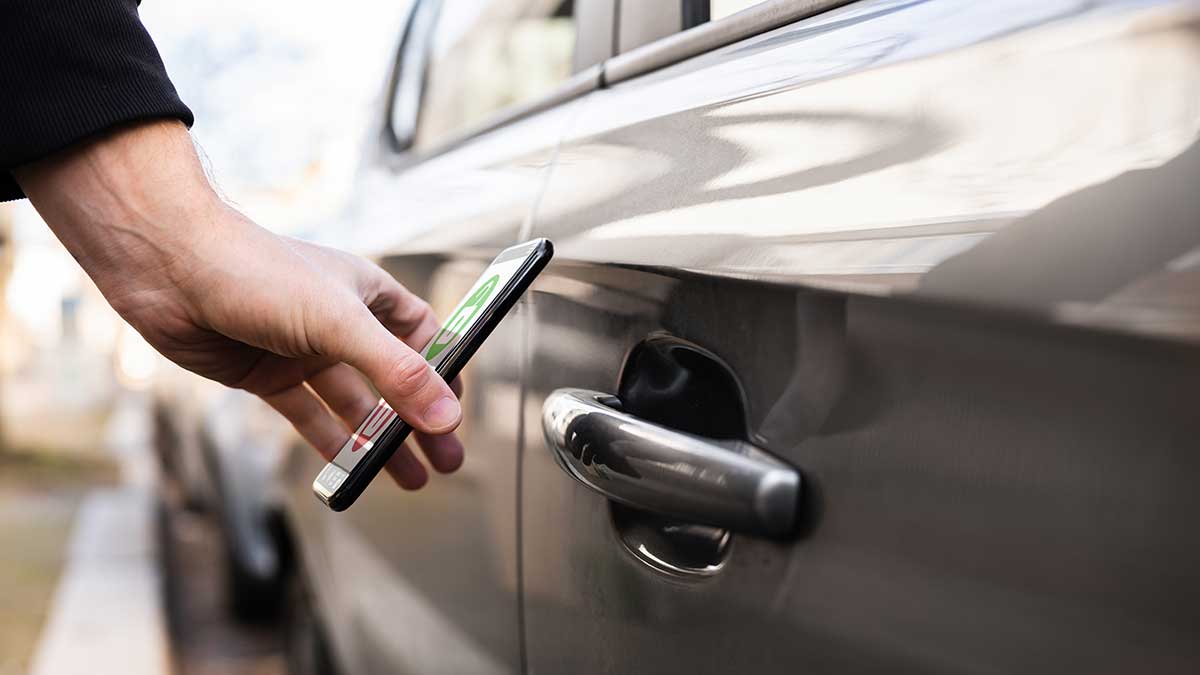
**The Digital Car Key: Unlocking the Future of Vehicle Access**
The car key is an icon. For decades, it has been synonymous with vehicle ownership—a simple piece of metal jingling in your pocket. It is one of the oldest pieces of car technology still carried by millions of drivers; supposedly dropped in a bowl at swingers’ parties in the 1960s and flipped as the ultimate symbol of cool by Steve McQueen in *Bullitt*. Yet digitalising this humble object using the Internet of Things (IoT) has proved far harder than one might expect.
The promise of the digital key revolution was straightforward: your smartphone could become a secure identity device, allowing you to unlock your vehicle, start the engine, and share access with others without ever needing to carry a separate fob. It promised a seamless blend of convenience and security, mirroring the ease of contactless payments. However, the reality has been much more complicated.
The challenge is not about the technology inside the phone or the car. Many luxury car brands have been using mobile phone-based digital keys for the better part of the last decade, and the technical capability is well-established. Instead, the primary hurdle is achieving industry-wide interoperability. As Alysia Johnson, President of the Car Connectivity Consortium (CCC), explains, the difficulty lies in “getting the majority of car makers and mobile phone companies to agree on a set of unlocking rules that can be used across both the phone and car markets.”
Consider a common scenario: a parent of two high school-aged children who share a vehicle. One child has an iPhone, the other an Android. If the car’s digital key technology only works with one of these operating systems, the sibling with the compatible device gains the convenience and security benefits, while the other is left using the physical key. This fragmentation stifles wider adoption within a single family, highlighting the critical need for universal standards.
### The IoT Behind the Key
At its core, a smartphone-based digital car key is an IoT system where the phone and vehicle act as two connected endpoints. They must securely authenticate each other before granting physical access, similar to using your phone for a contactless payment.
Unlike many IoT deployments focused on data collection, digital car keys perform a far more critical function: they control access to a valuable physical asset. The smartphone becomes a trusted identity device, while the vehicle acts as an edge endpoint capable of making its own security decisions without relying on constant cloud connectivity.
However, this security model is more complex than a simple tap-to-pay. A connected vehicle must not only verify that a device is authorised, but also that it is genuinely present and not a relay of a signal from a distance. To achieve this, the system typically uses Bluetooth Low Energy (BLE) to establish communication, Ultra-Wideband (UWB) to verify the device’s proximity and defend against relay attacks, and Near-Field Communication (NFC) as a fallback method, allowing the driver to simply tap their phone against the vehicle.
According to Johnson, “Not all digital key implementations are interoperable.” When non-certified, proprietary solutions limit compatibility to specific vehicles or apps, the user experience becomes fragmented. This makes it harder for consumers to rely on digital keys in the same way they trust other digital wallet experiences.
### The Battle for Trust and Standards
The move to digital keys also raises a crucial strategic question: who controls access to the vehicle when the key becomes software? A single unlocking experience might involve a smartphone manufacturer, a car maker, a chip supplier, and a security company, each with slightly different priorities—be it ease of use, maximum security, or promoting their own commercial interests.
“Interoperability cannot scale if each company approaches digital access differently,” Johnson asserts. “True interoperability requires a standard that is adopted, tested and certified across the ecosystem.”
This challenge is not unique to the automotive industry. It is a familiar problem across the IoT landscape. For a smart thermostat, an industrial sensor, or a connected vehicle to deliver on their promise, products from competing manufacturers must be able to trust one another. Digital keys are, therefore, the automotive industry’s latest interoperability challenge.
To address this, the Car Connectivity Consortium (CCC)—a group of more than 300 vehicle, consumer electronics, and technology companies—has been working to develop universal standards applicable to almost all cars and phones.
At a meeting in Germany last month, the CCC brought together automakers, smartphone companies, suppliers, testing laboratories, and security specialists to refine its CCC Digital Key specification. The latest testing programme focuses on new interoperability test cases, compatibility between older and newer versions of the technology, and expanded validation of BLE, UWB, and NFC.
### The Shift to Software
Like a credit card or flight boarding pass, the digital key lives in a phone’s digital wallet. It is designed for hands-free, passive entry and start, allowing a driver to unlock their car while carrying shopping or children.
Moreover, a key strength of the digital key is that vehicle access becomes software. Once access is a digital permission rather than a physical object, it can be shared, revoked, audited, or limited in ways previously impossible. Johnson notes that users can share access with friends and family directly from their device, “a bit like sending a link or sharing a photo.” Crucially, this shared access can be limited, suspended, or terminated when no longer needed, or even when the car is sold, offering a level of control never before possible.
The CCC reports significant momentum, having certified a total of 115 products from car makers and component providers through its programme last year, with another 140 certified in the first half of 2026. Participants include Audi, BMW, Hyundai, Kia, Mercedes-Benz, NXP Semiconductors, Polestar, Qualcomm, Texas Instruments, Volvo, and ZEEKR.
“This growth shows that interoperable digital vehicle access is moving towards broader scale,” says Johnson. “It will not be every car and every smart device overnight, but each additional certified product expands the ecosystem of vehicles, devices, and technologies that support interoperable digital vehicle access.”
### Security and the Road Ahead
Johnson also highlights that CCC-certified digital car keys offer security and convenience features that physical keys cannot match. The CCC digital key is resistant to relay attacks, thanks to UWB’s cryptographically secure time-of-flight measurement for determining distance, which helps protect against man-in-the-middle attacks. Furthermore, the key is stored within the device’s secure element, making it as secure as using a phone for point-of-sale payments.
Despite these advancements, customer adoption remains mixed. Many users express concerns regarding security, operability, and the potential for manufacturers to introduce recurring subscription fees for these services.
Nevertheless, Johnson remains optimistic. She believes that as new cars roll off the production line, the physical car key will follow items like video recorders, typewriters, and mix tapes into nostalgia.
“Digital keys represent the next evolution of vehicle access,” she concludes. “It’s a similar shift from cash to contactless payments. Cash still works as a suitable form of payment, yet contactless payment is a more convenient and secure way to complete the same everyday action.”
—
**Original Article Source:**
*This article is based on the editorial “The IoT behind the key” by John Thornhill, published on Electronic Specifier. You can read the original [here](https://www.electronicspecifier.com/editorial/the-iot-behind-the-key).*
