




The US Commodity Futures Trading Commission (CFTC) is taking legal action against New York, Connecticut, Arizona, and Illinois for enforcing state-level gambling regulations on prediction markets.
This comes amid an intense legal battle between state regulators and firms like Kalshi, with the central question being who holds the authority to oversee these “prediction” platforms. Several other states have already sent cease-and-desist notices or filed lawsuits against similar marketplaces.
Strategy purchased more than 56,000 Bitcoin. One of its final acquisitions in April was financed through a $250 million offering of the company’s common shares.
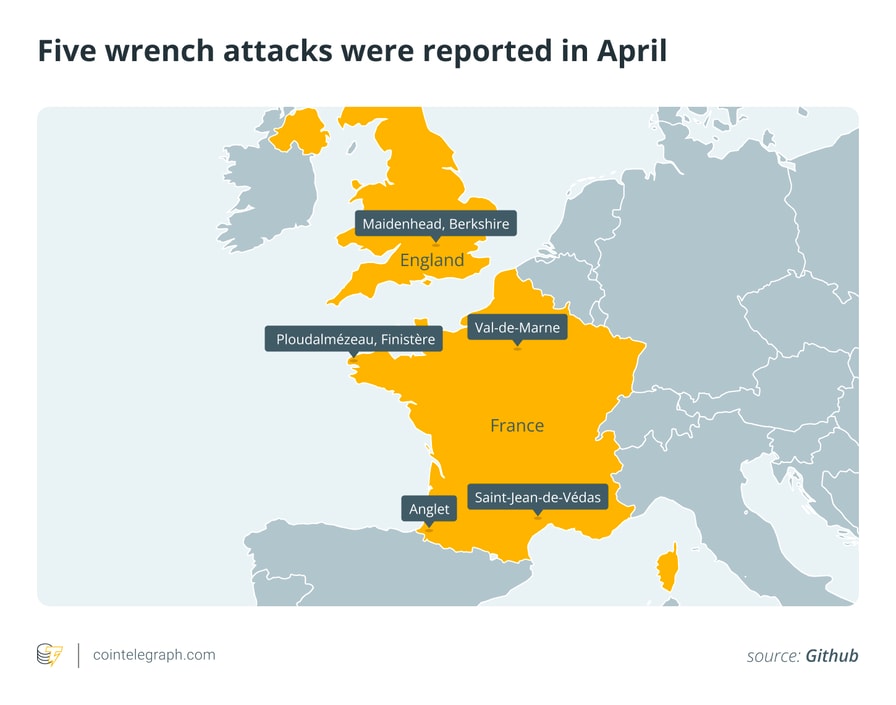
In France, prosecutors have indicted 88 suspected “wrench attackers” who allegedly used violence to extort cryptocurrency from investors.
Here’s April by the numbers:
US federal government takes legal action against four states over prediction market regulation
On April 24, the CFTC sued the state of New York to prevent it from imposing state gambling laws on prediction markets like Kalshi and Polymarket.
New York is the latest addition to a growing list of states—including Connecticut, Arizona, and Illinois—targeted by federal efforts to assert CFTC jurisdiction over prediction markets.
Unions across the US are seeking to curb gambling activity on platforms like Kalshi, as well as offerings from Coinbase and Robinhood. State regulators contend that gambling laws should govern what are essentially sportsbooks, while the prediction markets argue they provide swap contracts that fall exclusively under CFTC oversight.
An appellate court in New Jersey has sided with the CFTC and the prediction markets’ interpretation. However, a comparable case in Nevada could go the other way, positioning the matter perfectly for Supreme Court review.
Strategy adds 56,325 Bitcoin as STRC remains on the sidelines
Strategy—the tech company turned Bitcoin investment firm led by Michael Saylor—added 56,325 BTC to its portfolio in April.
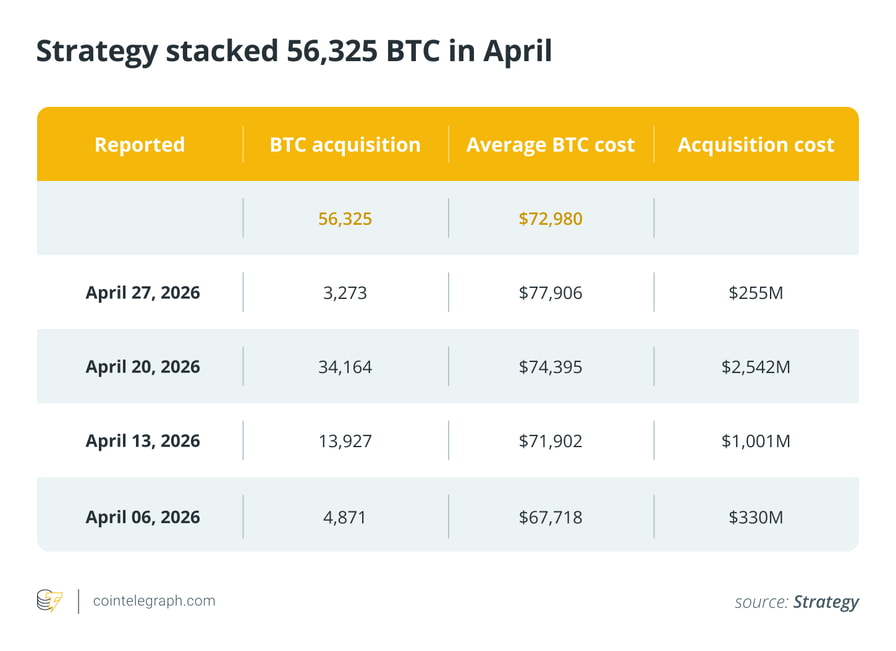
The firm acquired 3,273 BTC (approximately $249 million) on Monday through sales of common stock (MSTR). Per a filing with the US Securities and Exchange Commission, Strategy sold 1,451,601 Class A common shares and used the proceeds to purchase Bitcoin.
STRC, Strategy’s perpetual preferred stock, did not raise any funds in that particular filing. The company has grown more dependent on this short-term, high-yield credit instrument to generate capital for Bitcoin acquisitions.
Following a lackluster March for Bitcoin, when the firm’s BTC holdings were briefly underwater, Strategy is now showing a nearly 1% return on its Bitcoin holdings as of Tuesday.
Global tokenized RWAs exceed $30 billion in distributed asset value
The total distributed asset value of tokenized real-world assets (RWAs) crossed the $30 billion threshold for the first time in April.
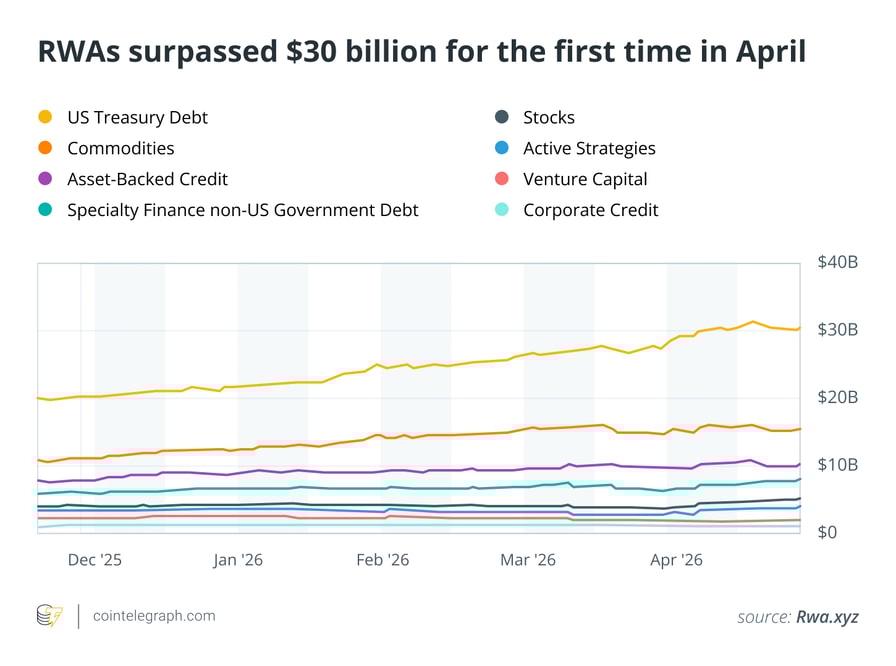
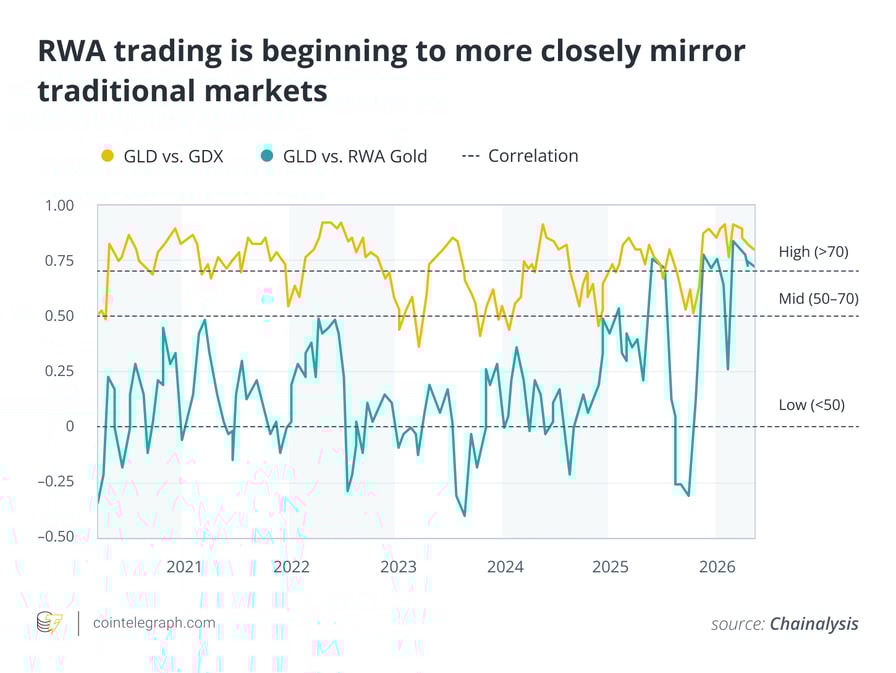
According to a Chainalysis report on the expanding market, institutions that have been testing tokenized real-world assets (RWAs) are now moving past their initial trial phases and starting to see blockchain-based systems as a viable option.
This growing involvement from major players and improved market liquidity have caused RWA trading behavior to increasingly resemble that of conventional financial markets, including reactions to indicators like inflation and geopolitical instability.
Five violent “wrench attacks” reported in April; French authorities charge 88 suspects
The disturbing trend of physical assaults on cryptocurrency holders persisted in April, with five separate incidents documented. Four took place in France, while one occurred in England, as tracked by Casa founder Jameson Lopp’s public database.
The rising visibility and public profiles of crypto traders and business leaders have fueled a sharp increase in kidnappings and ransom-driven attacks targeting notable industry figures.
Reports indicate there have been 47 such attacks in France so far this year. One executive from Ledger, a France-based crypto wallet company, attributes this partly to a regulation requiring entrepreneurs to register their personal names and home addresses publicly.
French law enforcement has taken action. On April 24, the National Organized Crime Prosecutor’s Office revealed that it had filed charges against 88 individuals across 12 federal jurisdictions.
Crypto executives are now investing more heavily in personal security measures, and specialized insurance providers have started offering kidnap and ransom coverage to meet rapidly growing demand.
Related: Crypto execs ramp up security as wrench attacks increase
Two US states now prohibit crypto kiosks, more take action against Bitcoin ATMs
Several US states have intensified their scrutiny of cryptocurrency ATMs and kiosks due to fraud and money laundering risks. In April, Tennessee
On April 13, Tennessee Governor Bill Lee signed House Bill 2505, making it illegal to install a cryptocurrency kiosk.
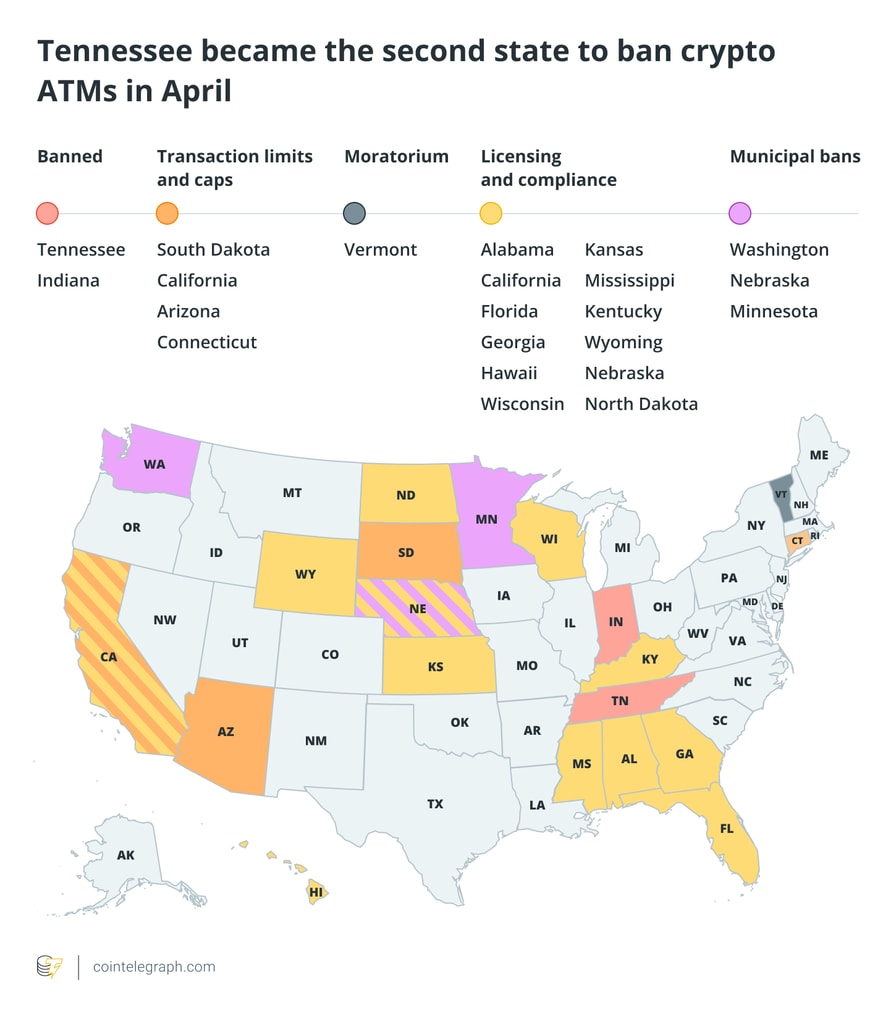
Data from Coin ATM Radar shows that there are currently 560 crypto ATMs operating in Tennessee. All operators and businesses that host these machines must close them by July 1. If they don’t, they could face serious penalties: up to 11 months and 29 days in prison, plus a fine of $2,500.
Tennessee became the second state to ban crypto ATMs outright. Indiana enacted its own ban last month. Meanwhile, several other states have rolled out strict licensing rules and tighter regulations. Vermont currently has a temporary hold on new crypto kiosk installations, and various cities across the country have also implemented local bans on the machines.
The American Association of Retired People (AARP) has been a strong advocate for these restrictions, pointing to a growing number of scams targeting senior citizens that involve these kiosks.
