



# Universal Robots Unveils Gen 7: A New Era for AI-Powered Collaborative Automation
**At a major industrial trade show, Universal Robots — a division of Teradyne Inc. — announced its seventh-generation robotics platform, marking a significant leap forward in how collaborative robots are designed, deployed, and integrated into modern manufacturing environments.**
The Denmark-based company introduced a completely redesigned ecosystem centered around its latest PolyScope X operating system. The platform combines a smaller, more powerful controller, a newly engineered end-effector interface, and an upgraded handheld programming device, all built with the goal of making advanced artificial intelligence accessible on the factory floor without sacrificing the simplicity users have come to expect.
## A Smaller Controller With Big Gains in Performance
Central to the Gen 7 release is a next-generation control unit that delivers 40 percent more computing power while occupying 30 percent less space than earlier models. Available in both a standalone configuration and a compact version suited for integration into existing automation cabinets, the new controller supports multi-network communication — allowing seamless connections to programmable logic controllers, human-machine interfaces, manufacturing execution systems, industrial PCs, and vision systems.
One of the more notable improvements is in networking. Rather than relying on external switches, the controller features built-in managed Ethernet switching, giving IT teams granular control over how data flows through a facility’s network architecture. This is a significant step toward making robots true participants in an interconnected smart factory ecosystem.
## Three New Robot Arms Expand the Lineup
Alongside the hardware upgrades, Universal Robots added three new collaborative robot models to its portfolio: the UR10g-1750, UR17g-1300, and UR18g-950. Named for their payload capacity in kilograms and reach in millimeters, these larger-format arms are designed for applications that demand greater reach and heavier lifting than previous models could comfortably handle. All are compatible with the e-Series and UR Series force- and power-limited configurations.
## A New Tool Flange Built for AI and Advanced Sensing
Perhaps one of the most forward-looking additions is the g-Series tool flange, which is specifically designed to support real-time vision and sensing workloads. By eliminating the cable clutter traditionally associated with mounting cameras and high-bandwidth sensors at the robot wrist, the flange simplifies setup while enabling more sophisticated AI-driven perception tasks.
The flange also incorporates built-in force-torque sensing, impedance control, and Real-Time Data Exchange (RTDE), giving robots a heightened sense of touch. These capabilities are essential for applications like dexterous manipulation, force-sensitive assembly, and other tasks that require fine motor control and environmental awareness.
A companion interface called the SP7 Smart Panel adds safety-compliant freedrive functionality, LED indicators, and three programmable input buttons that can run PolyScope X Smart Skills — reducing setup time in high-mix, low-volume production environments.
## The TP7 Teach Pendant: Lighter, More Intuitive
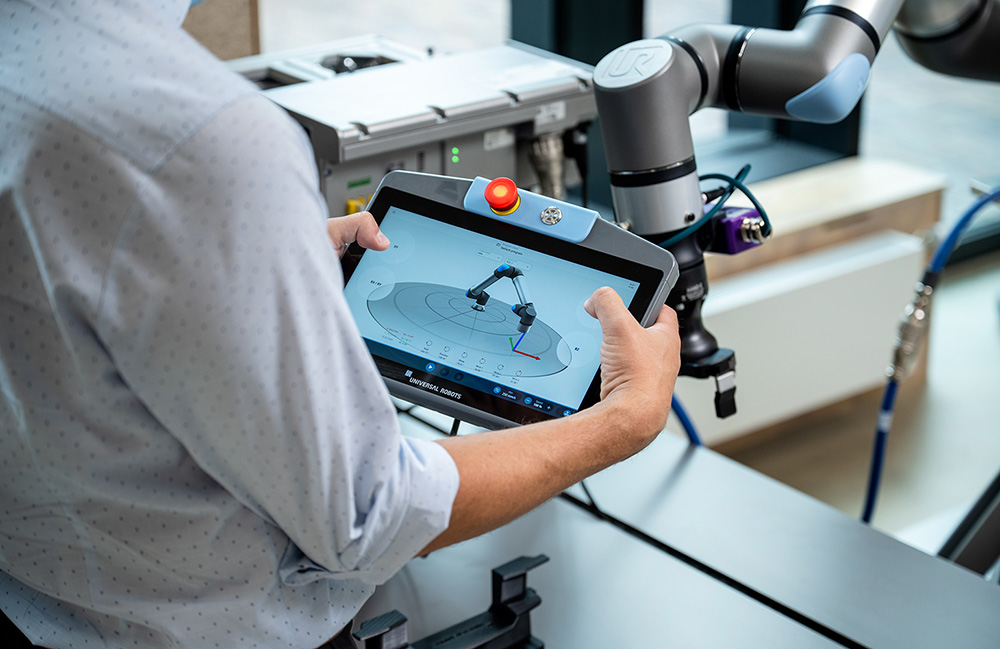
The new TP7 Core teach pendant represents a generational upgrade in how operators interact with their robots. Weighing more than 20 percent less than its predecessor, it features multiple grip positions, configurable smart buttons, a full-HD display, and a virtual joystick. Universal Robots’ product team emphasized that the design came from extensive user research, with dozens of prototypes tested and refined based on real-world feedback.
The goal was to make programming feel intuitive rather than intimidating, allowing operators to stay productive through extended shifts without a steep learning curve.
## Safety and Security at the Core
Safety remains a top priority for the Gen 7 platform. The system carries a PLd, Category 3 certification under ISO 13849-1, and all g-Series robots are TÜV-certified to ISO 10218-1 and UL1740. On the cybersecurity front, Teradyne Robotics holds IEC 62443-4-1 ML3 certification, confirming that secure development practices are embedded throughout the software lifecycle.
The company emphasized that its architecture ensures the robot’s safety controller retains final authority over all movements — meaning even when AI systems issue commands, the robot will reject any instruction that violates established safety parameters.
—
## Frequently Asked Questions (FAQ)
**Q: What makes Gen 7 different from previous Universal Robots platforms?**
A: Gen 7 represents a unified platform upgrade that includes a redesigned controller, tool flange, teach pendant, operating system, and three new robot arm models. It is specifically optimized for deploying AI-powered applications in industrial settings while maintaining the ease of use that has been Universal Robots’ hallmark.
**Q: Is the new controller compatible with older robot models?**
A: The Gen 7 controller is compatible with both the e-Series and UR Series force- and power-limited robot arms, though it is designed as part of the new g-Series lineup.
**Q: How does the tool flange support AI applications?**
A: The g-Series tool flange simplifies the connection of cameras and high-bandwidth sensors at the robot wrist, enabling real-time vision and perception — a cornerstone of modern physical AI and advanced automation.
**Q: What safety certifications does Gen 7 carry?**
A: The platform is PLd, Category 3 certified under ISO 13849-1. All g-Series robots are TÜV-certified to ISO 10218-1 and UL1740, and Teradyne Robotics is certified to IEC 62443-4-1 ML3 for cybersecurity.
**Q: What role does Teradyne see for physical AI in manufacturing?**
A: Teradyne envisions its robotics platforms as the deployment layer for physical AI — bridging the gap between AI research conducted in labs and real-world applications in factories. The goal is to make it straightforward for companies to run AI models on their production lines using collaborative robots.
**Q: Can existing Universal Robots users migrate to Gen 7?**
A: The article does not provide specific details about migration paths or backward compatibility for existing users. Prospective customers are encouraged to consult Universal Robots directly for upgrade guidance.
—
## Conclusion
Universal Robots’ Gen 7 platform signals a clear commitment to evolving collaborative robotics beyond traditional pick-and-place and material handling tasks. By shrinking the controller footprint while boosting computational power, embedding advanced networking capabilities, and designing every component — from the tool flange to the teach pendant — with AI-ready workflows in mind, the company is positioning its ecosystem as a practical gateway for manufacturers looking to adopt physical AI at scale.
The emphasis on maintaining ease of use, robust safety certifications, and strong cybersecurity practices demonstrates that Universal Robots is not chasing novelty for its own sake but rather solving real deployment challenges that factories face when integrating intelligent automation into their operations. As collaborative robots continue to move from isolated workcells into broader, connected production environments, platforms like Gen 7 will likely set the standard for what a modern industrial robotics system should look like.
Thank you for reading
