



# Inside the New Trump-Backed Stablecoin Bank: Foreign Ties, Capital Requirements, and Regulatory Guardrails
A national bank charter has been granted for an entity tied to the Trump family’s cryptocurrency venture, opening the door to the issuance of a stablecoin that already commands a market value exceeding $4 billion. However, the approval comes with a complex web of foreign ownership, binding promises of non-interference, and ongoing political scrutiny that raises questions about national security, capital adequacy, and the future of digital dollar-denominated tokens.
## The Charter and the Entity Behind It
The Office of the Comptroller of the Currency (OCC), the federal agency responsible for chartering national banks in the United States, gave the green light for World Liberty Trust Company to operate. The authorization, granted in mid-August, permits the bank to issue and redeem a stablecoin known as USD1.
The bank itself is held by a Delaware-based entity called WLTC Holdings. Its ownership structure mirrors that of World Liberty Financial, the broader crypto venture associated with the Trump family. The arrangement means that the new bank is essentially a financial arm built to consolidate the stablecoin’s issuance, reserve management, custody, and conversion functions under a single regulatory roof — rather than relying on third-party custodians like BitGo, which currently handles much of the coin’s infrastructure.
## Who Holds the Shares
Ownership is split between two major blocs. An entity linked to Sheikh Tahnoon bin Zayed al Nahyan, a senior figure in the United Arab Emirates government, reportedly holds the larger stake at 49%. A separate entity connected to the Trump family holds an estimated 38%. The remaining shares are believed to be distributed among additional investors.
It is worth noting that neither of these percentages appears in the OCC’s publicly available decision documents. The regulator did not disclose ownership percentages in its charter approval. Both figures come from individuals with direct knowledge of the arrangement, as reported by financial news outlets.
Sheikh Tahnoon bin Zayed al Nahyan holds a powerful position in the UAE, running the country’s national security apparatus and serving as the brother of the nation’s president. His involvement in the cryptocurrency space is not new. In early 2025, investors aligned with him committed $500 million to World Liberty Financial, with the transaction closing just days before the presidential inauguration.
## Capital Requirements and Reserve Backing
The OCC established a minimum capital floor for the new bank: at least $20 million in tier 1 capital, half of which must be held in liquid assets. While this sets a regulatory baseline, it is important to understand what this capital does — and does not — represent.
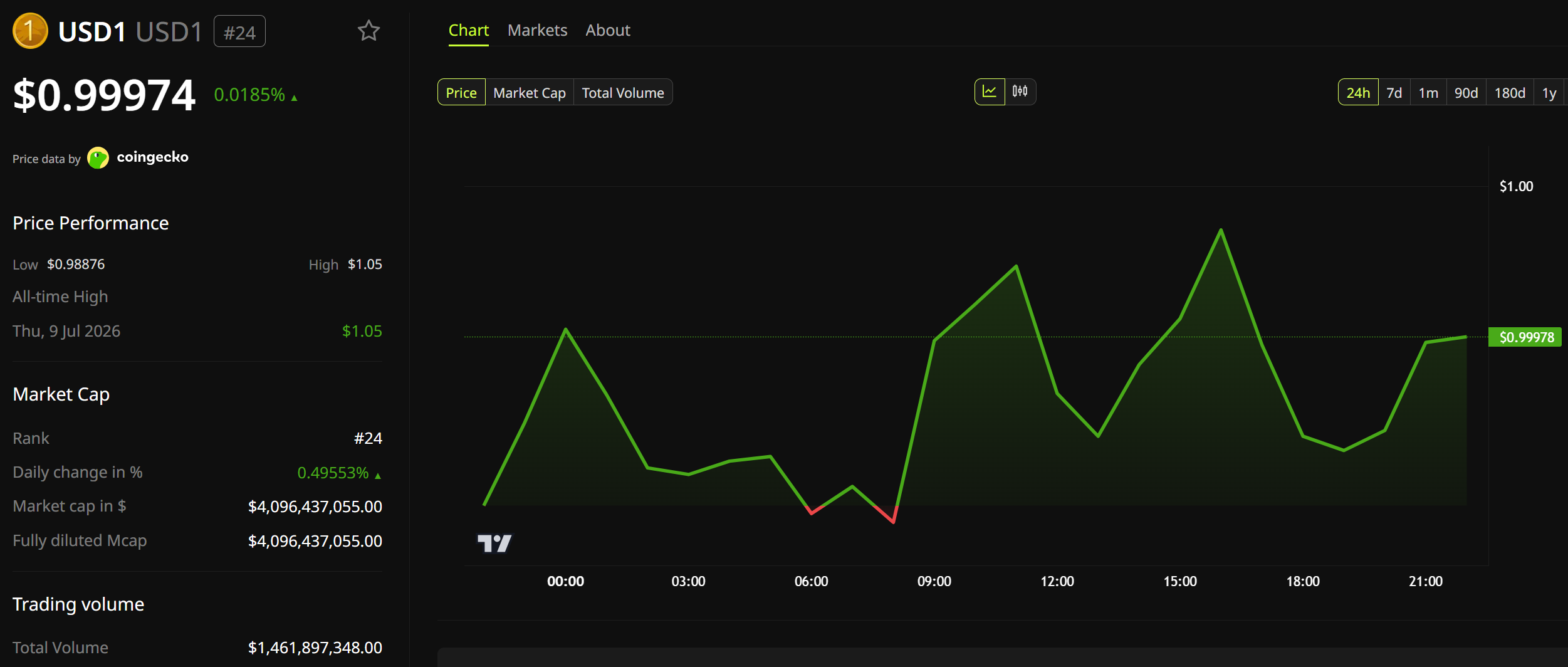
The stablecoin USD1 is supported by reserves, not by the bank’s own capital. The reserves are what maintain the coin’s peg to the U.S. dollar. At the time of the charter approval, USD1 was trading at $0.9997 and held a market capitalization of roughly $4.1 billion, placing it among the top 25 cryptocurrencies by value.
The relationship between the bank’s capital and the coin’s outstanding supply is striking. For every $205 of USD1 in circulation, the bank is required to hold approximately $1 of its own capital. This ratio has drawn attention from observers who question whether the capital buffer is proportionate to the scale of the product being offered.
The reserves themselves are invested in short-term U.S. Treasury bills, which have yielded approximately 3.79% in recent months. At that rate, the $4.1 billion in reserves would generate an estimated $155 million in annual interest. World Liberty has publicly estimated the yield at around $150 million, though the math suggests that figure may actually be conservative.
Currently, BitGo issues the stablecoin and retains a portion of the interest generated by the reserves. With the new bank taking over reserve management, all yield would stay within the bank’s ecosystem, potentially creating a more lucrative internal revenue stream.
## An Important Distinction for Holders
One critical detail for anyone holding USD1: stablecoins are not bank deposits. This means that USD1 does not carry Federal Deposit Insurance Corporation (FDIC) protection. If the bank or the reserve manager were to fail, holders would not have the same government-backed safety net that protects traditional bank deposits up to $250,000.
## The Passivity Pledges
Rather than allow outside investors to exert control over a regulated banking institution, the OCC required binding passivity commitments from three separate entities. These are legally enforceable promises not to interfere with the bank’s operations.
The commitments were signed by Eric F. Trump, who signed on behalf of DT Marks SC LLC in his capacity as president of that entity. A second commitment was signed by Hamad Khlfan Ali Matar Alshamsi, a former director at G42, the artificial intelligence firm associated with Sheikh Tahnoon. A third was signed by Zachary Folkman, a co-founder of World Liberty Financial, on behalf of AMGUS LLC.
Each passivity agreement contains the same core restrictions: the signatories cannot take board seats, cannot influence dividend decisions, pricing policies, personnel selections, or operational choices, and any voting stake exceeding 9.9% must be handed over to management through a proxy arrangement.
The OCC’s decision document explicitly states that while these investors were not treated as principal shareholders, the agency did collect passivity commitments from both domestic and foreign investors connected to World Liberty Financial. This marks only the second time such commitments have been required since the current administration returned to office, according to independent reporting.
## Political and National Security Concerns
The approval has not been without controversy. Senator Elizabeth Warren has urged the Comptroller of the Currency to pause the charter review process until the president divests from any cryptocurrency-related interests. In a formal letter to the OCC, the senator argued that any financial connection between Sheikh Tahnoon bin Zayed al Nahyan and an applicant for a national bank charter — particularly one owned by the president — should be considered an immediate disqualification on national security grounds.
The concern is partly rooted in the broader geopolitical landscape. Washington has been negotiating UAE access to advanced American semiconductor chips, and G42, the AI firm linked to Sheikh Tahnoon, has been under review regarding its supply approvals. Senate Democrats have called for congressional hearings to examine the intersection of foreign investment, presidential family business interests, and financial regulation.
World Liberty Financial has stated that the charter application was reviewed by career staff at the OCC, and the White House has denied that any conflicts of interest played a role in the process.
## What Comes Next
The bank cannot open its doors immediately. It has a window of 12 months to raise the required capital and 18 months from the date of the OCC’s approval to begin conducting business. Before that happens, a final review process stands between the charter and operations — one that will test whether the regulatory framework is satisfied by the passivity agreements alone, or whether deeper questions about ownership and foreign influence will need to be resolved.
The open question hanging over the entire arrangement is whether the regulatory exam will scrutinize who ultimately owns and controls the bank, or simply whether the paperwork declaring that outside investors will remain passive is sufficient.
—
## Frequently Asked Questions
**What is a stablecoin?**
A stablecoin is a type of cryptocurrency designed to maintain a stable value by being pegged to a traditional fiat currency, such as the U.S. dollar. USD1 is pegged at a ratio of roughly 1:1 with the dollar and is backed by reserve assets held in short-term U.S. Treasury securities.
**What does the OCC do?**
The Office of the Comptroller of the Currency is a federal agency within the U.S. Treasury Department that charters, regulates, and supervises all national banks and federal savings associations. It also oversees foreign banks operating in the United States.
**What are passivity commitments?**
Passivity commitments are legally binding agreements in which large investors in a regulated institution promise not to interfere with its management, operations, board composition, or financial decisions. They are a regulatory tool used to prevent outside owners from steering a bank they are not qualified or authorized to run.
**Why is foreign ownership a concern?**
Foreign ownership of U.S. chartered banks raises national security concerns because foreign entities could potentially gain influence over critical financial infrastructure. In this case, the involvement of an entity tied to a senior UAE government official has drawn particular scrutiny from lawmakers.
**Does USD1 have FDIC insurance?**
No. Stablecoins are not deposits and are not covered by FDIC insurance. If the issuing entity or reserve manager were to fail, holders would not have the same protections afforded to traditional bank depositors.
**How much capital does the bank need?**
The OCC requires a minimum of $20 million in tier 1 capital, with at least half of that held in liquid assets. While this is the regulatory floor, the scale of the stablecoin — with $4.1 billion in circulation — means the capital-to-asset ratio is very lean.
**Who currently manages USD1?**
BitGo currently issues the stablecoin and manages part of the reserve custody and interest revenue. The newly chartered bank plans to absorb these reserve functions, bringing all operations under one regulatory roof.
**What is the timeline for the bank to open?**
The bank has 12 months from the charter approval to raise the necessary capital and 18 months total to begin business operations. A final regulatory review must be completed before the bank can open.
**What did Senator Warren say about this?**
Senator Elizabeth Warren called for the OCC to delay the charter review until the president divests from cryptocurrency interests, citing national security concerns related to the financial ties between the applicant and senior UAE government figures.
**How much yield do the reserves generate?**
Based on current Treasury bill yields of approximately 3.79%, the $4.1 billion in reserves would generate roughly $155 million per year. World Liberty Financial has estimated $150 million, which appears to be a cautious figure.
—
## Conclusion
The granting of a national bank charter for a Trump family-backed stablecoin represents a significant milestone in the intersection of cryptocurrency, traditional banking regulation, and geopolitics. The arrangement layers together a novel digital asset product, a complex ownership structure involving foreign government-linked entities, and a regulatory framework designed to keep political interests at arm’s length from day-to-day bank management.
Whether the passivity commitments are sufficient to address the legitimate concerns raised by lawmakers and national security experts remains an open question. The bank must still navigate its capital-raising timeline, satisfy final regulatory requirements, and prove that its operations can withstand the scrutiny that will inevitably follow. For now, the USD1 stablecoin continues to trade near its dollar peg, its reserves continue to generate yield, and the broader industry watches closely to see how this experiment in regulated cryptocurrency banking unfolds.
Thank you for reading
