



Anker Solix F3800 Plus + 410W Solar Panels
pros and cons
- Works well as an expandable, small-scale solar setup.
- Helps you save between $12-$25 a month, depending on local rates.
- Flexible scalability means a smaller initial investment.
- Savings depend on your location, panel angle, and rates.
- The F3800 Plus isn’t as portable as other batteries.
- While cheaper than whole-home backup systems, it’s still expensive.
Follow ZDNET: Add us as a preferred source on Google.
As temperatures climb, so do electricity bills. I’ve been testing ways to reduce my energy costs using solar power, and I’ve found a practical solution. The Anker Solix F3800 Plus is a modular battery with a 3.84kWh capacity, functioning like a hybrid between a conventional gas generator, a fixed home battery backup, and a portable power station.
Also: Switch to plug-in solar? My advice after testing the DIY energy tech at home
Despite its wheels, the F3800 Plus isn’t meant for camping trips (though you could technically use it if you don’t mind moving 136 pounds). It’s essentially a portable battery that doubles as a reliable whole-home backup, able to run refrigerators, portable AC units, pumps, power tools, and even some central air conditioning systems.
Best solar deals of the week
Deals are selected by the CNET Group commerce team, and may be unrelated to this article.
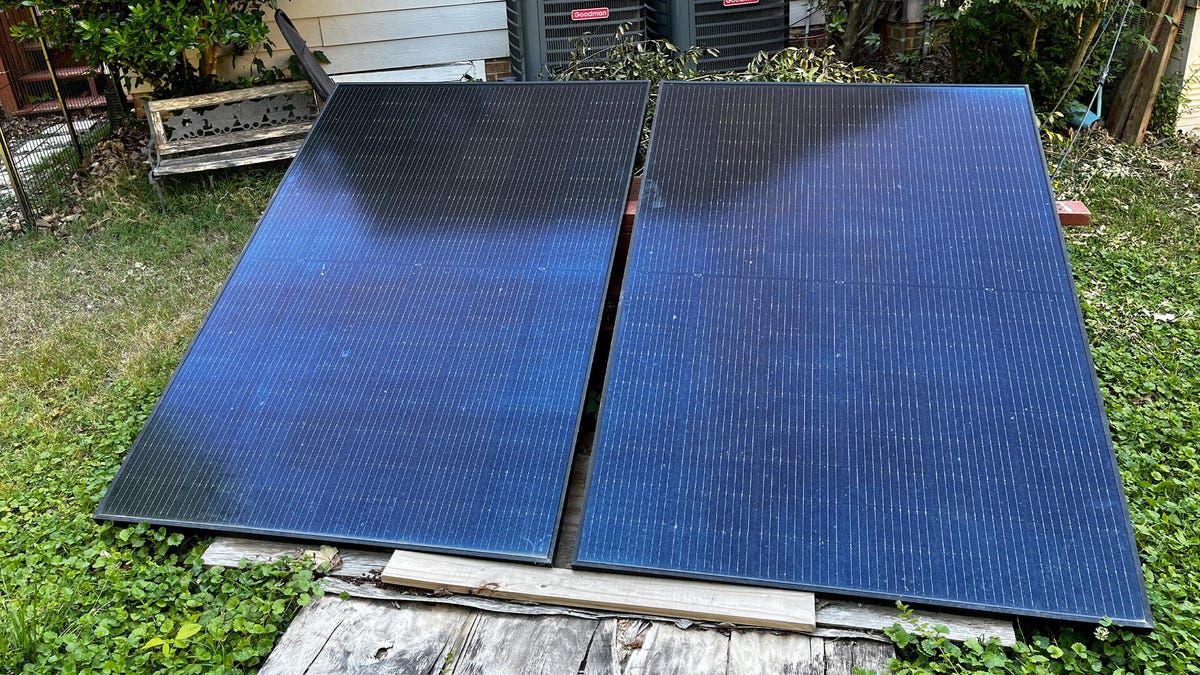
I paired the Anker Solix F3800 Plus with two solar panels, available as a bundle from Anker. Having had positive experiences with EcoFlow and Anker Solix portable panels in my backyard, I was eager to test these two 410W rigid panels.
Combined, the panels deliver 820W, though solar panels rarely achieve their maximum rated output. Fortunately, there are multiple ways to configure the F3800 Plus as a home backup system, from basic to advanced setups.
How to set up backyard solar panels
The easiest method to use the Anker Solix F3800 Plus as a backup is to plug appliances directly into it. If you place it in a fixed location and want to power your refrigerator, simply connect the solar panels to the station, run an extension cord to the fridge, and leave it plugged in permanently.
Depending on your area, running a full-size side-by-side refrigerator that consumes 25-67kWh monthly on solar energy could save you up to $20 per month on electricity costs. That adds up to $240 annually just for the fridge alone.
Also: I tested popular ‘power-savers’ on the market – here’s the only one that isn’t a scam
The most effective approach for a backyard solar panel system with an F3800 Plus is to use a generator inlet and transfer switch, particularly if your home already has one. This was the ideal solution in my case, especially since I had an existing (though non-functional) generator and an EcoFlow Smart Home Panel 3.
By connecting your F3800 Plus to a generator inlet with a transfer switch controlling selected home circuits, you can flip the switch during a power outage. This allows the F3800 Plus to serve as a backup generator, but without the fumes and heat produced by a traditional gas unit.
The third and most sophisticated option for using the Anker Solix F3800 Plus with solar panels is integrating it with a smart home panel or whole-home backup system. Anker offers its own Smart Home Power Panel that automatically detects outages and switches to battery backup without manual intervention, while also managing solar charging.
Also: I stopped leaving these 7 common household devices plugged in, and my energy bill noticed
This last option is more expensive and requires professional installation. However, it operates similarly to the Tesla Powerwall, EcoFlow Smart Home Panel, or Generac PWRcell—all popular whole-home battery backup systems.
What this setup generates for me
With two 410W solar panels totaling 820W and an F3800 Plus, you can create a continuous “essential loads” solar energy system. With good sunlight on clear days and optimal panel positioning, I average about 3.7kWh daily from my panels, potentially increasing to around 5kWh with better placement.
Beyond backup power, we’ve used stored solar energy from the Anker Solix F3800 Plus to run power tools in the yard.
Maria Diaz/ZDNET
My husband is building a custom base for the solar panels using brackets, casters, and wood to improve efficiency and portability, but it’s still on his to-do list. As shown in the photos, the panels currently rest on a temporary base made from leftover reclaimed wood from our garage. A movable base will eventually help us capture even more solar energy.
Solar offset vs continuous load
If your daily energy usage stays below your solar production, you could fully rely on solar power. However, this is challenging with a backyard system, given that the average US household consumes about 30kWh daily.
Using 3.5kWh each day while your panels generate 4kWh daily ensures your battery stays fully charged. But if you regularly use more power than your battery can store, it will run down every day.
That said, a modular system like the F3800 Plus paired with a handful of fixed solar panels can handle much of your everyday electricity usage. This includes devices that stay on constantly, such as routers, refrigerators, TVs, chargers, and even smart gadgets like robot vacuums.
Also: Anker’s whole-home backup is the power outage solution of my dreams – and it’s on sale now
However, you shouldn’t keep certain high-power appliances running continuously on an F3800 Plus with just two panels, such as central air conditioning units, electric dryers and ovens, space heaters, and electric water heaters. These appliances consume a lot of energy and draw constant power, so a couple of solar panels won’t be sufficient to keep them running indefinitely.
ZDNET’s buying advice
Rather than trying to power your entire house with a backyard solar system right from the start, focus on one that permanently covers your essential baseline electricity needs. The Anker Solix F3800 Plus and rigid solar panels are an ideal combination for that purpose, particularly as a modular solution that doesn’t require a large upfront investment.
This approach gives you time to save and gradually expand your system to manage a significant portion of your energy usage, which will result in lower electricity bills over time.
