



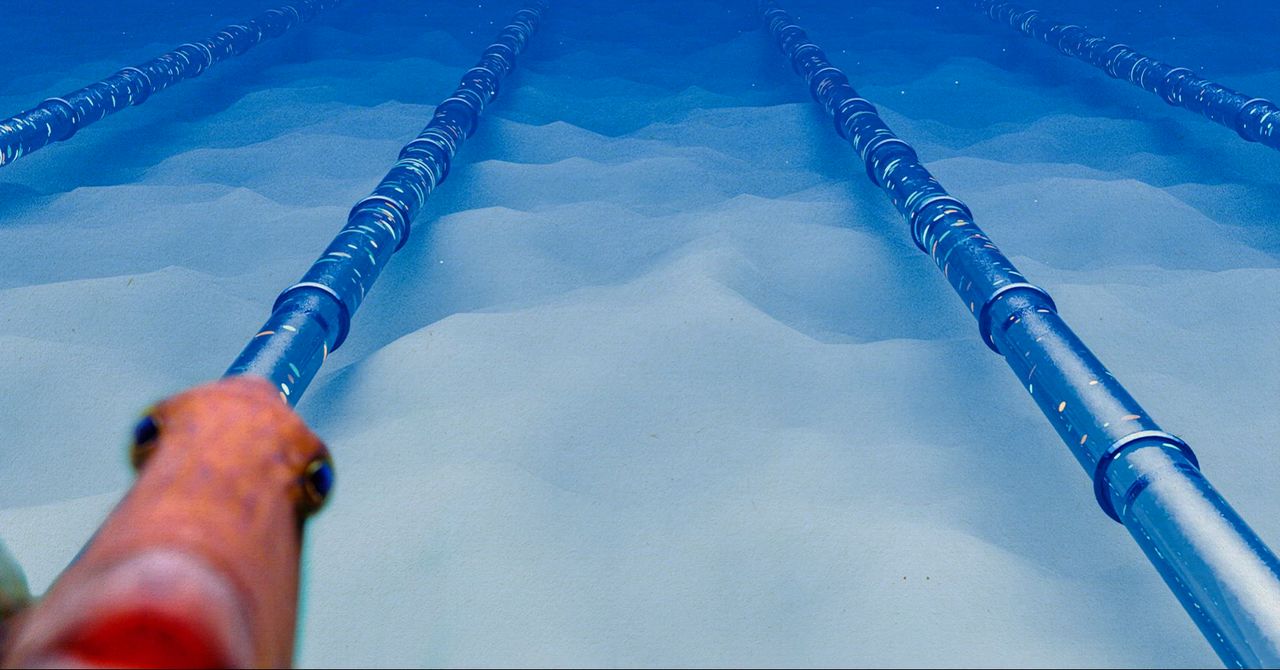
The Gulf’s AI ambitions hinge on something unexpectedly delicate: a small number of undersea cables threading through some of the world’s most unstable waterways.
Nations like Saudi Arabia and the UAE have invested heavily in AI infrastructure, drawing in hyperscalers and aiming to become future exporters of computing power. But as the region pivots from oil wealth to AI-driven economies, the infrastructure moving that data is turning into a growing strategic weakness.
Undersea cables have long carried the global internet. Now, they are becoming tools of geopolitics.
After tensions escalated between the US, Israel, and Iran earlier this year, experts cautioned that regional conflict could endanger critical cable infrastructure in the Gulf. In May, media reports suggested Iran was weighing control of all seven undersea cables passing through the Strait of Hormuz.
An estimated 95 percent of international data traffic travels via undersea cables. For the Gulf, the issue is concentration: Much of the region’s links to Europe and the US still rely on just a few paths through the Red Sea and the Strait of Hormuz.
The Middle East sits where Europe, Asia, and Africa meet, making it one of the world’s most critical transit zones for global internet traffic.
Today, a severed cable could do far more than slow internet speeds. It could threaten the Gulf’s entire emerging AI business model.
In many ways, Gulf nations are trying to convert energy wealth into AI infrastructure— exporting computing power and cloud capacity much as they once exported oil and gas.
For Middle Eastern economies preparing to become major exporters of compute capacity, the importance of and dependence on these cables is rising, especially because the hyperscalers establishing operations in the region require unprecedented levels of resilience.
Unlike traditional internet traffic, AI infrastructure depends on huge, continuous flows of data between hyperscale data centers, cloud providers, and enterprise customers. Even brief outages can cause major operational and financial losses, making resilient fiber infrastructure a business necessity rather than a luxury.
“Hyperscalers and regional carriers are pushing diversification because their needs have gone beyond bandwidth. They now require multiple independent paths, predictable latency, and survivability during geopolitical stress,” says Imad Atwi, partner at management consulting firm Strategy& Middle East.
AI Is Forcing the Gulf to Rethink Connectivity
The pressure is building. In 2025, two cables connecting Europe to the Middle East and Asia were severed in the Red Sea, degrading internet connectivity across the Gulf for days and causing an estimated $3.5 billion in damages from lost services.
That incident occurred before the AI rollout gained momentum and data centers went live. Now, hyperscalers are demanding the same resilience standards in the Middle East that they already depend on across transatlantic and transpacific routes. Those markets typically run across four or five physically separate network paths to reduce disruption risks.
The Gulf, by contrast, remains heavily reliant on a narrow set of routes.
“Hyperscalers now want similar route diversity across the Middle East, both for Gulf-Europe connectivity and for Europe-Asia traffic passing through the region,” says Bertrand Clesca, partner at subsea cable specialists Pioneer Consulting.
For years, proposed land-based and subsea routes across the Middle East struggled to advance because of regulatory hurdles, political instability, and regional conflict.
Now, many of those same corridors are being reexamined as vital digital infrastructure.
Atwi outlines a multilayered strategy taking shape across the Gulf. The first layer involves Gulf landing stations linked by terrestrial fiber corridors spanning Saudi Arabia, the UAE, and Oman, then stretching toward Europe and Asia through Jordan and the Levant. A second layer would add new subsea-terrestrial systems bypassing chokepoints around Egypt and Bab el-Mandeb. A third would establish northern overland corridors through Iraq, Syria, and Turkey.
The Internet’s New Strategic Corridors
Some of the region’s most ambitious projects involve countries previously seen mainly through the lens of conflict.
Land-based systems, like the one proposed via Syria, can support up to 144 fiber pairs compared to the 24 typical in today’s subsea cables, meaning the capacity potential is huge. The downside is they’re above ground, making them far more vulnerable to physical disruptions. This is not a theoretical risk.
