



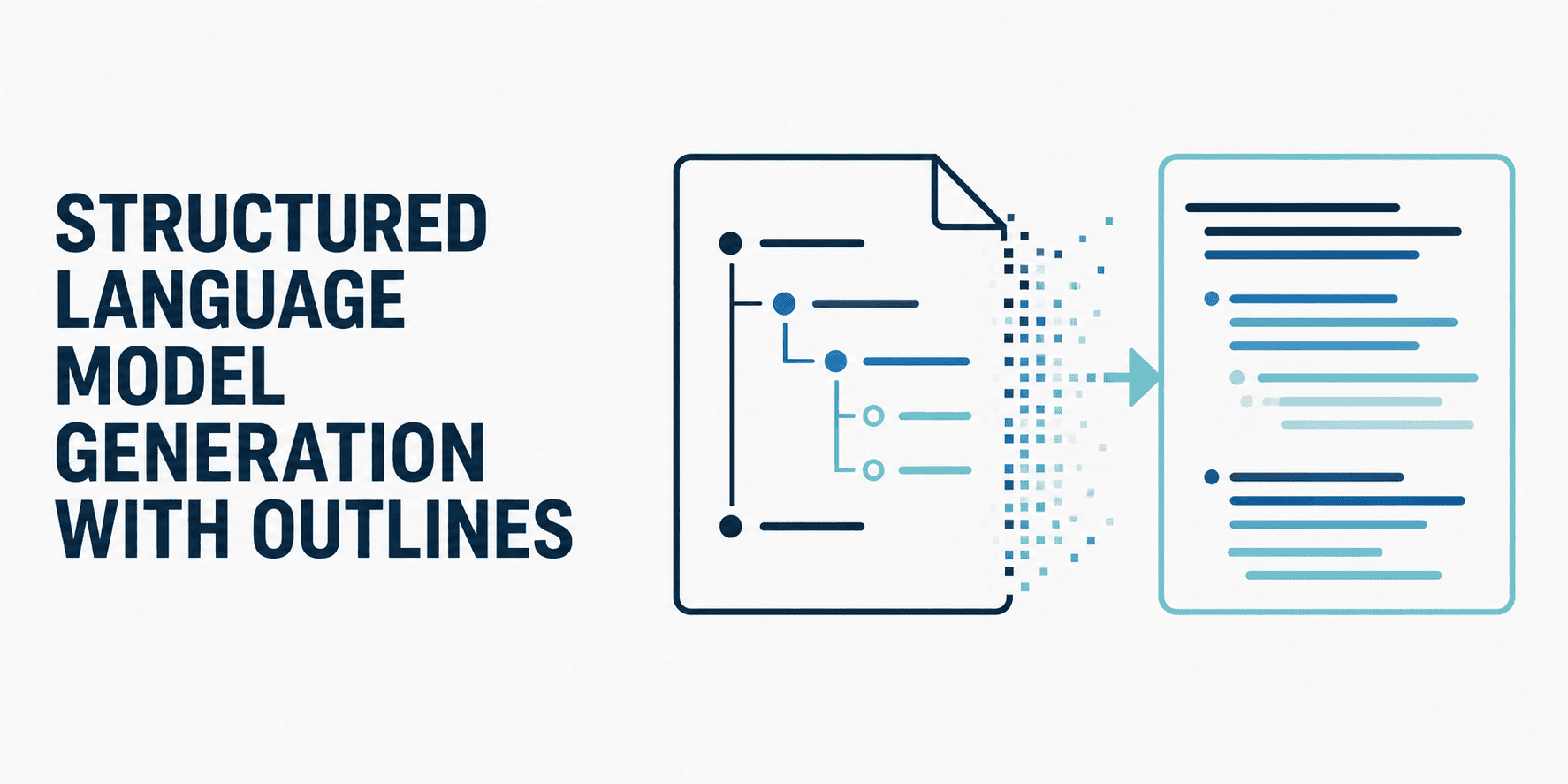
**Structured Language Model Generation with Outlines: A Practical Guide**
Usually, when asking an LLM — abbreviation for “Large Language Model” — for a neat, structured output like JSON objects, for instance, a mix of careful prompt crafting with a “pinch” of luck is required. Otherwise, it might be tricky to get the model to obtain the perfectly structured output you are expecting. Or so it was, until a novel open-source library came onto the scene: **outlines**. This library is designed to prevent typical issues experienced by LLMs in these specific output-oriented use cases, such as hallucinations. More precisely, it introduces a degree of deterministic certainty into the output generation process.
Let’s uncover what `outlines` allows us to do through this illustrative article, in which we will show some practical examples in Python!
—
### Use Case 1: Multiple-Choice Classification for Sentiment Analysis
Before fully diving into the first use case, you might be wondering: How does `outlines` work and how does it guarantee correctness in structured model outputs? At the inference level, it masks out “syntactically illegal” tokens during generation instead of attempting to fix poor text once generated. This makes it virtually impossible to break the rules underlying the specific output format sought.
Let’s see a first example in which we are building an analysis pipeline for customer support tickets, and we want *exactly* one option from a limited, approved list of possible options. This is pretty much like a classification problem, and `generate.choice()` is the function that helps us mimic it, by forcing the model at hand to choose one of the predefined literals or classes.
But first, let’s install it alongside the `transformers` to load pre-trained LLMs:
“`bash
pip install outlines[transformers]
“`
The following code uses `outlines.from_transformers()` to load a pre-trained model aided by Hugging Face’s auto classes for a model and its associated tokenizer. But the icing on the cake is: they are both wrapped in an `outlines` object that will later help tell the model what exactly to obtain. At the inference stage, we pass not only the user prompt asking to classify a review, but also a `Literal` object that contains the output constraints the model should limit to:
“`python
import outlines
from transformers import AutoTokenizer, AutoModelForCausalLM
from typing import Literal
# 1. Loading the backend using standard Transformer-based models
model_name = “microsoft/Phi-3-mini-4k-instruct”
# We use outlines to load the model with its from_transformers() function
model = outlines.from_transformers(
AutoModelForCausalLM.from_pretrained(model_name),
AutoTokenizer.from_pretrained(model_name)
)
# 2. Calling the model directly, passing our approved strings as type constraints
sentiment = model(
“Classify the sentiment of this customer review: ‘I’ve been waiting two weeks for my delivery and it’s still missing.'”,
Literal[“Positive”, “Negative”, “Neutral”]
)
print(sentiment)
“`
**Output:**
“`
Negative
“`
A word of warning here: although the literal we defined is part of Python’s built-in typing module, rather than `outlines`, our out-of-the-box library still assumes model control here: both the model and tokenizer are wrapped into an object that enforces standard Python types, building a finite state machine under the hood that limits the output to the options provided only.
—
### Use Case 2: JSON Object Generation
This example first defines a Pydantic object that defines the desired structure for a JSON object describing a fictional character with a name, description, and age. It then uses our previously wrapped `outlines` model, passing the character object to ensure the output generated strictly follows this structure for the JSON object requested:
“`python
from pydantic import BaseModel
# 1. Define a Pydantic model for the desired JSON structure
class Character(BaseModel):
name: str
description: str
age: int
# 2. Using the outlines-wrapped model to generate a JSON output conforming to the Pydantic model
json_output = model(
“Generate a JSON object describing a fictional character named ‘Anya’.”,
Character,
max_new_tokens=200
)
print(json_output)
“`
**Output:**
“`json
{
“name”: “Anya”,
“description”: “Anya is a young, adventurous woman with a passion for exploring new places and meeting new people. She has long, curly hair and bright green eyes that sparkle with curiosity. Anya is always eager to learn and loves to share her knowledge with others. She is kind-hearted and always willing to lend a helping hand to those in need. Anya’s favorite hobbies include hiking, reading, and playing the guitar. She is a free spirit who values freedom and independence above all else.”,
“age”: 25
}
“`
—
### Use Case 3: Pure JSON Generation for REST APIs
This third example, also JSON-related, is similar to the previous one but in a slightly different context. Imagine you are building an API backend requiring a well-defined JSON payload for updating a database. Asking a standard LLM to get this output will more often than not yield annoying, trailing characters like commas that are likely to crash a JSON parser.
With outlines, we define our JSON payload schema once again with a Pydantic-based custom class object.
“`python
from pydantic import BaseModel
from typing import Literal
import json
class ServerHealth(BaseModel):
service_name: str
uptime_seconds: int
status: Literal[“OK”, “DEGRADED”, “DOWN”]
# 1. Outlines should produce a raw string guaranteed to be valid JSON
raw_json_string = model(
“Report the current status of the main Auth database.”,
ServerHealth,
max_new_tokens=50
)
print(type(raw_json_string)) # This will just print:
# 2. Pretty-printing
parsed_json = json.loads(raw_json_string)
print(json.dumps(parsed_json, indent=2))
“`
**Output:**
“`json
{
“service_name”: “auth_db_status”,
“uptime_seconds”: 1623456789,
“status”: “OK”
}
“`
—
### FAQ
**Q1: What is the `outlines` library?**
`outlines` is an open-source library designed to guide Large Language Models (LLMs) toward generating structured and deterministic outputs. It helps prevent common issues like hallucinations or syntax errors by constraining token generation at the inference level.
**Q2: What problems does `outlines` solve?**
It solves issues like:
– Unwanted trailing characters (e.g., commas) in JSON output.
– Hallucinated or incorrect classifications.
– Inconsistent or malformed structured data generation, which is critical for API integrations and data pipelines.
**Q3: What models are supported by `outlines`?**
`outlines` supports models from Hugging Face’s `transformers` library, including models such as `microsoft/Phi-3-mini-4k-instruct`, and can be extended to other compatible backends.
**Q4: Does `outlines` work with local models?**
Yes, as long as the model and tokenizer can be loaded via Hugging Face’s `AutoModelForCausalLM` and `AutoTokenizer`, they can be wrapped and used with `outlines`.
**Q5: Can I use `outlines` for non-structured tasks?**
While `outlines` excels at structured output generation, it is primarily designed for scenarios where strict schema adherence is required. It may not add significant value for general conversational tasks.
—
### Conclusion
Since LLMs are trained to be chat-lovers capable of breaking syntax or hallucinating to “sound like humans” in their conversations with us, getting them to produce reliable, structured outputs like clean JSON objects can feel like a bit of a pain. **Outlines** is a new, open-source library that introduces deterministic certainty into LLMs’ output generation process for better, more reliable generation of structured outputs. This article showed three simple yet useful use cases for beginners with this interesting tool, demonstrating how it simplifies structured data generation for classification, JSON objects, and API payloads. With `outlines`, developers can significantly reduce the friction involved in harnessing LLMs for production-grade, data-intensive applications.
