



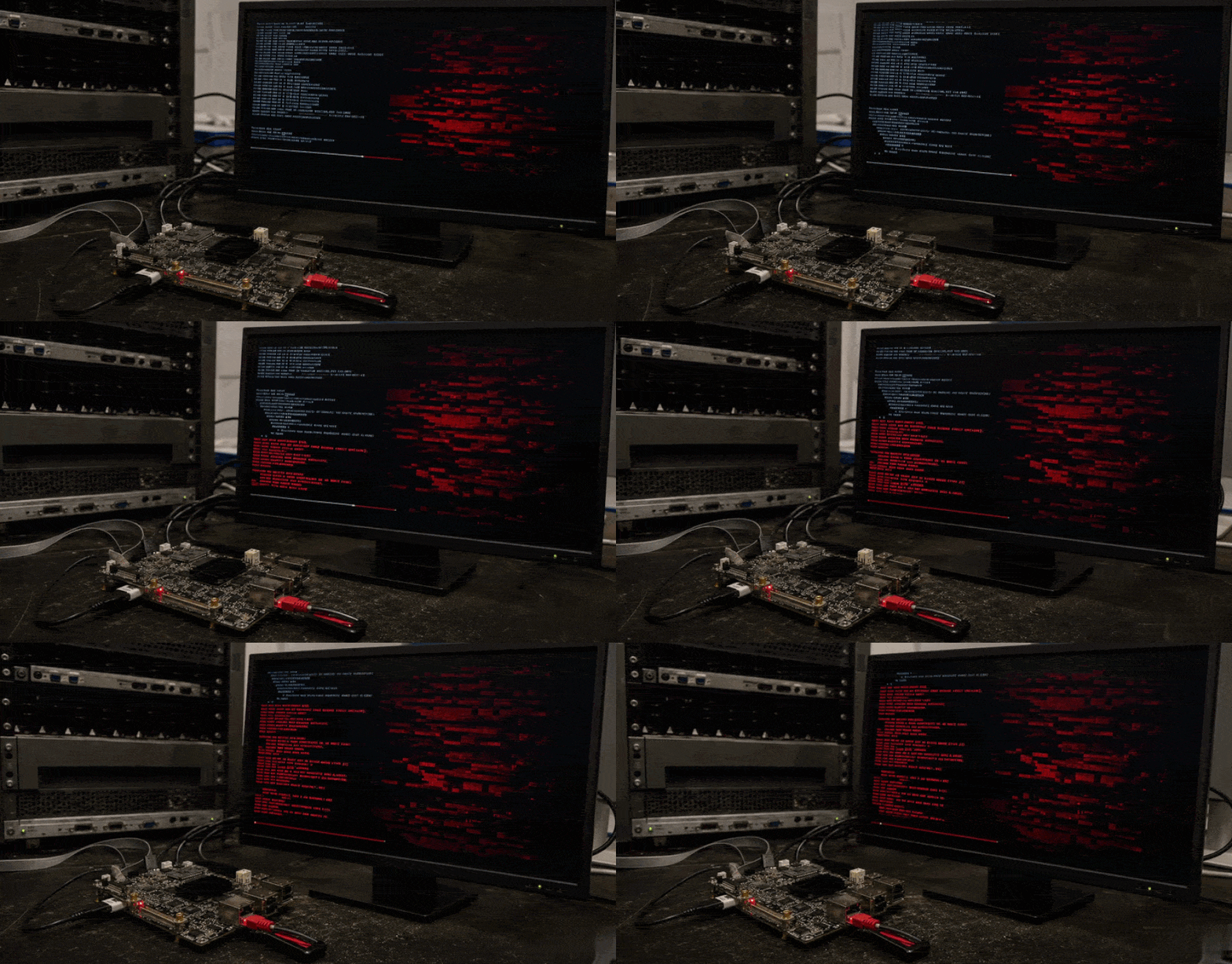
**Critical Security Flaws Found in U-Boot Bootloader**
A recent investigation by firmware security firm Binarly has uncovered six serious vulnerabilities in U-Boot, the widely used bootloader responsible for initializing hardware across an enormous range of devices—from home routers and smart cameras to server management chips in data centers.
What makes these findings particularly alarming is that four of the vulnerabilities can crash devices, while two allow an attacker to execute malicious code before the bootloader even verifies the authenticity of the software. Because U-Boot runs before the operating system, flaws at this stage can compromise the entire chain of trust.
### Details of the Vulnerabilities
U-Boot commonly bundles the kernel, device tree, ramdisk, and other boot components into a single package known as a Flattened Image Tree (FIT). It then checks the digital signature of this package before transferring control. Binarly’s research focused on weaknesses within that verification process.
The security firm identified six flaws, collectively tracked as **BRLY-2026-037 through BRLY-2026-042**. None have yet been assigned official CVE identifiers. The issues fall into two categories:
– **Two vulnerabilities enabling code execution**:
These stem from an unchecked value used during device-tree parsing. When U-Boot processes a malformed image, a function from the borrowed libfdt library can return a null pointer or a negative length. Failing to validate these values leads to either a stack buffer overflow or memory corruption that allows attacker-controlled code execution.
– **Four vulnerabilities causing crashes**:
These involve reading past the end of an image due to untrusted size or offset values, dereferencing null pointers from outdated image formats, or triggering stack exhaustion through deeply nested images.
### Real-World Risks and Attack Requirements
Although there are no confirmed reports of these flaws being exploited in the wild, the potential impact is severe. Exploits require delivery of a malicious boot image, which typically demands physical access or privileged network access to the update mechanism—as seen in previous attacks on Supermicro server management hardware.
In the worst-case scenario, recovering an affected device may require physical access and manual reflashing of memory chips. Code executed at the bootloader level can persist below the operating system and evade standard security tools.
### Urgency and Mitigation
At the time of reporting, no stable U-Boot release includes fixes for these issues. Although the development team merged patches in June, the July release (v2026.07) had already been frozen in April, meaning many devices shipped without protection. The next version, v2026.10, is not expected until October.
Users relying on U-Boot-based products should monitor for firmware updates from manufacturers. The researchers emphasize that this area of attack has been vulnerable before—notably through CVE-2026-33243—and stress that boot-time security plumbing remains a recurring weak link, even when signature verification appears intact.
Past incidents like LogoFAIL and BootHole further illustrate how image-parsing bugs in firmware continue to undermine even robust security features like Secure Boot.
—
*Original article source:* [U-Boot bootloader flaws let attackers hijack the boot process](https://arstechnica.com/information-2026/08/u-boot-bootloader-flaws-let-attackers-hijack-the-boot-process/) by Dan Goodin – published August 8, 2026 on Ars Technica.
