



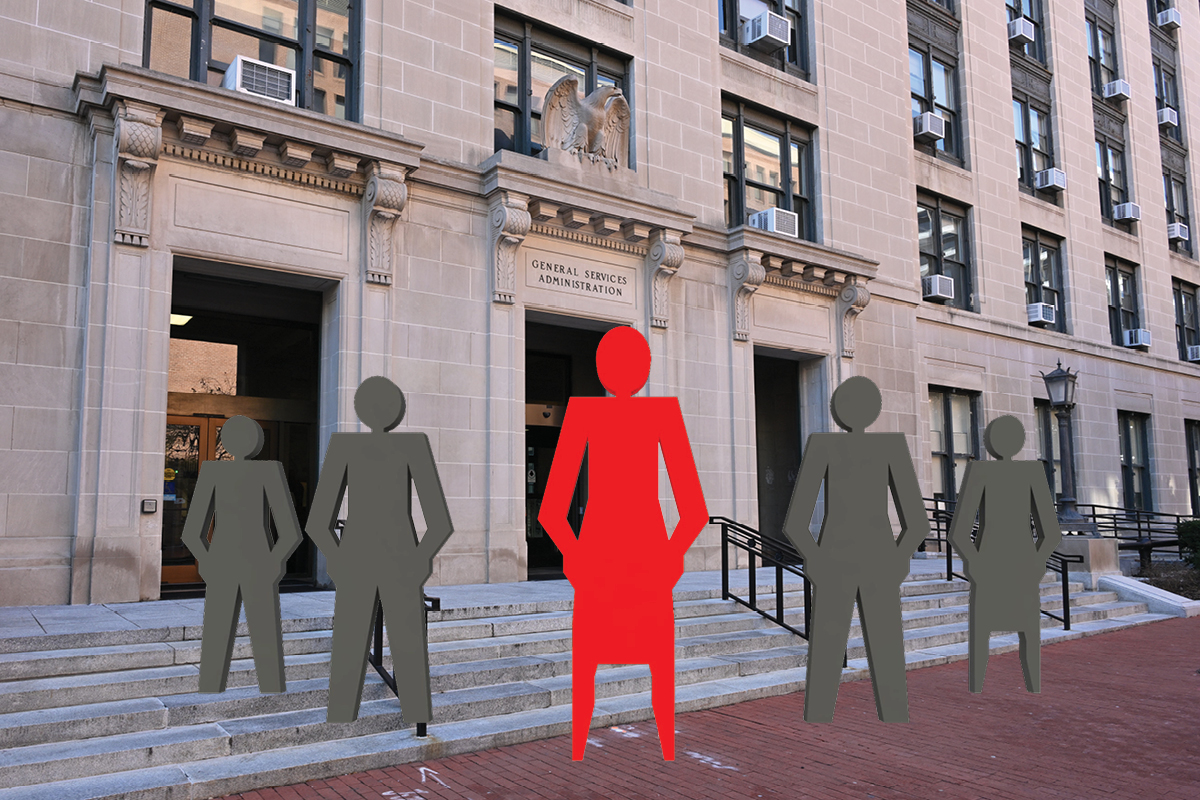
The Small Business Administration (SBA) is broadening the focus of its oversight of its socio-economic contracting programs. This new phase involves a comprehensive review of the Women-Owned Small Business (WOSB) program.
In a communication distributed earlier this week, the SBA notified economically disadvantaged women-owned small businesses that they must complete a questionnaire and submit their personal and business tax returns for the past three years, with a June 30 deadline.
“In accordance with federal regulations outlined in 13 C.F.R. § 127.400, the SBA is undertaking a formal program review to reconfirm that your company still satisfies the criteria for the Economically Disadvantaged Women-Owned Small Business (EDWOSB) certification,” the SBA’s compliance team within the Office of Government Contracting and Business Development stated in a message shared with Federal News Network. “Specifically, SBA officials will be checking that at least 51% of the business is owned by women who are classified as economically disadvantaged, as defined by 13 CFR 127.203.”
This new audit mirrors the investigative strategy the SBA previously applied to the 8(a) program. Back in December, the agency contacted over 4,300 firms enrolled in the 8(a) initiative, requesting 13 different forms of documentation. These requests covered everything from employee rosters to three years of banking records and copies of all contracts held under the 8(a) banner. That rigorous process resulted in 1,100 firms being temporarily suspended, and ultimately led to the removal of 154 companies from the program.
The SBA is currently attempting to overhaul the 8(a) business development framework. On Thursday, the agency published a draft regulation outlining new requirements for program admission. The SBA stated that “membership in a racial minority group will no longer automatically qualify an individual as ‘socially disadvantaged’ for 8(a) eligibility. Similarly, no individual will be excluded from entry into the 8(a) program solely based on being white. Going forward, every applicant must provide credible, factual proof of their personal social disadvantage.”
The agency clarified that these proposed changes would apply exclusively to businesses owned by individual entrepreneurs. The benchmarks for entities such as companies owned by Indian tribes, Alaska Native Corporations (ANCs), Native Hawaiian Organizations (NHOs), and Community Development Corporations (CDCs) would remain unchanged.
Furthermore, the new proposal does not affect the current standing of individually-owned businesses already participating in the 8(a) program.
The deadline for public comments on the draft regulation is July 13.
Building on Ultima decision
Senator Ed Markey (D-Mass.), who serves as the ranking member of the Small Business and Entrepreneurship Committee, asserted that the SBA’s proposed changes would sabotage the 8(a) program’s core goal: providing training, resources, and federal contract opportunities to entrepreneurs who have faced systemic discrimination in the U.S.
“The SBA’s proposed rule drastically misrepresents the reality of long-standing racial and ethnic discrimination in America. Nearly fifty years ago, Congress launched the 8(a) Business Development Program to give business owners who have battled historical and current prejudice a chance to work with the federal government and access support for business expansion,” Markey noted. “To be clear, the 8(a) initiative has always been open to any entrepreneur who can demonstrate they have suffered prejudice or cultural bias in fields such as education, employment, and business. Yet now, the SBA wants to base discrimination definitions on political preferences and permit applicants to simply verify their own eligibility without external proof. Rather than working to correct historical inequalities, this administration is once again choosing to twist facts to push forward its damaging agenda.”
Shane McCall, a legal partner at Koprince McCall Pottroff—a firm that advocates for small business contractors—explained that the SBA’s move to eliminate the “rebuttable presumption” of social disadvantage is a natural progression following the 2023 Ultima court ruling.
“However, the proposed regulation introduces significant new definitions for social disadvantage that specifically target racial quotas established by either public or private entities,” McCall explained. “Key examples include ‘unlawful diversity, equity, and inclusion programs or policies; unlawful affirmative action programs or policies; race-based quotas, set-asides, or hiring targets; or any government or private entity policies or programs that favor some groups over others based on race.’ We still need clarity on exactly how the SBA will enforce these updated standards.”
Both the newly launched WOSB audit and the suggested 8(a) reforms are designed to ensure federal contracting programs are not being exploited by unqualified firms while ensuring deserving ones are not excluded.
One industry insider expressed surprise at receiving the agency’s email, given that their business had recently renewed its certification, which remains valid for another three years.
Concerned about potential repercussions and wishing to remain unnamed, the industry executive raised several concerns regarding the notice. They questioned why the SBA is utilizing Survey Monkey for what is described as an official government examination, and whether that platform provides adequate security for sensitive data. The questionnaire asks for highly private financial details, including total cash holdings and specific amounts held in personal savings and checking accounts. Out of the 38 total inquiries on the survey, the SBA also requested:
- Has the Qualified Owner transferred any assets to immediate family members below fair market value within the last two years?
- Do you possess any retirement accounts? If so, please list each one along with the current balance.
- Do you own any stocks, bonds, or mutual funds? If so, please list each holding, specify the number of shares, and state the total market value for each.
- Do you own your primary home? If so, what is the remaining mortgage balance and the estimated current market value?
li>Do you have any life insurance policies with a cash surrender value?
“It makes me wonder about the time and effort invested into this process, and it really calls into question the credibility of the final outcome once the review is over,” the executive commented. “Will the SBA feed my information into some sort of algorithm or AI system to decide if I qualify, or will an actual human review this? Are they cross-referencing my current answers with my original application data, or is this being treated as an entirely independent audit?”
The SBA did not reply to a request for comment regarding the WOSB program audit.
Possible outcomes of SBA’s audit
The women-owned small business sector has experienced remarkable growth over the past ten years. Since Congress mandated a 5% contracting goal in 1994 through the Federal Acquisition Streamlining Act, various government agencies have steadily worked to expand this industrial sector. In fiscal year 2023, federal statistics indicate that 1,410 new WOSB firms entered the government contracting marketplace, showing an increase from the 1,183 new entries recorded the previous year, and up from the 1,276 new firms recorded in 2021. The General Services
The Administration hasn’t refreshed the supplier base dashboard since 2023.
Although federal agencies fell short of the 5% government-wide target between 2020 and 2024, total contract spending with these businesses still rose. According to the SBA’s June 2025 procurement scorecard, agencies awarded a record $31.7 billion to Women-Owned Small Businesses (WOSBs) in fiscal year 2024—up from $27.1 billion in 2020.
However, through the first eight months of fiscal year 2026, Leadership Connect reports a decline in contracting activity with Economically Disadvantaged Women-Owned Small Businesses (EDWOSBs).
From October through May of fiscal 2026, agencies issued 17 contracts totaling $2.3 million to EDWOSBs. By comparison, during the same periods in fiscal 2024 and 2025, agencies awarded 35 contracts worth $8.7 million and 29 contracts worth $4.7 million, respectively.
Overall, Leadership Connect found that all women-owned small businesses received $61.7 million in contracts since October of this fiscal year.
This upward trend in awards raised concerns about potential misuse, prompting the SBA to update its certification policies in 2020. Firms must now either apply via the SBA’s online certification system or through an approved third-party certifier. Additionally, the SBA mandated that every certified WOSB undergo recertification every three years.
In its current audit guidance, the SBA outlines two possible outcomes for EDWOSB participants:
- If the SBA confirms that the business still satisfies program eligibility criteria, it will notify the firm of its continued certification in its MySBA Certifications record. The firm’s certified EDWOSB status in the Supplier Based Schedule (SBS) will remain active.
- If the firm fails to respond to the program review within the required timeframe—or if the SBA determines it no longer qualifies—the agency will issue a notice of proposed decertification under 13 CFR 127.405. This notice will detail the grounds for decertification and require the business to respond in writing within 20 calendar days. Failure to cooperate or provide requested documentation may result in the SBA drawing an adverse inference.
The SBA also notes that economically disadvantaged WOSBs have the option to voluntarily exit the program before the audit process concludes.
“Although I haven’t seen any official announcement, it appears the SBA is reviewing economic disadvantage status for all EDWOSB participants,” said McCall. “Companies must submit supporting proof that they meet the EDWOSB economic disadvantage criteria—which closely mirror the rules used for the 8(a) program. This suggests the SBA is tightening oversight of the EDWOSB program, aligning it more closely with how the 8(a) program is managed.”
This heightened scrutiny coincides with legislative efforts to dismantle the WOSB program entirely. In April, Senator Mike Lee (R-Utah) and Representative Glenn Grothman (R-Wis.) introduced the Ending Discrimination in Government Contracting Act, which aims to eliminate federal contracting preferences for businesses owned by socially and economically disadvantaged individuals and women.
As of now, neither bill has advanced out of their respective congressional committees.
Copyright
© 2026 Federal News Network. All rights reserved. This website is not intended for users located within the European Economic Area.
