



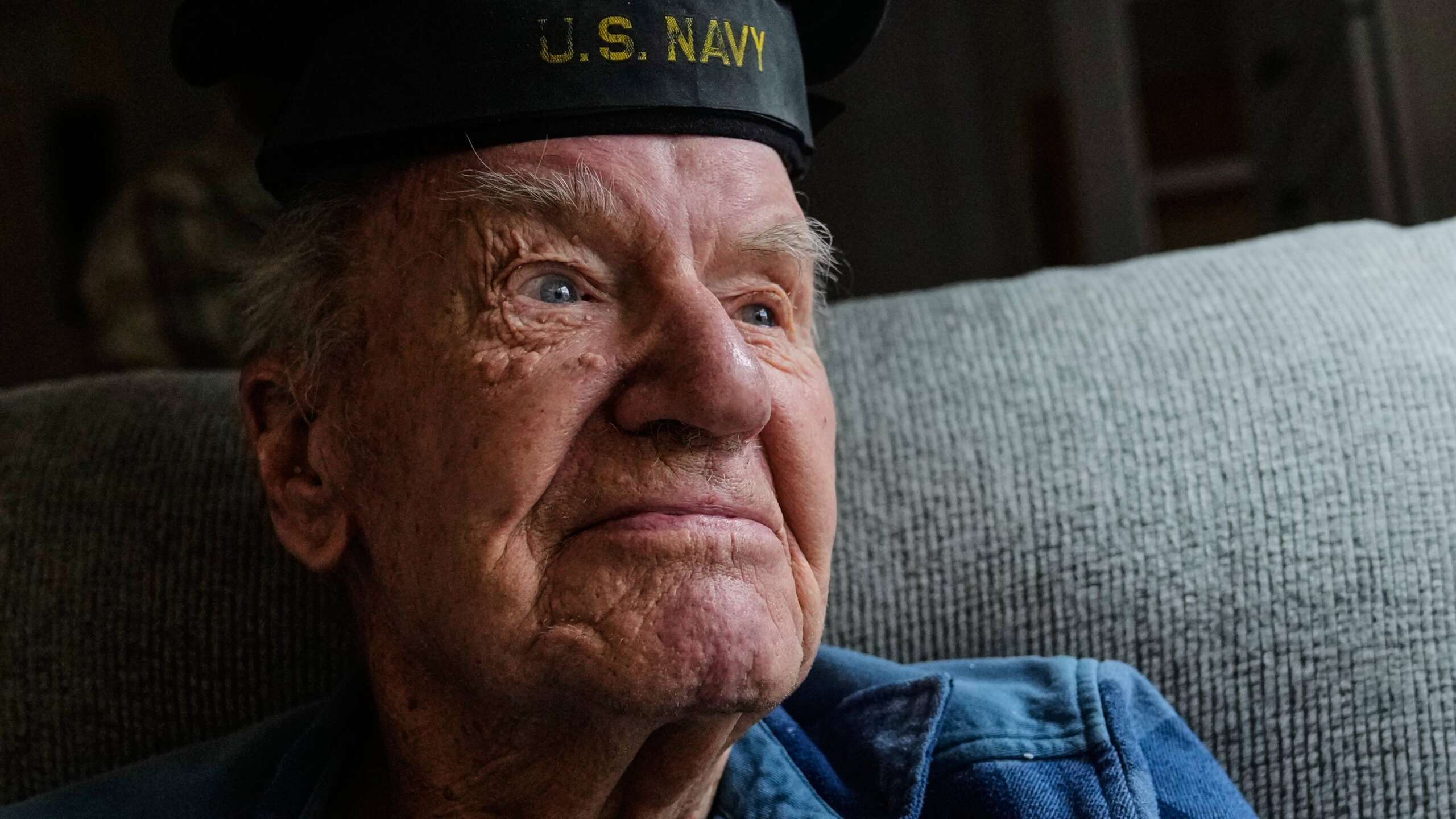
CENTERVILLE, Mass. (AP) — When Japanese forces struck Pearl Harbor, the nation’s oldest living survivor of the attack was deep below deck, working on repairs to a boiler aboard the USS St. Louis.
Freeman Johnson, who celebrated his 106th birthday in March, never actually saw the surprise assault. He didn’t hear his fellow sailors firing anti-aircraft guns at the incoming enemy planes — one of which was shot down. By the time he reached the upper decks, the St. Louis, a light cruiser, had already slipped past midget submarines and was making its way safely into open water.
“All the commotion was happening above me, and I was tucked away inside a steam drum. There was nothing to see — absolutely nothing,” said Johnson, who lives in Centerville, Massachusetts. His living room is packed with keepsakes and photographs from his time in the Navy, including images of the St. Louis and of himself as a young sailor, along with a display of Navy challenge coins and ribbons marking the places he traveled. His military identification tag — commonly called a dog tag — has been kept all these years.
Even as the St. Louis sailed into the vast Pacific, Johnson, whose wartime role aboard the ship was listed as a fireman, remained largely in the dark about what had happened.
“We were way offshore — way out. There was no land in sight at all. Just ocean stretching in every direction,” he recalled. “I was just an ordinary sailor, a swabbie — not an officer. They don’t give you information unless you need it. And I didn’t need to know. So I was told nothing.”
When Johnson visits schoolchildren, they frequently ask whether he was frightened that day. “You’re not scared. You’re far too busy to be scared,” he said in his rough, gravelly voice, his tone rising with emphasis. “On top of that, you don’t even know what there is to fear. You can’t see a thing. What exactly would you be afraid of?”
One of just 11 survivors remaining
Johnson became the oldest survivor following the death in December of World War II Navy veteran Ira “Ike” Schab, who was 105. With Schab’s passing and the death of Clarence Lane in February at age 100, only 11 survivors of the surprise attack remain. That assault killed just over 2,400 Americans and pushed the United States into World War II. The nation honors its fallen service members on Memorial Day, which falls on Monday this year.
Each year, a remembrance ceremony is held at the military base’s waterfront for those who survived Pearl Harbor.
Roughly 2,000 survivors attended the 50th anniversary commemoration in 1991. Only a handful came in more recent decades. In 2024, just two made the trip. This is out of an estimated 87,000 military personnel stationed on Oahu on that fateful day. No survivors traveled to Hawaii last year.
Growing public recognition
For most of his life, Johnson stayed out of the public eye and rarely spoke about surviving the bombing. After all, he was one of tens of thousands of sailors who were present on that devastating day. He remembered that his wife, Ruth, “thought that was something special,” so she contacted the Navy — “and the woman on the phone laughed at her.”
But as the oldest living survivor, he has become a local celebrity and the reluctant representative of one of the most pivotal events of World War II. Johnson arrived at his 106th birthday celebration in a limousine and was swarmed by television cameras. Letters arrive from around the world, and he is regularly called a hero whenever he goes out in public.
Johnson, who is hard of hearing, relies on a walker and lives with congestive heart failure, yet he can recount his wartime experiences with remarkable precision. A 19-year-old who was out of work and living at his family’s home in Waltham back then, Johnson said he was afraid of being drafted, so he chose the Navy — because he believed it would be less physically grueling than the Army.
“Growing up, I walked everywhere. If I needed to go somewhere, I either walked or rode my bicycle. But I had no interest in walking from France to Germany,” he said, seated in a recliner, dressed in an oversized flannel shirt, gesturing animatedly with his hands like a conductor leading an orchestra.
“That’s a long distance carrying a heavy pack on your back. … A day’s worth of water, a day’s worth of food, a 9-pound Springfield rifle — all on your back, marching through mud,” he said. “No, thank you. That’s why I joined the Navy.”
A witness to history
Johnson’s memories center less on combat while serving on the St. Louis, and later on the USS Iowa, and more on the ships’ prominent roles in world events. He helped commission the Iowa and vividly recalled the battleship’s preparations in November 1943 before it carried President Franklin D. Roosevelt to the Tehran Conference with British Prime Minister Winston Churchill and Soviet leader Josef Stalin.
The vessel was fitted with two elevators and a bathtub. All ammunition and much of the fuel were removed to reduce the ship’s weight as it navigated down the Potomac River to pick up Roosevelt. These supplies were later reloaded before the ship headed out across the ocean.
“It was a significant gathering,” Johnson said, remembering how the crew posed for photographs with Roosevelt. “I have no idea what they discussed, but it wasn’t my place to know. We picked him up, took him there, and brought him back home.”
Johnson also witnessed the end of the war from aboard the Iowa. He was positioned on the ship’s mast, watching surrender ceremonies about a mile away in Tokyo Bay on the USS Missouri on Sept. 2, 1945.
“I could see the boats approaching, carrying the Marines who were escorting the Japanese delegation onto the ship and seating them around the table,” he said. “It was over. The war had ended. A group of us gathered — the war is done. Let’s go home.”
Sharing the Pearl Harbor story
These days, his daughter, Diane Johnson, is often by his side. They share a household and make a point of traveling together every Dec. 7, frequently attending Pearl Harbor remembrance events — including the 65th and 80th anniversary commemorations in Hawaii. She often prompts her father with questions to get him talking and insists he has “a responsibility” to share the story of Pearl Harbor — particularly for younger generations who know little about the attack.
“It’s almost overwhelming when you really think about it. Well, the age — 106 — that’s what hits me,” she said. “Considering everything he’s lived through, he was there at the start, he was there in the middle, and he was there at the end when he watched the surrender ceremony. It’s quite something.”
Johnson began attracting wider attention after Diane heard a local TV report implying that the state’s last surviving Pearl Harbor veteran had passed away. She called to set the record straight, which raised his public profile. Johnson also became a regular fixture in the Cape Cod St. Patrick’s Parade, often marching near the front.
“I wish more people today were like him. He just carries on without complaining about a thing,” said Desmond Keogh, the parade’s chairman, who has walked alongside Johnson. “That’s what this country was built on. They were simply a different generation. They did what was right for their country.”
Despite all the attention surrounding Pearl Harbor, the gruff Johnson — known for his hearty cackling laugh and playful grin — doesn’t view it as the defining moment of his life.
That distinction belongs to marrying his late wife after the war and raising three daughters. He also spent years working in a machinist shop, then a convenience store, and finally delivering meals to seniors — all positions he eventually retired from, the last one at age 90.
“Pearl Harbor just happened to me. I can’t describe it any other way,” he said.
Copyright
© 2026 The Associated Press. All rights reserved. This website is not intended for users located within the European Economic Area.
