



**The TONTOU Attack: How Interrupt Injection Bypasses a Key AMD Spectre Defense**
A team of MIT researchers has uncovered a novel hardware-level exploit that can bypass a critical security mitigation in AMD processors, potentially allowing malicious programs to steal sensitive data. Dubbed **INTERRUPT INJECTION**, the technique targets the “Safe-RET” protection mechanism and demonstrates a new class of timing-based attacks dubbed TONTOU (Time-of-Neutralization to Time-of-Use).
### Understanding the Vulnerability
Modern processors employ speculative execution to improve performance, but this creates security vulnerabilities like Spectre, where attackers trick the CPU into executing unauthorized instructions. To combat this, AMD implemented the “Safe-RET” mitigation on its Zen architecture. This defense sanitizes the processor’s branch predictor state right before a kernel function returns, effectively neutralizing any malicious training an attacker may have performed.
However, the MIT research reveals a critical gap in this protection. An **unprivileged Linux program** can precisely time a hardware interrupt to land in the narrow window between when the CPU sanitizes its branch predictor and when the kernel actually uses it. By re-poisoning the predictor during this gap, the attacker can bypass the defense entirely.
### How INTERRUPT INJECTION Works
The attack requires no special privileges—only local code execution on the target machine. Here’s the process:
1. **Timing the Interrupt**: The attacker triggers a hardware interrupt at the exact nanosecond when the Safe-RET mitigation has completed its sanitization but the kernel has not yet resumed execution.
2. **Interrupt Handler as Gadget**: The interrupt handler itself becomes the “training gadget” that manipulates the CPU’s branch predictor state.
3. **Exploiting Inception**: The handler leverages a separate vulnerability (CVE-2023-20569, known as Inception) to fill the return stack buffer with an attacker-chosen target, ultimately enabling arbitrary code execution or data exfiltration.
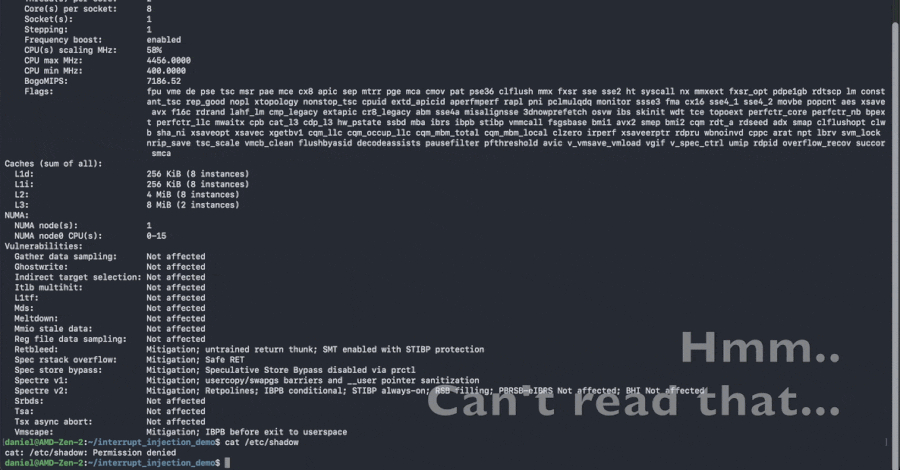
According to the researchers, on an AMD Zen 2 system running Linux 6.14, the exploit achieved a leak rate of 5.47 bytes per second with 91.97% accuracy, successfully locating and reading `/etc/shadow` (which stores password hashes) in five out of ten attempts.
### Impact and Affected Systems
AMD classified the severity of this issue as **High** and confirmed that the vulnerability affects processors from Zen 1 through Zen 4. The attack window is particularly narrow—on Zen 2, it spans just two instructions (six bytes)—but attackers can widen their odds by using techniques such as:
– Evicting cache lines with a sibling hyperthread
– Selecting specific syscalls (like `write`) to control register states
While Intel does not consider a mitigation necessary, citing existing guidance (INTEL-SA-00598), the researchers believe an end-to-end attack is possible by combining INTERRUPT INJECTION with existing kernel disclosure gadgets.
### The Fix
A patch has already been developed and integrated into the Linux kernel. The commit, titled **”x86/bugs: Make Safe-RET robust against interrupt injection,”** was authored by AMD engineers Borislav Petkov and David Kaplan. It addresses the flaw by:
– Preserving register state as if the Safe-RET sequence completed
– Avoiding execution of a `RET` instruction after the interrupt returns
AMD has also released a security bulletin (AMD-SB-7061) acknowledging the issue and noting that a fix is delivered through standard operating system updates.
### FAQ
**Q: What is TONTOU?**
TONTOU stands for *Time-of-Neutralization to Time-of-Use*. It describes a class of side-channel attacks that exploit the window between when a security mitigation neutralizes sensitive state and when that state is actually used.
**Q: Does this affect only AMD processors?**
While the research focused on AMD Zen architecture, the team believes a similar end-to-end attack could be developed for Intel processors by combining INTERRUPT INJECTION with existing kernel gadgets.
**Q: How can I protect my system?**
Apply all operating system and kernel updates. The fix is already included in recent Linux kernel versions.
**Q: What makes this attack different from traditional Spectre exploits?**
Unlike classic Spectre attacks that rely on malicious training, INTERRUPT INJECTION exploits a timing window in hardware-level defenses, making it a new variant of speculative execution vulnerability.
**Q: Is code available for this exploit?**
As of now, the artifact repository referenced in the research paper was not yet publicly available.
### Conclusion
The INTERRUPT INJECTION technique exposes a subtle but serious flaw in how hardware defenses interact with interrupt handling. While a patch is available, this discovery underscores the ongoing cat-and-mouse game in cybersecurity—where even robust mitigations can be bypassed with precise timing. System administrators are urged to apply kernel updates promptly and remain vigilant against emerging side-channel threats. As research continues, the security community must further harden speculative execution defenses against these increasingly sophisticated attacks.
