



**Morgan Stanley Ethereum Trust: Trading Shares and Understanding the Risks**
Morgan Stanley has launched a new Ethereum Trust (ticker: MSSE) on NYSE Arca, offering investors a way to gain exposure to Ethereum via an exchange-traded product (ETP). While shares trade like stocks during market hours, the underlying structure carries unique risks and mechanics that potential investors should understand.
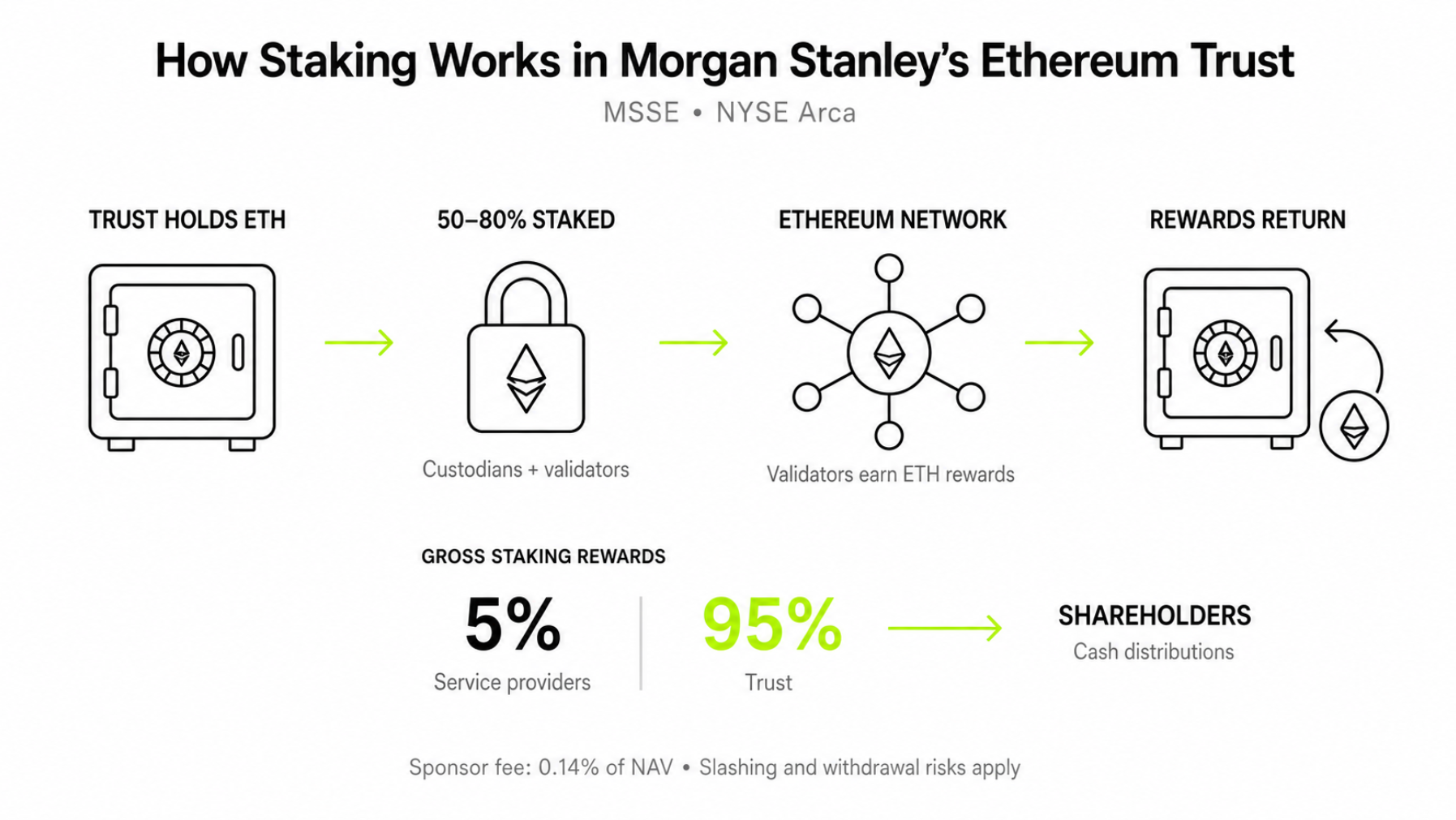
The trust holds Ethereum (ETH) and earns staking rewards, but it does so through a specific framework. Validators are operated by third-party providers, while custodian banks retain control of the private keys, preventing direct asset transfers by validators. This setup separates ownership from operational control and introduces different types of risk.
### When a Validator Error Hits the Share Price
Ethereum validators earn rewards for correctly performing network duties but can be penalized or “slashed” for violations such as signing conflicting messages. Slashing is rare but can cluster, especially during shared operational failures. For ETP investors, slashing reduces the trust’s asset base, which typically leads to a decline in net asset value (NAV) and share price.
According to Eva Lawrence, Head of Revenue at Figment, slashing penalties hit the fund itself rather than being billed separately to investors. While institutional-grade validators have strong track records, the trust’s prospectus notes that compensation may be subject to conditions, exclusions, and evidentiary requirements. It may not fully cover losses, especially in protocol-wide incidents.
Morgan Stanley’s custody model prevents validator-side asset diversion, but it does not eliminate economic liability. As Nitin Gaur of Nethermind notes, the key questions involve who absorbs losses, whether indemnity arrangements are backed by real balance sheets, and how exit queues are managed during stress.
### The Provider’s Balance Sheet Becomes Part of the Product
Staking providers are increasingly evaluated on uptime, security, and fees, but an ETP makes their financial strength and legal obligations part of the investment structure. The number of providers does not guarantee true diversification if they rely on shared infrastructure, such as the same cloud regions or client software.
As Benjamin Sarquis Peillard of Cap explains, asset managers should assess incident history, key management practices, and contractual terms, particularly in worst-case scenarios. Concentration in infrastructure or shared dependencies can undermine apparent diversification, turning provider selection into a correlation analysis as much as a vendor evaluation.
### A Liquid Share Sits Over a Withdrawal Queue
Staking changes the liquidity profile of the held asset. Ethereum restricts how many validators can enter or exit the network over time, creating potential mismatches between redemption demand and available ETH.
While the trust keeps some ETH unstaked to meet redemptions, exit delays can stretch to weeks or months during high demand. This dynamic creates a liquidity mismatch that investors must consider, especially if redemption requests surge unexpectedly.
### The Math Behind the 95% Reward Pass-Through
The trust charges a 0.14% annual sponsor fee, which is lower than many U.S. crypto ETPs. However, the staking revenue distribution is layered. Custodians and providers receive 5% of gross staking rewards, leaving 95% to the trust. Because only 50% to 80% of ETH is typically staked, the gross portfolio yield is lower than the protocol rate.
Using a 2.8% network APR as an example, a 50% staking allocation might generate roughly 1.4% in gross yield before fees, translating to about 1.19% after costs at that allocation. At 80% staking, the estimated contribution rises to nearly 2%. These figures are illustrative and do not account for activation delays, penalties, taxes, or operational expenses.
As Sarquis Peillard points out, low fees and high reward pass-through only work at scale. Smaller issuers may struggle to cover secure custody, monitoring, and risk management costs, which can affect long-term viability.
### Who Pays When Staking Goes Wrong?
Investor protection depends not only on validator performance but also on legal and funded loss-absorption mechanisms. Edward Wu of BloFin Research suggests that regulated staking products could use loss reserves, funded bonds, or pooled protection funds to create a first-loss layer between provider failure and investor capital.
Without such structures, legal design and provider solvency become critical. Historical cases, such as regulatory actions against staking-as-a-service products, show that rules and compliance can change the viability of a product independent of technical performance.
The Morgan Stanley Ethereum Trust offers a familiar trading interface but requires scrutiny of its staking ratio, exit policy, provider agreements, and balance sheet depth. Comparing fees is simple; understanding the loss waterfall is more complex but essential.
—
### FAQ
**What is the Morgan Stanley Ethereum Trust (MSSE)?**
It is an Ethereum-linked ETP listed on NYSE Arca that holds ETH and earns staking rewards through third-party validators. Shares trade during market hours, but the trust, not investors, directly holds and manages the underlying ETH.
**How are staking rewards distributed?**
The trust retains 95% of staking rewards after custodians and providers take a 5% fee. Investors receive a pass-through of this amount, net of the 0.14% sponsor fee and other expenses.
**What happens if validators are slashed?**
Slashing reduces the trust’s ETH holdings and NAV, which typically lowers share prices. Compensation may be limited by contract terms, exclusions, and availability.
**How liquid are shares compared to ETH itself?**
Shares trade like stocks, but redemption of underlying ETH can take days to weeks during high exit demand due to Ethereum’s staking withdrawal queue.
**Who bears the risk if staking goes wrong?**
Losses generally affect the trust’s NAV first. Investors do not have direct claims against validator keys or custody arrangements. The extent of protection depends on provider agreements and any funded loss-absorption arrangements.
**Should I compare fees only?**
No. The fee is only one factor. You should also review staking ratios, provider infrastructure, diversification, legal documentation, and historical operational performance.
—
### Conclusion
Morgan Stanley’s Ethereum Trust offers a regulated, share-class way to access Ethereum staking yields, but it introduces layered risks. The gap between share liquidity and ETH staking liquidity, combined with provider concentration and loss-absorption mechanics, means that product structure is as important as headline yields. Investors should weigh not only the expected returns but also the balance sheets and operational frameworks that stand between protocol performance and shareholder impact.
