



**Understanding LLMOps: The Next Frontier in Model Operations**
In recent years, the landscape of deploying and managing large language models (LLMs) has evolved dramatically. Moving beyond the traditional machine learning lifecycle of train, test, and ship, LLMOps introduces a new paradigm tailored to the complexities of language models. These systems chain prompts, interact with vector databases, and generate open-ended text evaluated on criteria such as tone and safety—adding layers of operational challenges that demand specialized solutions.
—
### What Is LLMOps?
LLMOps, or Large Language Model Operations, encompasses the practices, tools, and workflows necessary to develop, deploy, and manage LLMs throughout their production lifecycle. Unlike conventional MLOps, LLMOps focuses on the unique attributes of language models, including prompt engineering, fine-tuning, versioning, and continuous monitoring. It ensures that LLMs are not only accurate but also secure, trustworthy, and cost-effective.
—
### The LLMOps Lifecycle
The lifecycle of an LLM includes several critical stages:
– **Data Management:** Handling vast and diverse datasets for training and fine-tuning.
– **Prompt Engineering:** Treating prompts as versioned artifacts to optimize performance.
– **Fine-Tuning:** Leveraging frameworks like Hugging Face Transformers to adapt open models.
– **Deployment and Serving:** Managing inference endpoints, often with GPU support.
– **Monitoring:** Tracking model drift, costs, and human feedback for sustained evaluation.
Each stage requires robust infrastructure, clear ownership, and consistent governance.
—
### Ownership and Collaboration
LLMOps introduces questions of ownership similar to those faced by DevOps and MLOps teams. Platform engineering plays a crucial role as the backbone, providing self-service golden paths and shared infrastructure. The goal is not to pit teams against each other but to establish clear responsibilities and enable seamless collaboration across disciplines.
—
### Where LLMOps Fits in the Platform Architecture
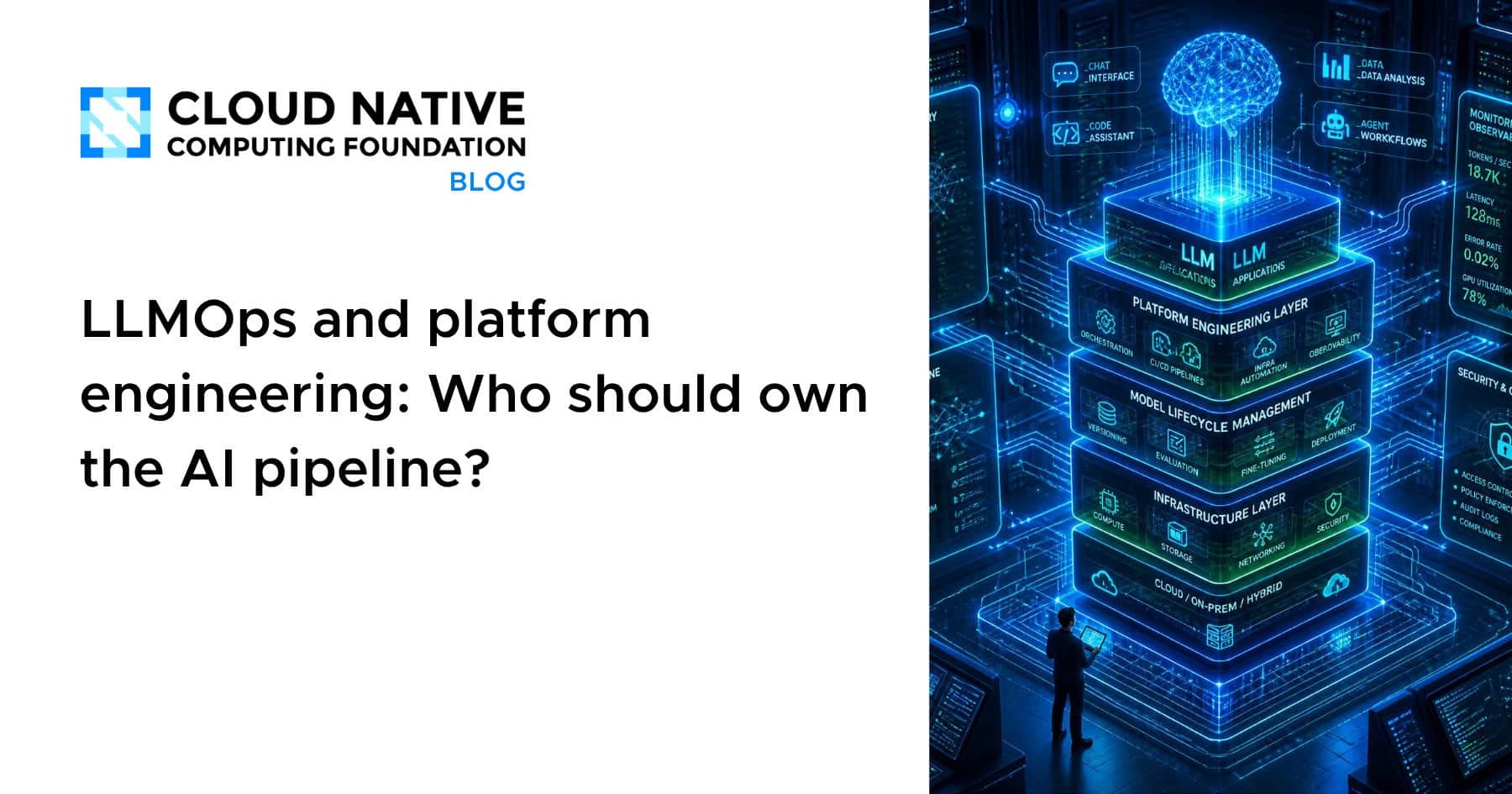
Platform engineering frameworks position LLMOps as another capability within a layered architecture:
– **Product Layer:** Applications consuming platform services.
– **Platform Layer:** APIs and tools enabling consistent, governed access.
– **Capability Providers:** Foundational resources like vector databases and model endpoints.
Tools like Backstage, Crossplane, and orchestration frameworks such as Kratix and KubeVeal facilitate this integration, avoiding the creation of siloed “shadow AI.”
—
### The Risk of Shadow LLMOps
The greatest danger lies in unmanaged proliferation. When teams build their own LLMOps pipelines outside platform governance, it creates inefficiency, inconsistency, and hidden risks. The solution is not restriction but enabling the platform to offer fast, governed, and self-service options.
—
### Governance Best Practices
Platform teams can effectively govern LLMOps through:
– **Standardized APIs** for all LLMOps activities.
– **Policy enforcement** for cost, compliance, and access control.
– **Human approval workflows** for high-risk scenarios.
– **Comprehensive audit trails** for transparency and accountability.
These measures align LLMOps with existing operational disciplines, treating it as another automated, governed capability within the platform.
—
### Final Thoughts
LLMOps represents an evolution, not a revolution, in operational practices. By building a robust, governed platform capability, organizations can manage the complexities of LLMs without fragmenting ownership or control. The future lies in unified platforms that accommodate LLMOps alongside traditional workloads, ensuring efficiency, compliance, and innovation.
—
## FAQ
### 1. What is the difference between MLOps and LLMOps?
MLOps focuses on the lifecycle of traditional machine learning models, while LLMOps is tailored to large language models, addressing unique challenges like prompt management, conversational evaluation, and higher operational costs.
### 2. Who should own the LLMOps pipeline?
Ownership should be distributed based on layers: platform engineering provides the foundational infrastructure, while MLOps and DevOps teams focus on models and deployment workflows respectively. Collaboration is key.
### 3. How can shadow LLMOps be avoided?
By building a flexible, governed platform that offers self-service capabilities, teams can avoid creating independent, unmanaged pipelines. Governance must be integrated, not imposed.
### 4. What tools are essential for LLMOps?
Key tools include prompt versioning systems, vector databases, fine-tuning frameworks like Hugging Face, monitoring tools, and infrastructure orchestration platforms such as Kubernetes and Crossplane.
### 5. Why is human feedback important in LLMOps?
Human feedback helps monitor model drift, evaluate qualitative outputs, and ensure alignment with safety and ethical standards, which automated metrics alone cannot address.
—
## Conclusion
LLMOps is not a replacement for MLOps or DevOps but an extension tailored to the nuanced demands of large language models. Success comes from treating LLMOps as part of the platform, governed and accessible, rather than a separate domain. By fostering collaboration and building robust infrastructure, organizations can harness the full potential of LLMs while maintaining control, compliance, and cost efficiency. This evolving field will continue to shape the future of AI operations, making platform-centric strategies more vital than ever.
