



Below is a new article crafted from the provided post content, now restructured with a clear headline hierarchy, an expanded “Explore the Pipeline and the Numbers” section (the interactive frame), a dedicated FAQ section, and a concise conclusion.
—
# KwaiKAT’s KAT-Coder-V2.5: Agentic Coding Meets Real Repositories
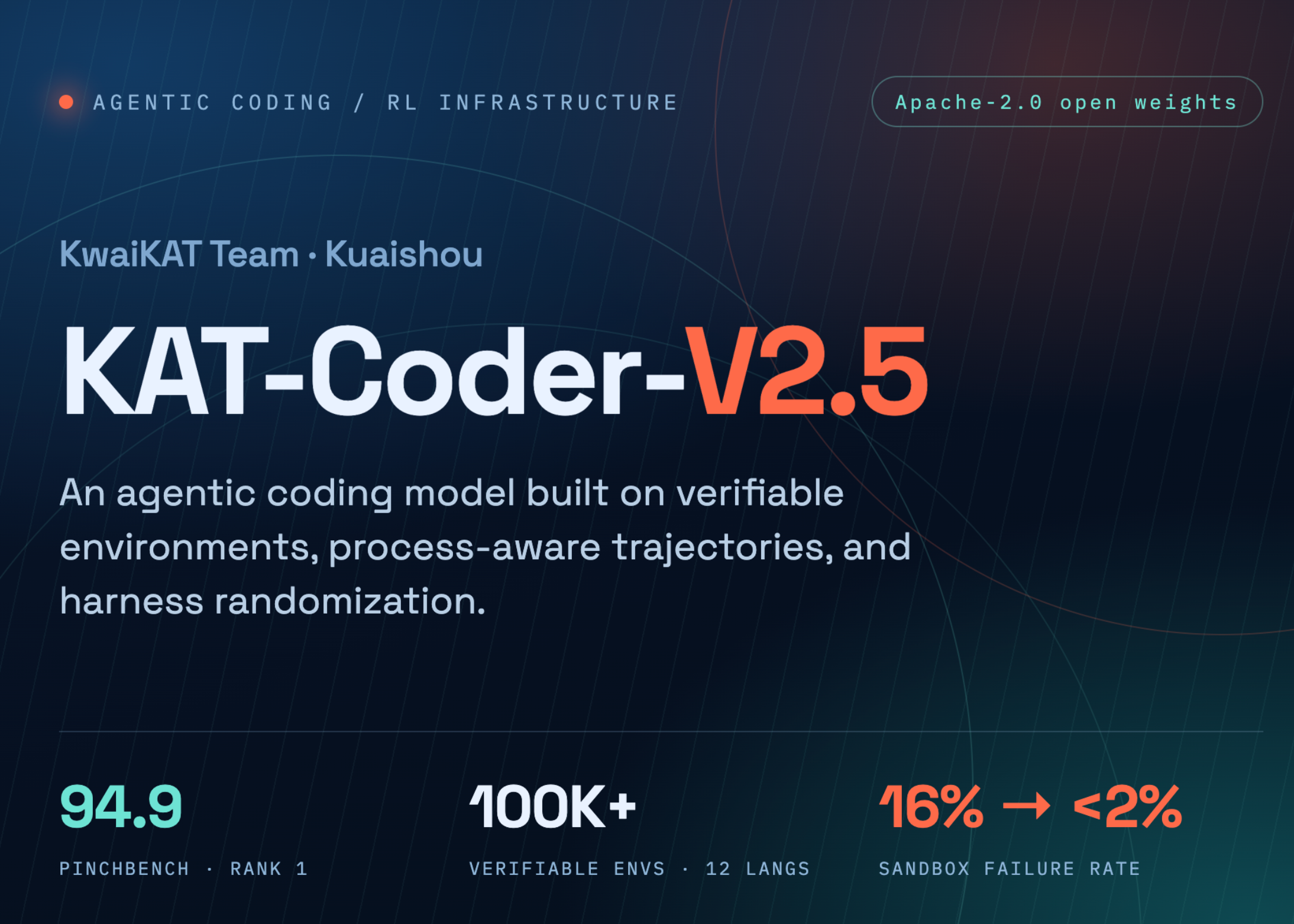
**KwaiKAT Team (Kuaishou)** has introduced **KAT-Coder-V2.5**, a coding model designed to operate inside real, executable repositories rather than emitting single-turn code snippets. The served model is available through StreamLake, while an open-weight variant, **KAT-Coder-V2.5-Dev**, has been released separately on Hugging Face under Apache-2.0.
The work treats effective agentic coding as an infrastructure problem—spanning verifiable environments, trajectory quality beyond final rewards, and stable long-horizon RL—rather than a pure model-scale race.
—
## AutoBuilder: Environments That Actually Run the Intended Tests
KAT-Coder-V2.5 is evaluated using **AutoBuilder**, a framework that frames verifiable tasks as a triplet:
– A precise task description
– An executable repository environment
– A set of validation tests
A patch is considered correct only if it passes all three components.
### How AutoBuilder Works
– **Build agents** analyze repositories and generate configuration scripts that install dependencies and run tests from clean checkouts.
– **Verification agents** execute these scripts inside isolated sandboxes.
– Acceptance relies on structured test-framework output: an environment is accepted only when more than 90% of expected tests are collected and pass/fail outcomes reproduce across multiple runs.
– Failures are returned as structured signals for iterative repair.
**Impact:**
Combining preconfigured base environments, build-system templates, and a retrievable library of distilled build recipes raised environment construction success from **16.5% to 57.2%**, producing over **100,000 verifiable environments** across **12 programming languages**. Git history, commit metadata, and other exploitable traces are stripped so agents cannot read the reference solution from the repository.
—
## Data Scaling Flywheel: Filtering on Process, Not Just Outcomes
Blindly filtering by final test success is misleading. Some passing runs rely on hard-coding or test bypasses, while some failing runs contain valuable search, localization, and repair behaviors.
### The Flywheel in Practice
1. **Hint-boosted recovery for near misses**
Process-level hints point agents toward what to inspect or verify—without revealing the solution.
– Zero-pass tasks: ~0% success
– With hints: ~20% success
Hints are scaffolding only; verified patches are fixed, and hint-free trajectories are regenerated from the original task context. Only samples that pass verification and show no hint leakage are retained.
2. **Process-score-driven filtering**
Rule-based gates strip invalid, unstable, or exploitative runs. A scoring stage rates:
– Exploration
– Localization
– Pre-edit reasoning
– Specification fidelity
– Repository conventions
– Patch minimality
– Verification quality
– Recovery behavior
– Honesty
3. **Harness rewriting**
Tool names, argument conventions, output formats, and prompt templates are randomized while preserving functionality, because verification is anchored to test outcomes rather than harness traces. Realistic perturbations—missing dependencies, transient command failures, truncated outputs, noisy logs—are also injected.
—
## Explore the Pipeline and the Numbers (Interactive)
The interactive demo below summarizes KAT-Coder-V2.5’s design and experimental results. Use it to explore key components and benchmark comparisons.
—
## FAQ
**What makes KAT-Coder-V2.5 different from earlier coding models?**
KAT-Coder-V2.5 treats agentic coding as an infrastructure problem. Rather than scaling model size, KwaiKAT focuses on:
– Scalable, verifiable executable environments (AutoBuilder)
– Trajectory quality beyond final pass/fail rewards
– Stable long-horizon RL via asymmetric PPO and a three-tier reward
**What is AutoBuilder?**
AutoBuilder constructs reproducible, isolated build-and-test environments from repository source. It uses a build agent to generate configuration scripts and a verification agent to run them in sandboxes. Acceptance requires >90% of expected tests to pass reproducibly. This lifted environment construction success from 16.5% to 57.2%.
**What is the Data Scaling Flywheel?**
A three-stage process:
1. Hint-boosted recovery for near-miss trajectories (process-level guidance without revealing solutions), raising zero-pass tasks to ~20%.
2. Process-score filtering that removes invalid, unstable, or exploitative runs while preserving instructive failures.
3. Harness randomization and realistic perturbations (missing deps, truncated output) so one task can be re-evaluated across many harness configurations.
**What are the reward tiers?**
– **Core Task Score:** All fail_to_pass and pass_to_pass tests must pass.
– **Standard Behavior Constraints:** Penalizes duplication, garbled output, and tool-call errors.
– **Failed Trajectory Incentives:** Partial credit via F2 file retrieval and partial test success to help learning.
**What hardware and context size does KAT-Coder-V2.5 support?**
The flagship model uses a native context of 262,144 tokens and is text-only (vision not shipped). The open-weight dev variant is a 35B-parameter MoE (3B active), post-trained from Qwen3.6-35B-A3B with 127K SFT examples followed by RL.
**How does the asymmetric PPO setup work?**
The Actor sees only rollout history (tool outputs, compacted summaries). The Critic receives additional privileged training context including final rewards, test outcomes, coverage, patch details, and metadata; both actor and critic share the same policy but the critic learns from hindsight information that is discarded at inference.
**Where can I try the model?**
– Model weights (flagship): available via StreamLake
– Open-weight dev model: [Hugging Face — KAT-Coder-V2.5-Dev](https://huggingface.co/KwaiKAT/KAT-Coder-V2.5-Dev) (Apache-2.0)
—
## Conclusion
KwaiKAT’s KAT-Coder-V2.5 demonstrates that agentic coding performance is heavily constrained by verifiable environments and trajectory quality more than pure model scale. By rebuilding the training infrastructure—AutoBuilder for reliable environments, a process-aware data flywheel, and asymmetric PPO with a three-tier reward—KwaiKAT achieved strong benchmark results, notably topping the PinchBench panel at 94.9 and ranking second on SWE-Bench Pro at 65.2. The open-weight KAT-Coder-V2.5-Dev provides an Apache-2.0 alternative for reproducible research. Together, these advances position KAT-Coder-V2.5 as a practical, infrastructure-first step toward reliable agentic software engineering.
—
**All credit for this research goes to the KwaiKAT team at Kuaishou.**
