



# Justin Sun Launches $1 Million Academic Prize to Redefine Scientific Reward in the AI Era
**Geneva, Switzerland** — A new initiative has been unveiled that aims to fundamentally reshape how scientific breakthroughs are recognized and rewarded in the age of artificial intelligence. The project, spearheaded by tech entrepreneur and philanthropist Justin Sun, introduces a decentralized bounty system that ties monetary rewards directly to the solution of well-defined mathematical problems and the machine-verifiable proofs that accompany them.
## A New Model for Scientific Recognition
The academic bounty program operates on a “problem list” model. Rather than relying on traditional nomination processes, institutional credentials, or the prestige of the individuals involved, the system awards prizes strictly based on the strength and verifiability of the mathematical work submitted. Once a problem is added to the list, it becomes permanently locked — problems can be added over time, but none can be removed. Similarly, prize funds that have been awarded are never reclaimed.
The top prize for any single solved problem stands at US$1 million, with the first round of awards already recognizing breakthroughs across 66 mathematical challenges.
## First Winners and the Navier–Stokes Breakthrough
The inaugural list of laureates was recently announced, with the largest individual payout going to a research team at OpenAI. The team earned the US$1 million prize for solving and formally proving the Existence and Smoothness of the Three-Dimensional Navier–Stokes Equations — a problem that had been listed among the Clay Mathematics Institute’s seven Millennium Prize Problems in 2000.
The Navier–Stokes equations, which describe the behavior of fluid motion, have been central to physics and engineering for roughly two centuries. They were developed in the 19th century by French physicist Claude-Louis Navier and Irish-born British mathematician George Gabriel Stokes, among others. Despite their wide applicability, proving certain fundamental properties of these equations had remained unresolved for generations.
According to public disclosures, the solution was generated by OpenAI’s internal models, with the formal Lean verification carried out by GPT-6 Astra.
## Permanent Problem List and AI-Driven Verification
The organizers behind the prize have described a vision of creating what they call the “Nobel Prize of the AI Era.” The repository of mathematical challenges and the corresponding formalized code will be maintained as a publicly accessible, continuously updated resource. All proofs, verification materials, and standards will be hosted on open platforms, and prize disbursement records will be recorded on a blockchain for permanent traceability.
The current problem list spans some of the most famous unsolved questions in mathematics, including the formal verification of the Poincaré Conjecture, the Riemann Hypothesis, and Goldbach’s Conjecture. It also includes a significant number of unsolved problems originally proposed by the late mathematician Paul Erdős, a recipient of the Wolf Prize.
## Core Principles and Inclusivity
The program is built around three guiding tenets: openness, public benefit, and open source. There are no restrictions based on nationality, institutional affiliation, or personal identity, and the framework makes no distinction between human contributors and artificial intelligence systems. All resources are dedicated exclusively to prize disbursement and public initiatives, with no profit motive embedded in the structure.
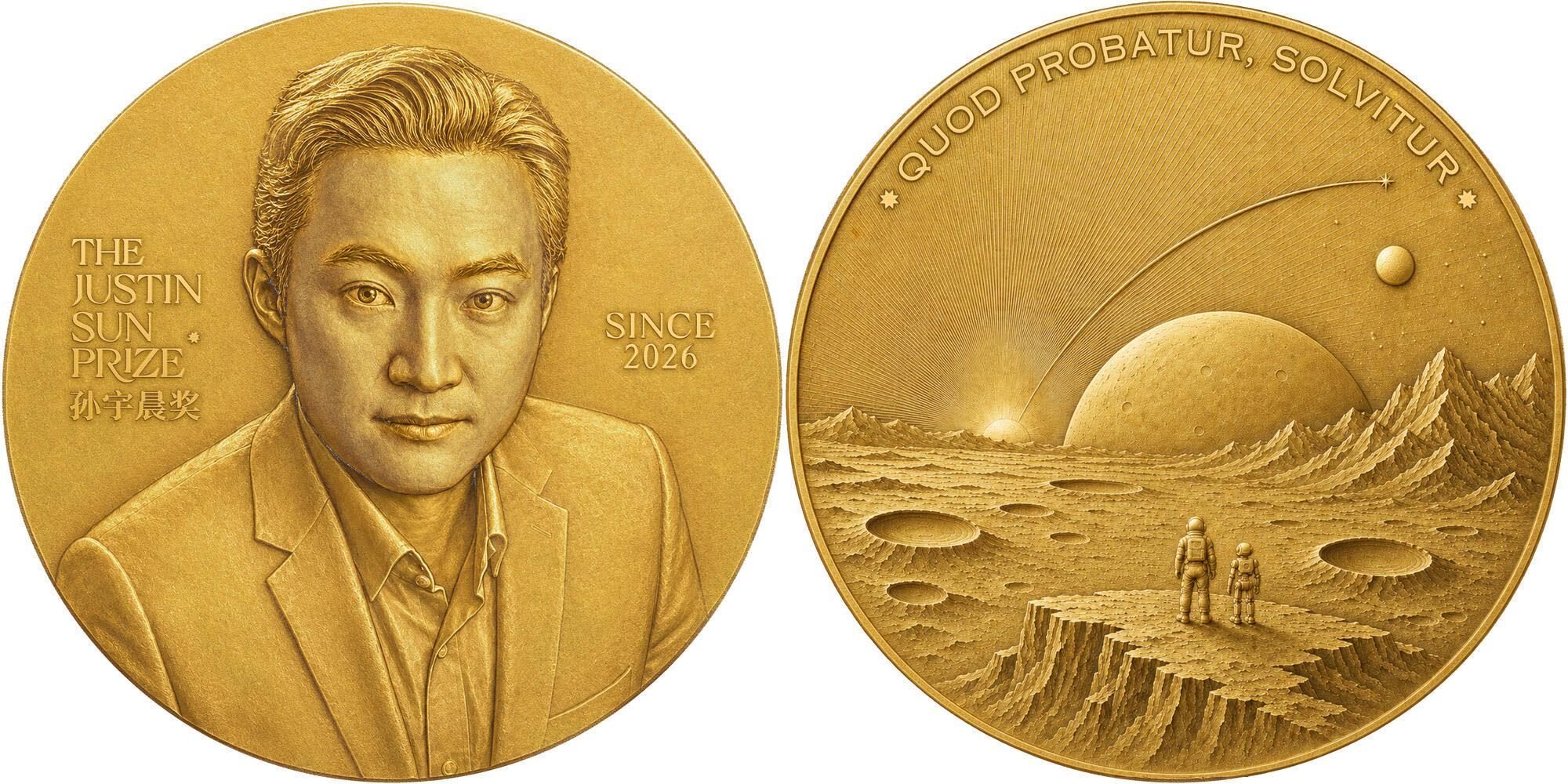
Winners in addition to their prize money will receive a formal certificate and a specially minted medal. The medal’s edge bears the Latin inscription “Quod probatur, solvitur,” which translates to “Proved, then paid.”
## Funding and Payout Details
The prize payouts will be issued in either USDT on the TRON blockchain (TRC-20) or USDC on Ethereum (ERC-20), with recipients free to choose the network that suits them. The initiative is funded through Justin Sun’s personal philanthropic resources, adding to a track record that includes more than US$45 million donated across technology, environmental protection, disaster relief, and other public causes.
## Frequently Asked Questions
**Q: What is the Justin Sun Prize?**
A: It is a decentralized academic bounty program that awards prizes for breakthroughs in fundamental mathematics and machine formal verification. The initiative uses a “problem list” approach, where monetary rewards are tied directly to verified solutions of specific mathematical challenges.
**Q: How much is the top prize?**
A: The top prize for any single problem is up to US$1 million.
**Q: How are winners selected?**
A: Winners are determined by being the first to produce a qualifying breakthrough that includes a machine-verifiable formalized proof. There is no traditional nomination process, and no credential or institutional requirements apply.
**Q: Can problems be removed from the list once added?**
A: No. The problem list operates on a write-only basis — problems can be added over time but cannot be removed once listed.
**Q: Must awarded prize money be returned if the proof is later found to be flawed?**
A: No. Prize funds are permanently disbursed and do not need to be returned under any circumstances.
**Q: Is the prize open to both humans and AI?**
A: Yes. The program makes no distinction between human contributors and artificial intelligence systems.
**Q: How are winners paid?**
A: Recipients can choose to receive their prize in USDT on TRON (TRC-20) or USDC on Ethereum (ERC-20).
**Q: What are the core principles of the prize?**
A: The program operates on three principles: openness, public benefit, and open source. All materials, verification standards, and disbursement records are publicly available.
**Q: Who is Justin Sun?**
A: Justin Sun is the founder of TRON, a blockchain platform that processes over $13 trillion in volume since its inception, and the founder of the Office of Justin Sun, which supports initiatives in technology, blockchain, AI, scientific research, philanthropy, and space exploration.
## Conclusion
The launch of this decentralized academic prize represents a significant departure from the traditional models of scientific recognition. By anchoring rewards to verifiable mathematical proofs and embracing both human and AI contributors equally, the initiative seeks to accelerate progress in fundamental science at a time when artificial intelligence is reshaping every corner of research and discovery. Whether it achieves its ambitious goal of becoming the defining academic award of the AI era remains to be seen, but its open, transparent, and enduring structure sets a compelling new standard for how scientific breakthroughs can be incentivized and celebrated.
Thank you for reading
