



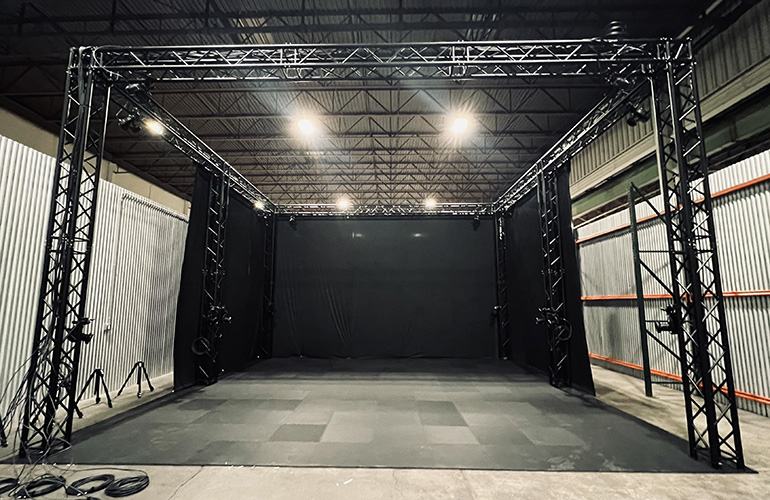
# New Motion-Capture Facility Aims to Accelerate Humanoid Robot Development with Precision Data Collection
A specialized research facility dedicated to generating high-fidelity motion data for training humanoid and industrial robots has officially opened its doors. The laboratory, developed in partnership with a leading motion-capture technology provider, promises to address one of the most persistent bottlenecks in physical artificial intelligence: the scarcity of precise, real-world interaction data.
## The Data Problem Behind Physical AI
While large language models trained on internet-scale text corpora have made rapid strides, robots face a fundamentally different challenge. They cannot simply ingest vast amounts of text to learn how to interact with the physical world. Every action a robot takes — grasping an object, navigating a crowded space, reacting to an unexpected obstacle — must be informed by carefully collected, high-quality motion data.
“Physical AI has to earn its tokens one interaction at a time, and they have to be deliberate,” said a senior robotics executive involved with the facility. The gap between the abundance of digital data and the scarcity of physical-world training examples has become a critical obstacle for companies building the next generation of human-like machines.
## Why Direct 3D Capture Matters
What sets this new lab apart is its approach to data collection. Rather than inferring three-dimensional movement from two-dimensional video feeds — a method that introduces errors and ambiguity — the facility captures motion data directly from the bodies themselves, whether those bodies are human operators or mechanical robots.
The system relies on an array of high-precision infrared optical tracking cameras capable of measuring movement at the sub-millimeter level with millisecond-level latency. This level of fidelity goes well beyond what wearable sensors or single-camera setups can achieve, providing what experts describe as “ground truth” data rather than an approximation.
When training a humanoid robot that may weigh close to 200 pounds, precision isn’t optional — it’s essential. Inaccurate readings during training can lead to jerky movements, unsafe interactions, or failed task execution in real-world deployments.
A practical example illustrates the stakes: instructing a robot to pick up a mug seems simple enough, but there are multiple valid approaches — grasping by the handle or lifting from the base. The right choice depends entirely on context, such as whether the mug contains a hot liquid. Current datasets often lack this nuanced understanding, and the new facility aims to fill that gap with carefully instrumented, scenario-specific recordings.
## Bridging Real-World Data and Simulation
Collecting data in uncontrolled environments — what practitioners call “the wild” — remains the gold standard for training physical AI systems. A robot encountering a mug sliding down a conveyor belt in dozens of orientations, speeds, and lighting conditions provides far richer training material than any controlled studio setup. However, gathering such data at scale is prohibitively expensive and logistically complex.
The new approach seeks a middle ground: use carefully collected real-world data as a foundation, then seed simulation environments that can generate virtually unlimited variations of each scenario. As simulation platforms grow more sophisticated, they can take real motion data and permute environmental variables — lighting, object placement, surface friction, human positioning — to create combinatorially rich training sets without requiring additional physical data collection.
Despite the promise of simulation, experts caution that human responses during teleoperation or egocentric data capture are often incomplete. If a person drops a sharp object during a recording session, they may instinctively step back and power down the equipment, thinking they’ve made an error. The result is a gap in the training data precisely where the robot most needs to learn how to respond.
Another frontier being explored is multi-agent data collection — instrumenting environments so that humans and robots can interact simultaneously, generating the kind of collaborative training data that remains largely absent from current datasets.
## From Training Data to Safety Validation
Beyond generating motion data for model training, the facility offers a second critical service: independent robot evaluation and safety validation. Customers can send in their robots for rigorous testing across scripted scenarios, including interactions between robots and people.
Because the lab’s externally mounted cameras observe robots from an outside perspective, they provide an objective check on the robot’s own internal sensor readings — which are often noisy and prone to drift. This exocentric viewpoint serves as a trusted third-party benchmark, allowing developers to validate their internal telemetry or provide independent verification of performance claims for trust and safety purposes.
The validation process draws on rigorous, multi-stage quality assurance methodologies that the parent company has refined over decades of serving mission-critical sectors including finance, government, and healthcare — and more recently, frontier AI laboratories pushing the boundaries of what physical AI systems can do.
## Accessibility and Flexibility
The facility is designed to serve a broad range of clients. Customers can purchase pre-packaged motion-capture datasets for immediate use, or commission fully custom data collection projects tailored to specific hardware platforms or task requirements. The lab also offers motion retargeting capabilities, allowing data captured on one platform to be adapted for use on another, maximizing the utility of every recording session.
## Looking Ahead: Efficiency and the Future of Robot Training
Industry insiders acknowledge that the volume of data required to train capable physical AI systems is staggering, and much of it is redundant. An emerging consensus holds that the next evolution in robot training will focus on doing more with less — identifying the most informative subset of data and discarding the noise. Early-stage research with academic partners is already exploring how to extract the most value from every hour of recorded interaction.
The opening of this facility signals a growing recognition that physical AI will require its own specialized data infrastructure — one that mirrors the rich ecosystem of datasets, benchmarks, and evaluation frameworks that has driven progress in software-based artificial intelligence.
—
## Frequently Asked Questions
**Q: What is physical AI, and how is it different from traditional AI?**
A: Physical AI refers to artificial intelligence systems that interact with the real world through physical bodies — such as robots, drones, or wearable devices. Unlike traditional AI that primarily processes text, images, or audio, physical AI must interpret and act upon three-dimensional environments in real time, requiring specialized data that captures movement, force, and spatial relationships.
**Q: Why is motion-capture data so important for humanoid robots?**
A: Humanoid robots must replicate the complex movements of the human body — walking, reaching, grasping, and adapting to unexpected situations. Motion-capture data provides the precise kinematic patterns needed to train the control systems that govern these movements, ensuring they are smooth, efficient, and safe around people.
**Q: How accurate is the motion-capture technology used in the facility?**
A: The infrared optical tracking system achieves sub-millimeter spatial accuracy and millisecond-level temporal precision, far exceeding the resolution of wearable sensors or monocular video-based approaches. This level of detail is critical when training robots that handle objects near people or perform delicate tasks.
**Q: Can customers use the data on their own robotic platforms?**
A: Yes. The facility offers motion retargeting services that allow data collected on one platform to be adapted for use on another, making the datasets broadly compatible across different hardware configurations and software stacks.
**Q: What kinds of safety validation services are offered?**
A: Customers can submit their robots for independent evaluation across a range of scripted scenarios, including human-robot interaction tasks. The lab’s external cameras provide an objective, third-party assessment of the robot’s movements and responses, helping developers verify that their systems meet safety and performance specifications.
**Q: How does real-world data collection differ from simulation-based training?**
A: Real-world data captures the full complexity and unpredictability of physical environments, which is essential for robust AI training. However, it is expensive and difficult to scale. Simulation allows researchers to generate variations of real scenarios — changing lighting, object positions, or environmental conditions — at scale. The ideal approach combines both, using real data as a foundation and simulation to expand coverage.
**Q: Who can benefit from using this facility?**
A: The facility is designed to serve a wide range of organizations, including humanoid robot developers, industrial automation companies, research universities, wearable technology firms, and any team building physical AI systems that require high-quality training data and independent performance validation.
—
## Conclusion
The launch of this dedicated motion-capture laboratory represents a significant step forward in addressing the data bottleneck that has long constrained the development of physical AI systems. By combining sub-millimeter precision capture technology, real-world data collection expertise, and independent validation services under one roof, the facility offers a comprehensive pipeline that spans the entire lifecycle of robot development — from initial training through final safety certification.
As the humanoid robotics sector enters a phase of rapid innovation, the availability of high-quality, precisely measured training data will increasingly determine which systems can transition from laboratory prototypes to reliable, real-world deployments. Facilities like this one are poised to become critical infrastructure for the physical AI industry, accelerating progress while raising the bar for safety and performance.
Thank you for reading
